
Table of Contents
- The Moment Before You Hand Over the Check
- Why This Happens
- How Construction Escrow Actually Works: 5 Steps
- A Short Field Example
- How Escrow Removes the Problem at the Source
- How to Set Up Construction Escrow
- FAQ
- Keep Your Money Protected
- References
The Moment Before You Hand Over the Check
What is construction escrow, and why do so many homeowners wish they had used it? You are about to write the biggest check of the year to a contractor you met a few weeks ago. Your stomach tightens. That feeling — that quiet dread before the money leaves your account — is exactly the problem escrow was built to solve.
You are not being paranoid. You are being a responsible property owner. And there is a structure designed for this exact moment.
Why This Happens
Home renovation runs on trust. You trust the contractor to show up. They trust you to pay. But trust is a feeling, and feelings do not build kitchens.
The traditional model asks you to pay first and hope second. A contractor requests a large deposit. Sometimes it is 50% upfront. You pay it because that is “how it works.” Then the money is gone — out of your control, into someone else’s account, before a single wall has moved.
Here is the root of the anxiety. The handshake is a liability. A handshake feels binding. Legally and financially, it protects almost nothing. When money moves ahead of the work, all the leverage shifts to the person holding your cash.
Three things tend to go wrong:
- The 50%-upfront trap. A deposit that large has no relationship to work completed. If the job stalls on day three, you have paid for half a project and received almost nothing.
- The disappearing contractor. Not every contractor vanishes. But when one does, the money is already spent — often on another client’s job, or gone entirely.
- The dispute with no referee. Work quality slips. You withhold payment. They stop working. Now two frustrated people argue over money that one of them already controls.
None of this means contractors are villains. Most are honest professionals. The problem is structural, not personal. When there is no neutral party and no rule about timing, good projects can still go bad. Understanding what is construction escrow starts with understanding this gap.
How Construction Escrow Actually Works: 5 Steps
So, what is construction escrow in practical terms? It is a neutral, third-party service that holds your project funds and releases them in stages — only as each agreed milestone is completed and verified.
Think of it as a referee for the money. Not on your side. Not on the contractor’s side. On the side of the deal working as written. Here is the flow.
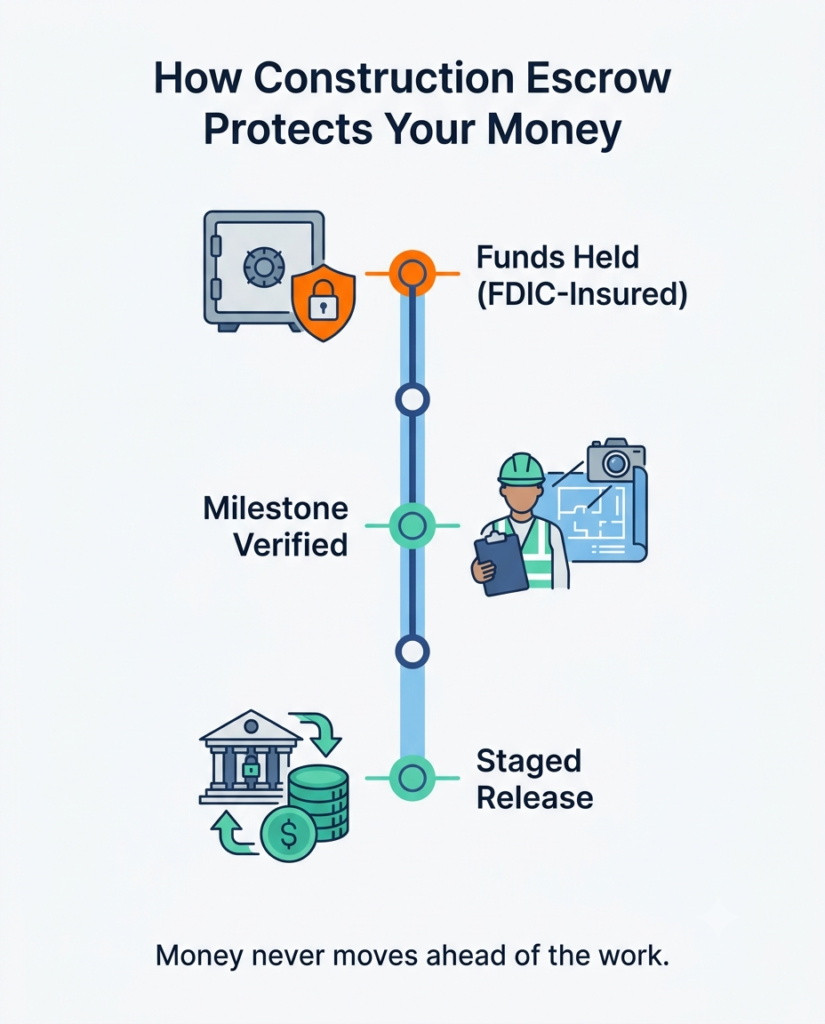
- The funds are deposited and held. You place the project money into a secure, FDIC-insured account held by the escrow service. FDIC insurance means the deposit is federally protected up to standard limits. The money is committed to the project — but it has not moved to the contractor.
- The milestones are defined upfront. Before work begins, you and the contractor agree on a milestone schedule. A milestone is a specific, verifiable stage: demolition complete, rough plumbing installed, cabinets set. Each milestone is tied to a specific payment amount.
- The work gets done, then verified. The contractor completes a milestone. Before any money releases, that stage is verified against what was agreed. Verification is the gate. No verification, no release.
- The staged release happens. Once a milestone is verified, the escrow service releases that milestone’s payment to the contractor. This is the staged release — money in measured increments, matched to real progress.
- The cycle repeats to completion. Deposit held, milestone verified, staged release. Again and again until the project is done and the final payment clears.
Notice what changed. You are no longer paying for promises. You are paying for progress. And the contractor gets a powerful benefit too: proof the money exists and a guarantee they get paid the moment work is verified. No more chasing checks.
That is the quiet genius of it. Escrow protects both parties at once. You can read more about how staged releases are structured on our escrow services page.
A Short Field Example
Consider a homeowner — call her Dana — planning a $60,000 kitchen remodel.
The old way: the contractor asks for $30,000 upfront. Dana pays. Demolition happens, then the crew slows down. Weeks pass. Materials never arrive. The contractor stops answering. Dana is out $30,000 with a gutted kitchen and no leverage. The money already moved.
The escrow way: Dana places $60,000 into a construction escrow account. She and the contractor agree on six milestones of roughly $10,000 each. Demolition is completed and verified — the first $10,000 releases. Rough plumbing is completed and verified — the next release. When the crew slows down at milestone three, Dana still holds $40,000. The contractor has every reason to finish, because the money is right there, waiting for verified work.
Same contractor. Same project. Completely different outcome. The difference is not trust. The difference is structure.
How Escrow Removes the Problem at the Source
Every renovation horror story shares one root cause: money moved ahead of the work. So the fix is not more paperwork or a tougher contract. The fix is a rule.
Money should never move ahead of the work.
That single principle is what construction escrow enforces. It does not ask you to judge character or predict behavior. It changes the timing of the money so that judgment is not required. Understanding what is construction escrow really comes down to this: it converts a feeling you cannot verify — trust — into a structure you can.
Consider what disappears when funds are held in escrow:
- The disappearing-contractor risk shrinks. If someone walks off the job, the unearned money is still protected. It never left the account. The money can’t vanish.
- The 50%-upfront trap is gone. There is no giant deposit sitting in someone else’s account. Payments track completed, verified stages.
- Disputes get a neutral anchor. Because a third party holds the funds and verification gates each release, both sides have a reason to keep things fair.
This is why we say it so plainly: trust is a feeling; structure is protection. Escrow is that structure. For homeowners, that is the whole point of asking what is construction escrow in the first place — you are looking for a way to make the biggest check of the year safe.
How to Set Up Construction Escrow
Setting it up is simpler than most owners expect. Here is the shape of it.
- Talk to a neutral escrow provider before you sign the construction contract. The escrow terms and the milestone schedule work best when they are built into the deal from the start.
- Define your milestones clearly. Vague milestones cause vague disputes. Specific, verifiable stages make releases clean.
- Confirm the account is FDIC-insured. Your funds should sit in a protected account, not a contractor’s operating account.
- Agree on how verification works. Know who confirms a milestone is complete before money releases.
- Loop in your own professionals. An attorney or financial advisor can review terms for your specific situation.
You can see common questions answered on our construction escrow FAQs page, or contact us to talk through your project.
One important note: this article is information and structure, not legal or financial advice. Every project and every state is different. Consult your own licensed professional before making decisions about your specific situation.
FAQs
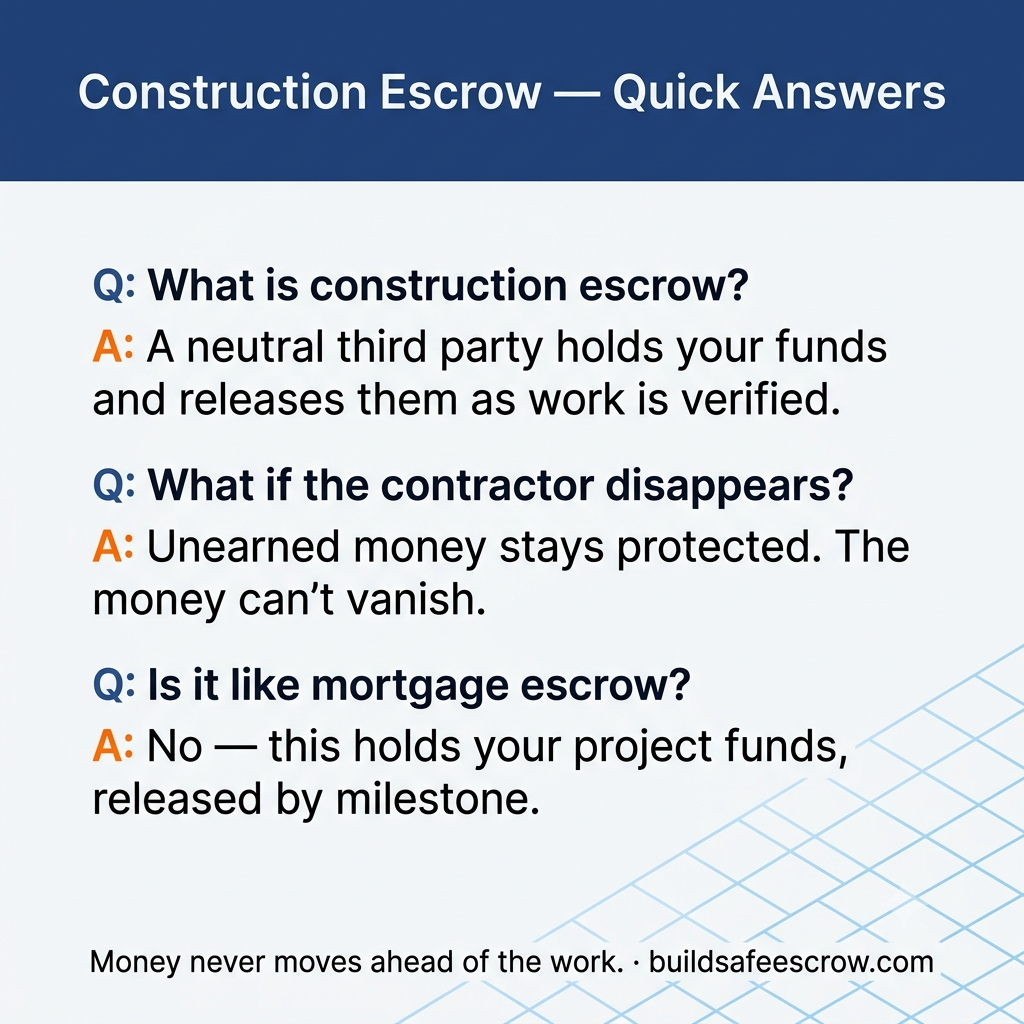
Is construction escrow the same as the escrow in my mortgage? No. Mortgage escrow usually holds money for taxes and insurance. Construction escrow holds your project funds and releases them to the contractor in verified stages as work is completed.
Who pays for construction escrow — me or the contractor? It varies by agreement. Sometimes the owner covers the fee, sometimes it is shared. The cost is typically modest next to the size of the funds being protected.
What happens to my money if the contractor disappears? Any unearned funds stay in the escrow account. Money only releases against verified milestones, so work that was never done was never paid for. The money can’t vanish.
Can I use construction escrow for a small renovation? Yes. Escrow scales to the project. If the check feels big enough to make you nervous, it is big enough to protect.
Does escrow slow the project down? Not when milestones are defined well. Verified work triggers prompt release, so an honest contractor often gets paid faster and with less friction.
Keep Your Money Protected
You now have a plain-English answer to what is construction escrow — and a way to stop paying for promises. Two easy next steps:
- Subscribe to The Build Brief. Get one short read each Friday on how construction money actually moves — subscribe to The Build Brief.
- Talk through your project. Schedule a free consultation and see how milestone-based escrow would work for your renovation.
Money should never move ahead of the work. Let’s keep yours where it belongs — protected until the job is done.
References
- FDIC — Deposit Insurance
- Levelset / Procore — Construction Payment Reports
- Consumer Financial Protection Bureau
- U.S. Census Bureau — Construction Spending