
Commercial tenant buildouts are some of the most profitable work a contractor can take — and some of the slowest to get paid for. Getting paid on commercial tenant buildouts is hard for a structural reason: the job usually involves more parties than a typical renovation, and the money to pay you often sits behind a tenant improvement allowance, a landlord’s approval process, and sometimes a lender’s disbursement schedule. Every additional hand the money has to pass through is another place your payment can stall.
Why commercial tenant buildouts are so hard to get paid on
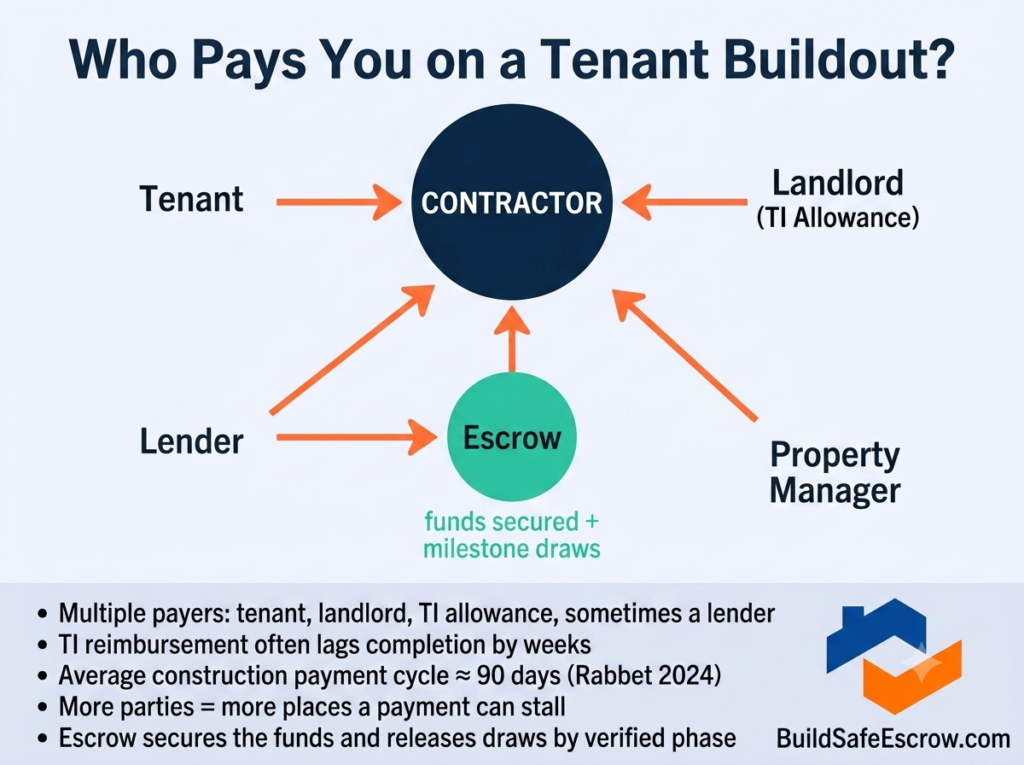
On a residential job, there is usually one decision-maker holding the checkbook. On commercial tenant buildouts, you might be dealing with the tenant who hired you, the landlord who controls the tenant improvement (TI) allowance, a property manager coordinating approvals, and occasionally a lender funding the space. As Cushman & Wakefield explains, the TI allowance is the landlord’s contribution to the buildout — and it is most often paid as a reimbursement after work is completed and documented, which means you finish the work, submit the paperwork, and then wait.
That wait is not trivial. According to commercial real estate advisor The Cauble Group, landlords typically reimburse a clean draw package within 30 to 60 days of receiving it — and that clock only starts once the work is done, invoices are paid, and lien waivers are collected. On a buildout with multiple approvers, the gap between completing the work and collecting your money can stretch well beyond that. The more parties involved, the more documentation, sign-offs, and handoffs stand between you and the draw.
The TI allowance is a reimbursement, not a deposit
This is the single most important thing to understand about buildout cash flow: in the most common structure, you pay for construction up front and the landlord reimburses you afterward. There are other arrangements — a landlord-managed turnkey buildout, or direct payment where the landlord pays your invoices as work progresses (LoopNet breaks down the main structures here) — but the reimbursement model puts the financing burden squarely on you. You need working capital to float the entire job, and you carry that exposure until the draw clears.
The risks contractors carry on buildouts
- Reimbursement lag: You front labor and materials, then wait for the TI allowance to be released after completion and verification.
- Approval bottlenecks: A payment can sit because one party hasn’t signed off, even when the work is done and everyone agrees it’s done.
- Unclear funding source: When it isn’t crystal clear whether the tenant or the landlord pays for a given scope item, that item becomes the one that gets disputed at payment time.
- Final-payment exposure: As with most jobs, the last and largest draw is the one most likely to be held hostage to a punch list or a paperwork gap.
How escrow brings order to a multi-party job
Construction escrow is built for exactly this kind of complexity. Before the buildout begins, the project funds — including the agreed TI allowance — are deposited into a secure, neutral third-party account. That single step solves the biggest uncertainty on commercial tenant buildouts: you can confirm the money is actually there and committed before you mobilize, instead of trusting that a reimbursement will materialize after you’ve already spent.
From there, the escrow provider releases payments in draws tied to verified milestones — demolition complete, rough-in and inspections passed, finishes installed, space turned over. Each draw is released promptly once that phase is confirmed, on terms everyone agreed to in the escrow agreement. The neutral third party becomes the single, clear point of disbursement, which cuts through the approval bottlenecks that normally slow a multi-party job.
Why escrow protects everyone on commercial tenant buildouts
Escrow is not a contractor-only benefit on a buildout — it is why landlords, tenants, and lenders increasingly favor it. The tenant knows they are only paying for completed, verified work. The landlord knows the TI allowance is being disbursed against real progress, with a clean record of where every dollar went. The lender, if there is one, gets the same draw discipline and documentation it would want anyway. Everyone is working from the same verified milestone schedule, so there is far less room for the misalignment that creates payment disputes.
For you, the payoff is simple: predictable cash flow on jobs that are otherwise notorious for unpredictable money. You stop financing the landlord’s reimbursement cycle out of your own pocket, and you stop letting a missing signature decide when you get paid. On commercial tenant buildouts — the most complicated jobs you take — escrow is what turns “we’ll get you paid eventually” into a schedule you can actually run a business on.
Frequently Asked Questions
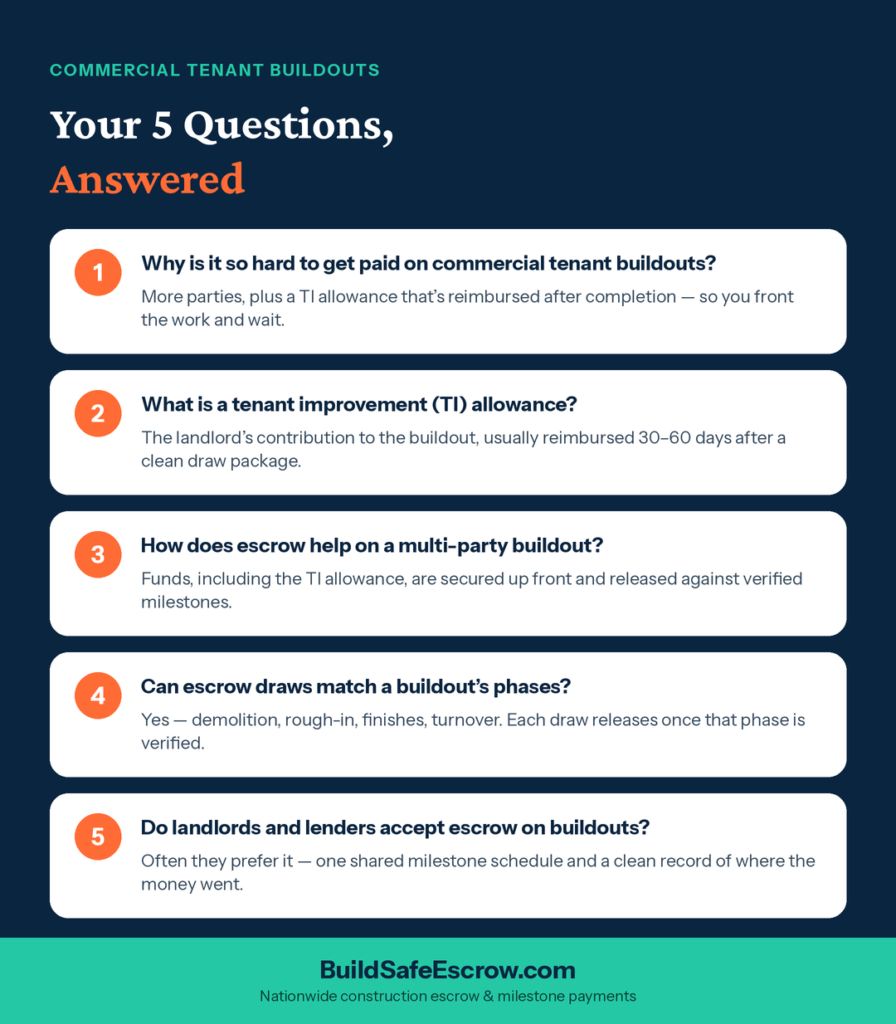
Why is it so hard to get paid on commercial tenant buildouts?
Commercial tenant buildouts usually involve more parties than a typical job — the tenant, the landlord controlling the tenant improvement allowance, a property manager, and sometimes a lender. The TI allowance is often paid as a reimbursement after completion, so you front the work and wait, and every additional approver is another place the payment can stall.
What is a tenant improvement (TI) allowance?
It’s the amount a landlord agrees to contribute toward building out a leased commercial space for a tenant. It’s frequently paid as a reimbursement after the work is completed and documented — commonly within 30 to 60 days of a clean draw package — which is a major reason contractors wait so long to collect on buildouts.
How does escrow help on a multi-party buildout?
The project funds, including the agreed TI allowance, are deposited into a neutral account before work starts, so you can confirm the money is committed. Draws are then released against verified milestones through a single point of disbursement, which cuts the approval bottlenecks that slow multi-party jobs.
Can escrow draws match a buildout’s phases?
Yes. The milestone schedule is set to the project — for example, demolition complete, rough-in and inspections passed, finishes installed, space turned over — and each corresponding draw is released once that phase is verified.
Do landlords and lenders accept escrow on buildouts?
They often prefer it. Escrow gives the landlord a clean record that the TI allowance is being released against real progress, gives the tenant assurance they only pay for completed work, and gives any lender the draw discipline and documentation it wants — all from one shared milestone schedule.