
Construction payment problems are one of the biggest threats contractors face on every project—and not because of bad work, but because of broken payment systems. Delays, last-minute renegotiations, unpaid change orders, and final payment disputes are happening every day, even between good contractors and well-intentioned clients. What you’re about to read breaks down the real reasons behind construction payment problems, how they quietly drain your cash flow, and most importantly, how to fix them before they cost you time, money, and your next opportunity.
The Job Is Done… So Why Isn’t the Payment?
The crew packed up. The materials were installed. The milestone was completed exactly as agreed.
And then comes the pause.
Not the kind you planned for; the kind where payment turns into a conversation instead of a transaction.
For many contractors, getting paid isn’t a process—it’s a negotiation that starts after the work is done.
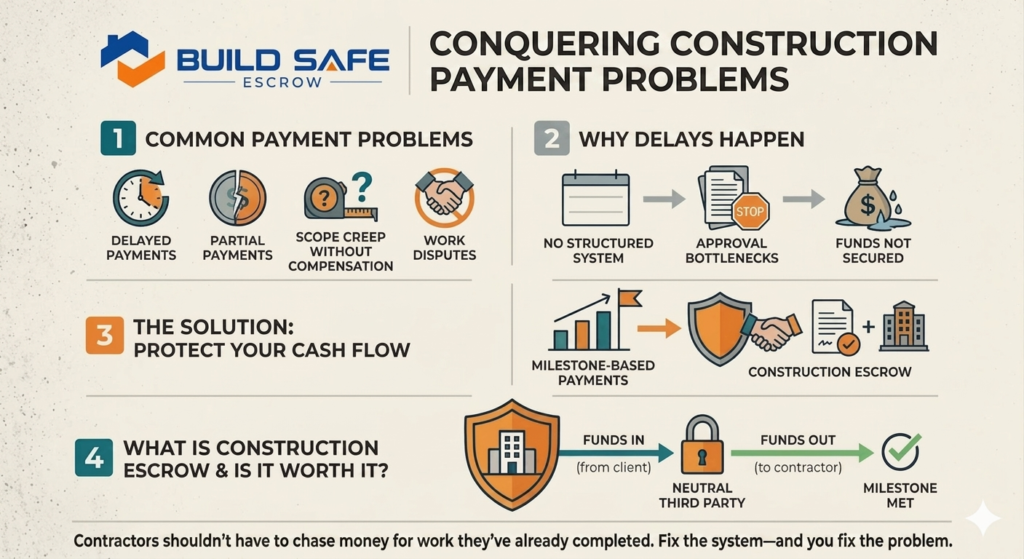
1. Payment Delays That Turn You Into the Bank
Every contractor knows this story.
You finish a milestone, submit your request, and then…
- “We’ll review it this week.”
- “The bank hasn’t released the funds yet.”
- “Can you wait just a few more days?”
Meanwhile:
- Payroll is due
- Suppliers need to be paid
- The next project is already underway
You’re no longer just building; you’re financing the project.
2. The Post-Work Renegotiation Trap
This one is the most frustrating because it happens after delivery.
- “We expected this to cost less.”
- “We’re not happy with part of it.”
- “Can we adjust the final number?”
Payment becomes leverage.
And suddenly, the agreement you signed at the beginning feels optional.
3. Scope Creep That Never Gets Paid
It always starts small.
“Can you just add this one thing?”
But over time:
- Extra work piles up
- Change orders aren’t formalized
- Payment gets delayed or forgotten
What should have been additional revenue becomes unpaid labor.
4. Approval Bottlenecks You Can’t Control
You did your part.
But payment depends on:
- Owner approvals
- Inspectors signing off
- Multiple decision-makers aligning
And if one person delays?
Everything stops.
5. Partial Payments and “Adjustments”
You invoice $25,000.
You receive $18,500.
No warning. No agreement.
Just:
- “We held some back”
- “We adjusted for this issue”
- “We’ll settle the rest later”
Your pricing becomes flexible—but only on their terms.
6. Starting Projects Without Secured Funds
This is one of the biggest hidden risks.
Many projects begin without:
- Verified funds
- Fully committed budgets
- Clear payment structures
And contractors only discover the problem mid-project.
7. The Final Payment Problem
Ironically, the last payment is the hardest to collect.
At 90–95% completion:
- Clients lose urgency
- Punch list items delay payment
- Leverage shifts away from the contractor
The closer you get to the finish line, the higher the risk.
What’s Actually Causing These Problems?
It’s not always bad clients.
Most of the time, it’s:
- No structured payment system
- No neutral third party
- No clear milestone enforcement
- Funds not secured upfront
Even good people end up in bad situations when the process is weak.
The Fix: Milestone-Based Payments with Escrow
Instead of chasing payments, contractors are shifting toward structured systems like construction escrow.
Here’s what changes:
- Funds are secured before work begins
- Payments are tied to milestones
- A neutral third party manages disbursements
- No one can withhold or renegotiate unfairly
It turns payment from a conversation into a process.
Why Contractors Are Adopting This Model
Because it solves the exact problems above:
- No more guessing if funds exist
- No more chasing approvals endlessly
- No more unpaid change orders
- No more last-minute renegotiations
It creates something rare in construction:
predictability.
Fixing Construction Payment Problems Starts Before the Project Begins
Construction payment problems don’t start at the end of a project—they start at the beginning, when payment structures are unclear, funds aren’t secured, and expectations aren’t aligned. The reality is, most contractors aren’t losing money because of bad clients, but because of systems that leave too much room for delays, disputes, and uncertainty. By shifting to a structured approach with secured funds and milestone-based payments, contractors can eliminate the guesswork, protect their cash flow, and focus on what they do best—building. Fix the process, and construction payment problems stop being part of the job.
Ready to Stop Chasing Payments?
If you’re tired of delays, disputes, and uncertainty, it’s time to change how your projects are structured.
Get a custom escrow setup for your next project:
👉 Get a quote
- Fast setup (1–3 business days)
- Milestone-based payment protection
- Built for contractors, owners, and developers
Or Talk to Our Team First
Not sure how it fits your projects?
Request a quote and we’ll walk you through the structure that works best for your jobs:
👉 Schedule a Call Today
FAQS: Why Contractors Struggle to Get Paid; And How to Fix It Before It Costs You Your Next Project
What are the most common payment problems contractors face?
Payment delays, partial payments, scope creep without compensation, and clients renegotiating after work is completed are among the most common issues.
How can contractors avoid payment delays?
By using milestone-based payment structures and securing funds upfront through escrow, contractors can eliminate uncertainty and reduce delays.
What is construction escrow?
Construction escrow is a financial arrangement where project funds are held by a neutral third party and released as agreed milestones are completed.
Do contractors benefit from escrow?
Yes. Escrow protects contractors by ensuring funds are available, payments are structured, and disbursements are not dependent on client discretion alone.
Can escrow help with change orders?
Yes. Change orders can be documented, funded separately, and added to the next milestone—ensuring contractors are paid for additional work.