

The Old Way of Paying for Construction Is Showing Its Age
For decades, construction projects have relied on a payment system that often feels outdated. Property owners pay large deposits upfront, contractors depend on periodic payments to keep projects moving, and everyone hopes that trust alone will keep the process running smoothly.
Sometimes it works.
But too often, it doesn’t.
Projects stall. Payments get delayed. Contractors struggle to maintain cash flow. Property owners worry whether their money is being used properly. When disagreements arise, both sides can find themselves locked in disputes that derail timelines and budgets.
Many homeowners only realize the risks after something goes wrong. In fact, contractor disappearance during a project has become so common it even has a name; the “construction vanishing act.” We explored this phenomenon in detail in our article When a Contractor Disappears: Understanding the Construction Vanishing Act
These challenges are not always caused by fraud or bad intentions. Often they stem from outdated payment structures that rely too heavily on trust without financial safeguards.
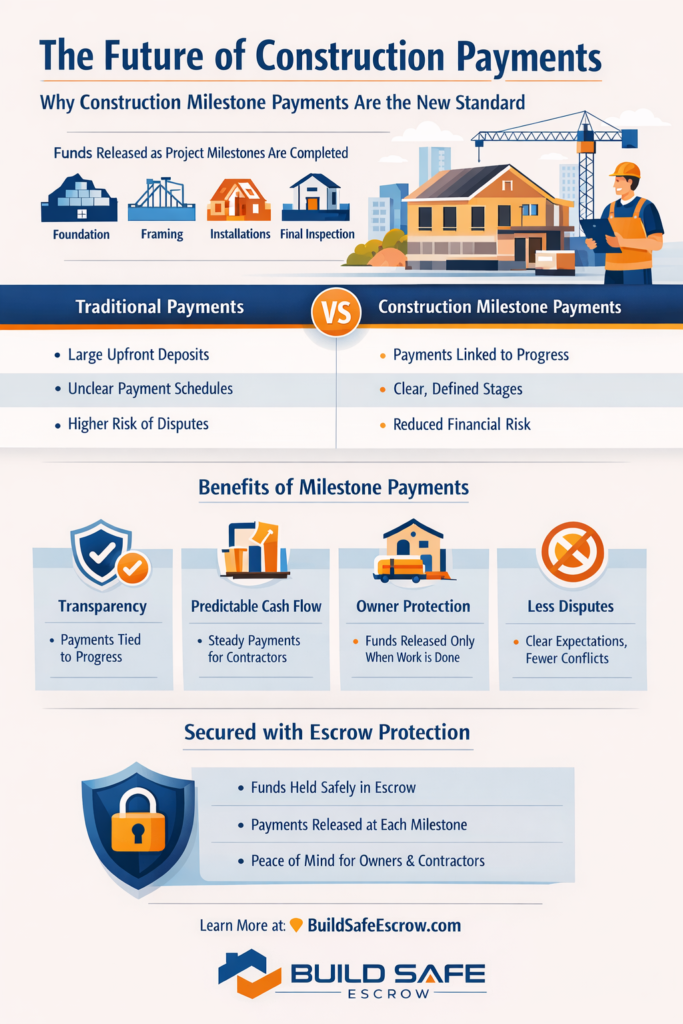
That is why the industry is beginning to adopt a more structured and transparent model: construction milestone payments to ensure that payments are made at specific stages of a project, thereby enhancing accountability and trust.
Across residential renovations, commercial projects, and major developments, construction milestone payments are becoming the new standard for managing project finances and reducing risk, providing clarity to both contractors and property owners.
What Are Construction Milestone Payments?
Construction milestone payments divide a project’s total cost into multiple payments tied to specific stages of progress.
Instead of paying a large deposit and hoping everything goes smoothly, funds are released when predetermined milestones are completed.
Typical construction milestones may include:
- Project mobilization or start of work
- Foundation or structural completion
- Framing and rough mechanical installations
- Major systems installation (electrical, plumbing, HVAC)
- Final inspections or completion
Each milestone triggers a payment once the work has been completed according to the agreed scope.
This approach ensures that both contractors and property owners remain aligned throughout the life of the project.
Contractors receive payments as work progresses, while property owners gain reassurance that funds are tied directly to project progress.
Why the Industry Is Moving Toward Construction Milestone Payments
Construction projects are complex. They involve multiple trades, materials, permits, inspections, and timelines that can stretch for months.
Traditional payment structures struggle to keep pace with that complexity.
Construction milestone payments introduce structure and clarity to the financial side of construction projects, which is why the model is gaining traction across the industry.
Several key factors are driving this shift.
Greater Transparency
One of the most important benefits of construction milestone payments is transparency.
Both parties clearly understand:
- When payments will be made
- What work must be completed to trigger each payment
- How progress will be verified
This level of clarity reduces misunderstandings and helps prevent disputes before they arise.
The lack of financial clarity is also part of what many experts call the construction trust gap; a growing disconnect between expectations and financial protections in renovation projects.
We explore this issue further in Trust Is Not Enough: How Escrow Sets the Standard in Modern Buildingp
Improved Cash Flow for Contractors
Contractors frequently face financial pressure when payment schedules are unclear or inconsistent.
With construction milestone payments, contractors gain predictability. They know when funds will be released and can plan their operations accordingly.
This helps contractors:
- Pay subcontractors on time
- Order materials without delays
- Maintain steady project progress
Reliable payments ultimately support smoother and faster project completion.
Greater Security for Property Owners
For property owners, one of the biggest concerns during a renovation is paying large sums of money before work has been completed.
Construction milestone payments reduce this risk by linking payments to verified progress.
Instead of releasing large deposits upfront, funds are distributed gradually as work moves forward.
This approach gives property owners confidence that their investment is being used appropriately at every stage of the project.
Fewer Payment Disputes
Payment disputes are among the most common causes of conflict in construction projects.
By clearly defining payment triggers, construction milestone payments create a framework that reduces financial misunderstandings.
When expectations are aligned from the beginning, projects tend to run more smoothly.
Traditional Construction Payments vs Construction Milestone Payments
For many years, construction projects relied on large deposits and loosely defined payment schedules. While this system may work in some cases, it often creates uncertainty for both contractors and property owners.
By contrast, construction milestone payments introduce structure, accountability, and financial transparency throughout the project lifecycle.
| Traditional Construction Payments | Construction Milestone Payments |
|---|---|
| Large upfront deposits are often required | Payments are tied to project milestones |
| Payment timing may be unclear | Payment triggers are clearly defined |
| Property owners risk paying too much too early | Funds are released as work progresses |
| Contractors may chase delayed payments | Contractors receive predictable payments |
| Payment disputes are more common | Structured milestones reduce disputes |
| Payments exchanged directly between parties | Payments can be managed through escrow |
| Trust is often the only safeguard | Structured payment system adds accountability |
When construction milestone payments are combined with escrow, the payment process becomes significantly more secure.
Example of a Construction Milestone Payment Schedule
To better understand how construction milestone payments work, here is an example of a typical milestone payment structure for a renovation or construction project.
| Milestone | Description | Example Payment |
|---|---|---|
| Project Start | Contract signed, permits submitted, mobilization begins | 15% |
| Foundation / Structural Work | Foundation or structural phase completed | 20% |
| Framing & Rough Systems | Framing, electrical, plumbing, HVAC rough-in completed | 25% |
| Major Installations | Drywall, flooring, cabinetry or key installations | 20% |
| Substantial Completion | Project nearing completion, punch list prepared | 10% |
| Final Completion | Final inspection passed and project delivered | 10% |
Each payment is triggered by completed work, helping ensure that funds move in alignment with project progress.
Why Milestone Payments Work Even When Life Happens
Construction projects often take months to complete, and during that time many unexpected events can occur.
Contractors may face staffing shortages or health issues. Property owners may experience financial changes. Supply chain disruptions can delay materials.
These situations are not necessarily the result of bad intentions.
They are simply part of life.
That is why many modern projects are embracing a philosophy of secure first, build later, ensuring that financial structures are in place before construction begins.
We discuss this concept further in Secure First, Build Later: The New Norm for Renovations
A structured system of construction milestone payments helps protect both parties when unexpected events arise.
The Missing Piece: Secure Management of Construction Milestone Payments
While construction milestone payments bring structure to construction finances, they are most effective when managed through a neutral and secure system.
That is where construction escrow comes in.
Escrow allows project funds to be securely held by a neutral third party and released only when agreed milestones are completed.
When construction milestone payments are combined with escrow, the process becomes more transparent, structured, and secure.
How Escrow Strengthens Construction Milestone Payments
Escrow-backed construction milestone payments offer several advantages.
Funds Are Secured Before Work Begins
When project funds are deposited into escrow, contractors know the money is available and reserved.
This eliminates one of the biggest risks contractors face: chasing payments after work has already been completed.
Payments Are Released Based on Verified Progress
Escrow ensures that construction milestone payments are released only when agreed milestones are completed.
This alignment protects property owners while ensuring contractors are paid fairly.
Reduced Financial Tension
Money is one of the biggest sources of tension in construction projects.
By placing funds into escrow and releasing them according to milestone progress, escrow removes much of the financial friction between parties.
For a deeper look at this concept, read Trust Is Not Enough: How Escrow Sets the Standard in Modern Building
The Future of Construction Is Built on Trust and Structure
Construction is an industry built on craftsmanship, expertise, and collaboration.
But the financial systems supporting construction projects must evolve alongside the industry.
Traditional payment structures often place unnecessary risk on both property owners and contractors.
By contrast, construction milestone payments create a structured system that promotes accountability, transparency, and fairness.
When paired with escrow protection, this model creates a safer environment for everyone involved.
Final Thoughts
Construction projects involve large investments, complex timelines, and many moving parts.
A better financial system can help keep those projects on track.
That is why construction milestone payments are rapidly becoming the new standard across renovation and construction projects.
By combining structured payment schedules with secure escrow protection, the industry can create a more reliable and transparent environment where both contractors and property owners can succeed.
Build With Confidence; Pay With Structure
Construction projects succeed when expectations, timelines, and finances are aligned. Construction milestone payments create the structure that keeps projects moving forward while protecting both property owners and contractors.
At Build Safe Escrow, we help projects start with confidence by securing funds in a neutral escrow account and releasing payments only as agreed milestones are completed.
This approach reduces financial risk, improves transparency, and ensures contractors are paid as progress is made.
If you are planning a renovation or construction project, the smartest first step is to put the right financial structure in place.
Learn how Build Safe Escrow can help protect your project and simplify construction milestone payments.
Visit: https://buildsafeescrow.com
Schedule a FREE CONSULTATION
Read more about Construction Escrow and Milestone Payments
- Home Renovation Cost in 2026: What Owners Should Budget, State by State
- Construction Escrow for Contractors: How It Works and How You Get Paid
- How Construction Escrow Works: A Simple Guide for Property Owners
- Construction Escrow for Property Managers: How It Works, Simplified
- Property Manager Vendor Payments: How to Pay Contractors Across a Portfolio Without Carrying the Risk