
Table of Contents
- Why “percent complete” turns into a fight
- What is a schedule of values in construction?
- How do you create a schedule of values?
- Billing against the schedule of values without friction
- How owners and lenders read your pay application
- Field example: one $210,000 job, two ways to bill
- How escrow puts the money in place before the work starts
- FAQ
A clear schedule of values decides whether your pay app clears in days or sits in an inbox for weeks. If you are a general contractor or builder, you know the scene. Framing is up, your crew moved on, and the owner’s rep is still debating whether that line is 60% or 80% done.
You did the work. Now you are chasing the check, one phone call at a time.
Why “percent complete” turns into a fight
Most payment disputes start long before the pay app. Nobody agreed in advance on what “done” looks like for each slice of the contract.
A few root causes show up over and over:
- Lines that are too big. “Interior finishes: $60,000” gives nobody a way to measure progress. Is it 40% done when the drywall is hung, or when paint starts?
- Front-loading. This means shifting contract value toward the start of the job so early bills run high. AIA Contract Documents notes that front-loading “accelerates cash flow to the contractor, resulting in overpayments early in the project.” Owners and architects know this, so they push back harder on every early line.
- No backup. A percentage with no photos, inspection reports or delivery tickets is just an opinion.
- Change orders floating outside the schedule. Extra work that never gets its own line is the hardest money to collect.
Every one of these turns a payment into a negotiation. The fix starts before the first shovel moves.
What is a schedule of values in construction?
A schedule of values is an itemized list that splits your total contract price into line items, each with a dollar value, so you can bill each month for the work completed on every line.
AIA Contract Documents defines it as “an itemized list that allocates the entire contract sum to the various portions of the work.” It is common on fixed-price (stipulated sum) and guaranteed maximum price contracts.
It becomes the backbone of every pay application, the formal monthly request for payment. On AIA-style projects, the contractor fills out the G702 Application and Certificate for Payment as the summary page. The G703 Continuation Sheet carries the line-by-line detail. According to AIA, G703 “breaks the contract sum into portions of the work” based on the schedule the contractor prepares. AIA also notes it “does not publish a standard schedule of values form.” The structure of your lines is up to you and your contract.
That freedom cuts both ways. A sloppy schedule of values invites arguments for the whole job. A sharp one settles most of them before they start.
It protects the owner just as much. The Construction Specifications Institute (CSI) says it directly: “a proper schedule of values supports progress payments that are fair to both the owner and contractor.”
How do you create a schedule of values?
Build it from the way the work will be inspected, not the way you priced it. These steps keep it measurable.
- Break the job by phase and trade. Sitework, foundation, framing, roofing, rough mechanical, drywall, finishes, closeout. You can borrow the division structure from CSI MasterFormat, the standard used across North America to organize how project requirements are described. Matching your lines to the specs makes them easier for an architect to check.
- Tie each line to a verifiable milestone. A good line ends at something a third person can see: a passed inspection, a dried-in roof, a delivered and installed cabinet set. If a stranger can’t confirm it, split the line.
- Keep lines small enough to measure. A line that runs most of a month is easy to argue about. Two or three smaller lines with clear end points are not.
- Include general conditions as their own line. General conditions are your project overhead: supervision, temporary facilities, permits, insurance, cleanup. Bill them evenly over the job’s duration so they track time, not just early activity.
- Make the math match. The lines must add up exactly to the contract sum. AIA lists this as a basic best practice.
- Explain retainage up front. Retainage is a portion of each payment held back until the end of the job to protect the owner if work isn’t finished. The G703 tracks it line by line. Your contract sets the percentage and when it is released, so read that clause closely. Rules vary by location, so confirm with your attorney.
- Add change orders as new lines. When scope changes, the approved change order gets its own line with its own value. CSI advises revising the schedule “prior to the next progress payment request.” Never bury extra work inside an existing line.
Price the lines honestly. A balanced schedule earns faster approvals than a padded one, because reviewers stop hunting for the padding.
Billing against the schedule of values without friction
Once the schedule is approved, each pay application becomes routine. You report progress line by line.
- Percent complete per line. For each line you show the value of work completed this period and to date. Keep the number honest and the backup ready.
- Stored materials. Materials delivered but not yet installed can often be billed. The G703 includes a column for stored materials. Your contract decides what qualifies and what proof you need, such as invoices, photos or insurance on the stored goods.
- Backup documentation. Attach inspection sign-offs, dated photos and delivery tickets for the lines you bill. CSI notes that documentation substantiating a value “must be well-organized and readily available, to be furnished upon request.”
- Lien waivers. A lien waiver is a document in which you give up lien rights for the amount you were paid. Expect to be asked for one with your pay applications. Autodesk notes that AIA billing “incorporates key documents such as lien waivers and insurance certificates.” Understand conditional versus unconditional forms before you sign; your attorney can explain which applies to you.
Submit on the same day each month. Predictable billing builds trust faster than any phone call.
How owners and lenders read your pay application
Picture the person on the other side of the desk. They want to pay for work that exists, and nothing more.
An architect or owner’s rep compares your percentages against what they see on site. AIA notes the architect may review supporting data “to verify that the schedule of values is not being front loaded.”
On bank-funded jobs, the lender may send a draw inspector. Levelset explains that this inspection is “conducted by a neutral third party after a pay application or draw is submitted to the lender.” The article adds: “Most draws are billed on a percentage of completion basis.” The inspector compares “that percentage to what is observed on site for each line item on the draw.” They also photograph materials stored on site.
So every line will be measured against reality by someone. The only question is whether your lines make that easy or hard.
Field example: one $210,000 job, two ways to bill
Illustrative example. Names and figures are fictional.
Marcus Bell runs a small general contracting firm. He signs a $210,000 contract for a two-story addition.
Version one, front-loaded. His first draft has five lines. “Mobilization and general conditions” carries $42,000, and “Framing” is a single $50,000 line. In month two he bills framing at 80%. The owner’s rep walks the site and says 60%. That gap is $10,000, and the whole pay app stalls while they argue.
Version two, milestone-tied. Marcus rebuilds his schedule of values with eight lines that add up to the same $210,000:
| Line | Value |
|---|---|
| General conditions (billed evenly over six months) | $18,000 |
| Sitework and foundation | $26,000 |
| Framing and sheathing | $38,000 |
| Roofing and windows (dried in) | $24,000 |
| Rough plumbing, electrical and HVAC | $34,000 |
| Insulation and drywall | $22,000 |
| Finishes: cabinets, trim, flooring, paint | $36,000 |
| Fixtures, punch list and closeout | $12,000 |
He also splits framing into three sub-lines. First-floor walls carry $14,000. Second floor and roof framing carry $16,000. Sheathing plus a passed framing inspection carries $8,000.
In month two, both framing sub-lines for walls and roof are done and photographed. Sheathing and the inspection are still ahead. He bills $14,000 plus $16,000, for $30,000, and leaves the last $8,000 for next month. The owner’s rep checks the photos, confirms on site and approves. Nobody debates a percentage, because each sub-line has a clear finish line.
Same job. Same crew. One version produced an argument; the other produced a check.
How escrow puts the money in place before the work starts
A good schedule of values tells everyone what each step is worth. It doesn’t guarantee the money for that step exists when you finish it.
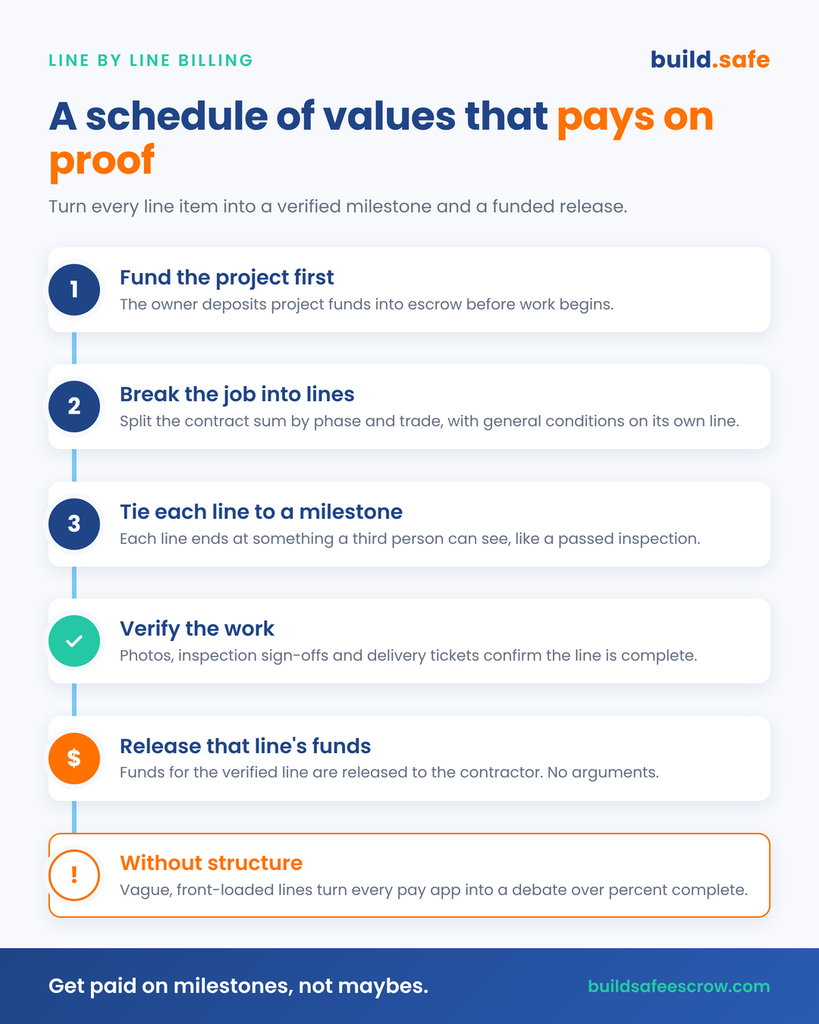
That is the gap escrow closes. Build Safe Escrow offers construction escrow services built for this. The owner deposits project funds into a secure, FDIC-insured account before work begins. Each line or milestone on your approved schedule becomes a release point. When the milestone is completed and verified, the funds for that line are released to you.
Money never moves ahead of the work, and it never lags far behind it either.
Look at what this does for each side:
- For you, the contractor: the money is already funded before you mobilize. You aren’t wondering whether the owner can pay. You are only proving the work is done.
- For the owner: nothing is released early. Front-loading has nowhere to hide, because funds follow verified milestones.
- For both: a neutral third party holds the funds. Build Safe Escrow is not a lender and not on anyone’s side. We act as the referee.
Trust is a feeling, and structure is protection. Escrow turns a handshake into a schedule both parties signed. Our guide on how contractors get paid on time shows how this fits your cash flow.
FAQ
Who prepares the schedule of values?
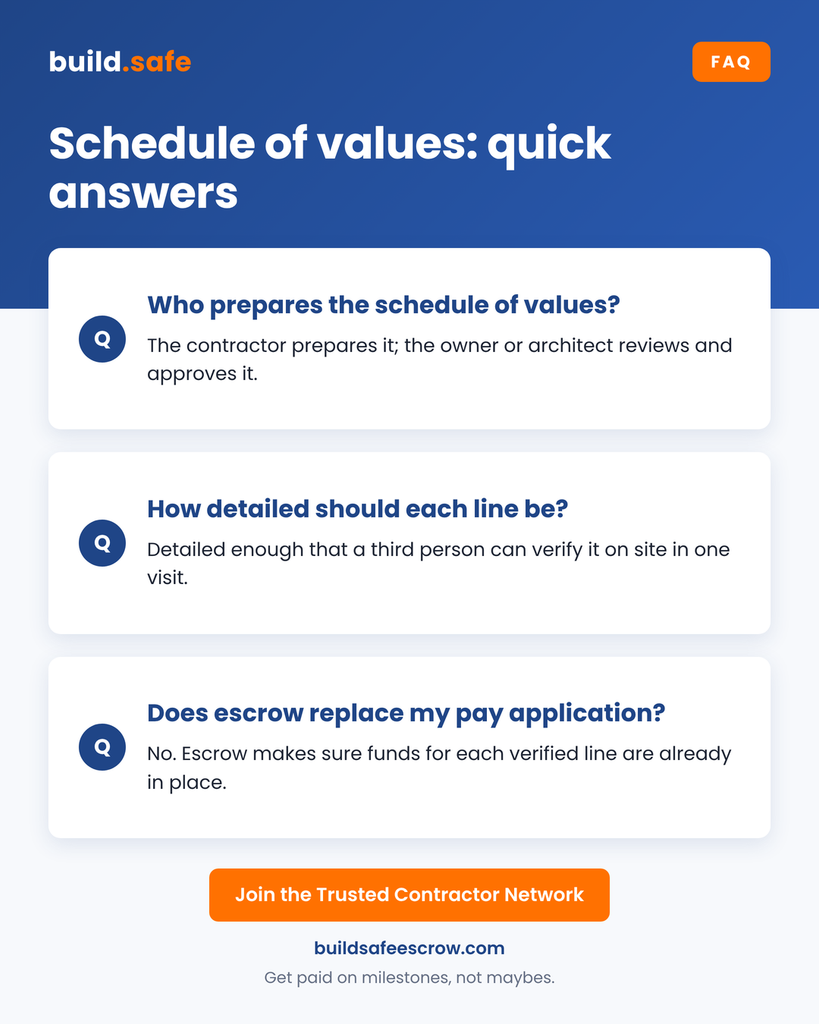
The contractor prepares it, and the owner or architect reviews and approves it. CSI notes the first progress payment typically shouldn’t be certified until the schedule is submitted and accepted.
Can I change the schedule of values after the job starts?
Usually yes, with approval. AIA’s A201 general conditions allow revisions as actual costs shift. Approved change orders should be added as new lines before your next pay application.
Is front-loading illegal?
It depends on your contract and how far it goes, and it carries real risk. Levelset warns that “excessive frontloading may reach the level of overbilling.” Owners also lose trust fast. Ask your attorney about your contract terms.
How detailed should each line be?
Detailed enough that a third person can verify it on site in one visit. If a line takes more than a few weeks to complete, consider splitting it.
Does escrow replace my pay application?
No. Your pay application still documents progress. Escrow makes sure the funds for each verified line are already in place and released on a clear structure.
Get paid on milestones, not maybes
The Build Brief: Get one short read each Friday on how construction money actually moves. Subscribe to The Build Brief.
For contractors: Build trust. Win more projects. Get paid on milestones, not maybes. Join the Trusted Contractor Network, free for builders and general contractors.
References
- AIA Contract Documents, What is a Schedule of Values and Why is it Important to a Contractor?
- AIA Contract Documents, Summary: G703, Continuation Sheet
- Construction Specifications Institute, Progress Payments, Schedules of Values, Part 1: Fundamentals
- Levelset, Construction draw inspections