Table of Contents
- Why subs get asked to sign before the check clears
- What is the difference between a conditional and unconditional lien waiver?
- The four waiver types, in plain terms
- When should a subcontractor sign a conditional lien waiver?
- Six habits that keep your lien rights intact
- Field example: one waiver, two outcomes
- Escrow lines up the paperwork with the money
- FAQ
- Get paid on milestones, not on promises
- References
The pay app is due Friday, and the general contractor wants a conditional lien waiver attached, or an unconditional one “to keep things moving.” If you run a specialty trade crew, you know the moment. You are last in line for the money, and you are being asked to give up rights before the money exists.
Most subs sign because the job has to keep going. That instinct is fair. It just needs a system, so the form you sign matches the money in hand.
This guide is general information, not legal advice. Some states require specific statutory forms and wording; rules vary, so confirm with your attorney before you sign.
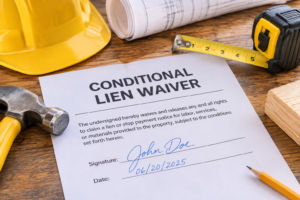
Why subs get asked to sign before the check clears
A lien waiver is a document in which you give up some or all of your right to file a mechanic’s lien, in exchange for payment. A mechanic’s lien is a legal claim against the property that secures payment for labor and materials you furnished.
Waivers flow uphill. Before releasing the next draw, the owner or lender wants proof that everyone below the general contractor has been paid. So the general contractor collects waivers from each sub, often before money moves. Each party is protecting its own exposure.
The problem is timing. The draw request, the waiver, and the payment rarely land on the same day. At the bottom of the chain, gaps in timing become gaps in your bank balance.
That gap is real. Siteline surveyed 492 construction finance and operations professionals for The State of Subcontractor Billing in 2026. It found that 92 percent of subcontractors floated payroll from their own pockets in the past year while waiting for payment. The same survey found that 43 percent of subcontractors wait more than 90 days to collect final payment and retainage.
If you are already carrying the job on your own cash, an unconditional waiver signed early removes one of your last tools. A conditional lien waiver keeps that tool in place.
What is the difference between a conditional and unconditional lien waiver?
A conditional lien waiver only takes effect once you receive the payment it describes, while an unconditional waiver takes effect the moment you sign it, whether or not you were paid.
With a conditional lien waiver, the release depends on a condition: the payment clears. If the check bounces or the wire never arrives, the waiver generally does not cut off your rights for that amount. Levelset describes a conditional progress waiver as the “safest choice of the four” when you are unsure which form to use.
With an unconditional waiver, there is no condition. Procore notes that an unconditional waiver “takes effect immediately upon signing.” Sign one before the money lands, and you may have released your lien rights for an amount you never received.
The working rule is short: a conditional lien waiver before payment, an unconditional one only after funds clear.
The four waiver types, in plain terms
Waivers sort along two lines. The first is conditional or unconditional. The second is progress (sometimes called partial) or final.
- Conditional progress waiver: releases rights for work through a stated date, but only once that payment is received.
- Unconditional progress waiver: releases rights for work through a stated date, effective on signing.
- Conditional final waiver: releases all remaining rights on the job, effective once final payment is received.
- Unconditional final waiver: releases all remaining rights on the job, effective on signing.
Progress waivers carry a through-date, the last day of work the waiver covers. Final waivers usually have none, because they cover the whole project.
Treat the final unconditional waiver with the most care. Once it is signed, there is usually nothing left to claim.
When should a subcontractor sign a conditional lien waiver?
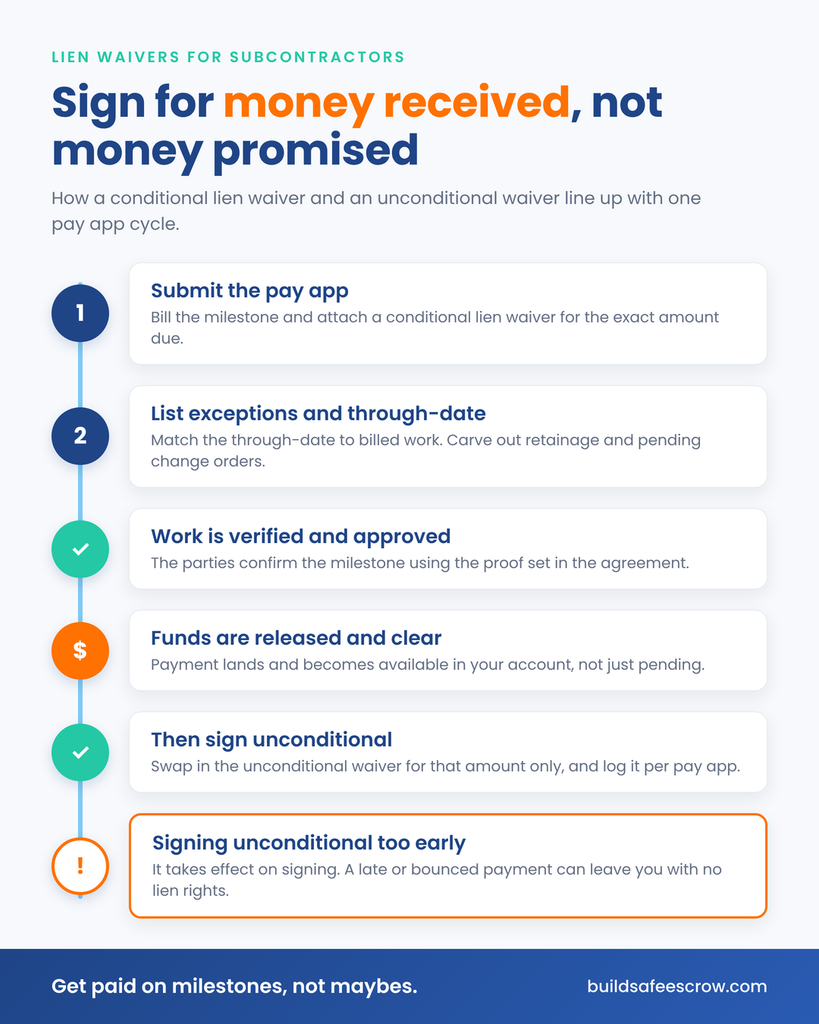
Sign a conditional lien waiver when you submit a pay request and the payment has not yet reached your account.
That covers most of the billing cycle. You send the pay app, attach a conditional lien waiver for that amount, and wait. The owner and general contractor know your rights release once you are paid.
Switch to an unconditional waiver only once you have cleared funds. That means the money is available in your account and cannot be reversed by a bounced check or recalled transfer. A deposit that shows as “pending” is not cleared. Levelset advises against giving an unconditional waiver while “the check hasn’t yet cleared the bank.”
Some contracts pair each new pay app’s conditional lien waiver with an unconditional waiver for the prior period. That can work, as long as the unconditional one covers only money you already received.
Six habits that keep your lien rights intact
These fit on one page of your billing checklist.
- Match the waiver to the money. Each conditional lien waiver should state the exact dollar amount being paid and nothing more. Do not sign for the full contract value when you are billing one milestone.
- Read the through-date every time. If you are paid through the 15th, a through-date of the 31st can release two weeks of unpaid work.
- List your exceptions. Retainage, the portion of each payment held back until the end of the job, is not paid yet, so carve it out in writing. Do the same for pending change orders, disputed amounts, and extra work under review. If the form has no exceptions section, ask your attorney how to note them.
- Wait for cleared funds before going unconditional. Confirm the money is available, not just deposited. A day of patience beats a bounced check with no lien rights behind it.
- Use the required form where one applies. Some states require specific statutory forms and wording; rules vary, so confirm with your attorney before you sign.
- Track waivers per pay app. Keep a log for each project: pay app number, amount, waiver type, through-date, exceptions, date signed, and date funds cleared. Months later, you can answer any question in a minute.
If retainage is a regular pain point, our guide to retainage in construction for subcontractors covers how holdbacks work.
Field example: one waiver, two outcomes
Dana Okafor runs a six-person drywall crew. She bills $38,400 for hang and tape on a mid-size residential build, with $4,200 held as retainage. The general contractor asks for an unconditional progress waiver through month end.
In the first version, Dana signs. A separate dispute delays the owner’s draw, and her payment slides three weeks. She covers two payrolls from her line of credit. On paper, her lien rights through month end, retainage included, may already be gone.
In the second version, Dana sends a conditional lien waiver instead. It lists the $34,200 she is due now, a through-date matching her billed work, and exceptions for the retainage and a pending soffit change order. The payment still runs late. Her rights stay in place until the funds clear, and she signs the unconditional waiver that day.
Same job, same delay. The conditional lien waiver made the difference.
Escrow lines up the paperwork with the money
Trust between a sub and a general contractor matters. Trust is a feeling, though. Structure is protection, and construction escrow turns the feeling into the structure.
With escrow, the owner or a lender deposits project funds with a neutral third party, such as Build Safe Escrow. The money sits in a secure escrow account and is released in stages, as each agreed milestone is completed and verified. Money never moves ahead of the work.
That changes the waiver conversation for subs.
- The money already exists. You are not signing against a draw that may or may not be funded. The milestone funds are already held.
- Release follows verification. The Escrow Agreement spells out what counts as proof, such as an inspection report, photos, or a sign-off. When that step is met and approved, the release moves forward.
- The waiver exchange can follow the release. If the Escrow Agreement says so, releases can be conditioned on documents like lien waivers. The parties can then sequence it: a conditional lien waiver goes in with the pay request. The unconditional waiver comes only after funds clear.
Build Safe Escrow does not prepare or collect your waivers, and it takes no one’s side. If an owner does not approve a payment request, the funds stay in escrow. The agreement sets up a dispute-resolution process that seeks to avoid litigation. Either party can bring in a third-party mediator.
Read more on our escrow services page, or browse the construction escrow FAQs for fees and setup.
FAQ
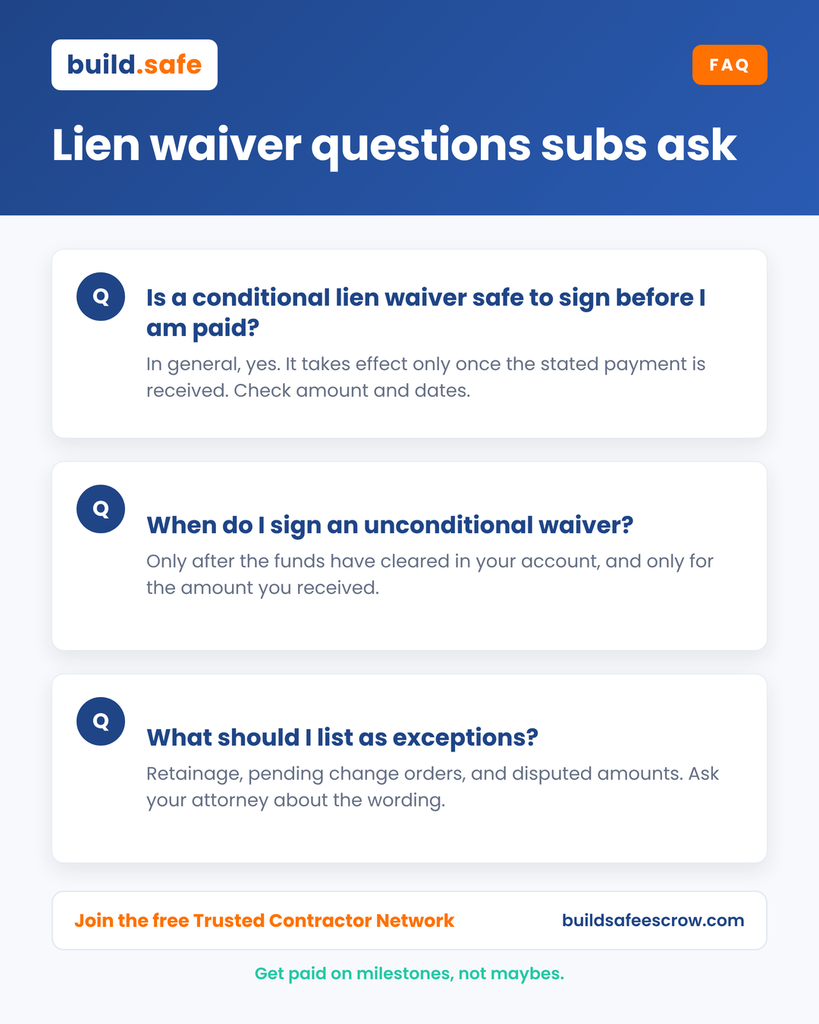
Is a conditional lien waiver safe to sign before I am paid?
In general, yes. It is designed to take effect only once the stated payment is received. Still, check the amount, through-date, and exceptions, and confirm the form meets local requirements with your attorney.
Can I swap my conditional lien waiver for an unconditional one once the check is in hand?
A check in hand is not cleared funds. Wait until the payment is available in your account and cannot be reversed. Then sign the unconditional waiver for that amount.
What should I list as exceptions on a waiver?
Anything unpaid that the through-date might otherwise cover. Common examples are retainage, pending change orders, and disputed amounts.
Does a progress waiver give up my retainage?
It can, if the language is broad and retainage is not listed as an exception. Carve it out in writing, and ask your attorney about the wording.
Does Build Safe Escrow prepare lien waivers?
No. Build Safe Escrow holds project funds as a neutral third party and releases them per the Escrow Agreement. If the agreement makes waivers a release condition, the parties provide them.
Get paid on milestones, not on promises
You work in stages. You should be paid in stages, from money already set aside.
Get one short read each Friday on how construction money actually moves: subscribe to The Build Brief.
If you are a specialty trade or subcontractor, join the free Trusted Contractor Network. Build trust. Win more projects. Get paid on milestones, not maybes.
References
- Siteline, “92 percent of subcontractors floated payroll last year, new Siteline report finds” (The State of Subcontractor Billing in 2026, published Aug 13, 2026): https://www.siteline.com/blog/92-percent-of-subcontractors-floated-payroll-last-year-new-siteline-report-finds
- Levelset, “Should You Sign That Lien Waiver?” (updated May 31, 2023): https://www.levelset.com/blog/should-you-sign-that-lien-waiver/
- Procore, “Successfully Navigating Construction Lien Waivers” (updated June 11, 2024): https://www.procore.com/library/lien-waivers