

Table of Contents
- Why the setup feels harder than the project
- How do I set up a construction escrow account?
- Seven decisions to settle before you set up a construction escrow account
- The documents to gather first
- Five questions to ask any escrow provider
- Bringing your contractor in without souring the relationship
- Setup mistakes that weaken the protection
- From the field: a $148,000 addition, set up in the right order
- How escrow removes the risk at the source
- Do you need an escrow account for remodeling a house?
- Frequently asked questions
- Get the next step right
- References
You have decided to set up a construction escrow account, and now you face a contract, a deposit request and many unknowns. If you are a homeowner starting a renovation, addition or custom build, that knot in your stomach is normal. You are about to hand a large sum to people you have known for a few weeks.
The good news: the setup is a short list of decisions. Make them in order and the anxiety has somewhere to go.
Why the setup feels harder than the project
Most owners have never done this before. Your contractor has run dozens of jobs. You may run one or two in a lifetime.
That gap creates three pressures. First, the deposit request often arrives before the work it pays for. Second, nobody hands you a checklist, so you do not know what “ready” looks like. Third, raising the topic of protection can feel like accusing someone you just hired.
You are not alone in this. Spending on improvements and repairs to owner-occupied homes is projected at $519 billion through mid-2027. That figure comes from the Harvard Joint Center for Housing Studies (LIRA, released July 23, 2026). Your project is a small slice of that. It may still be most of your savings.
How do I set up a construction escrow account?
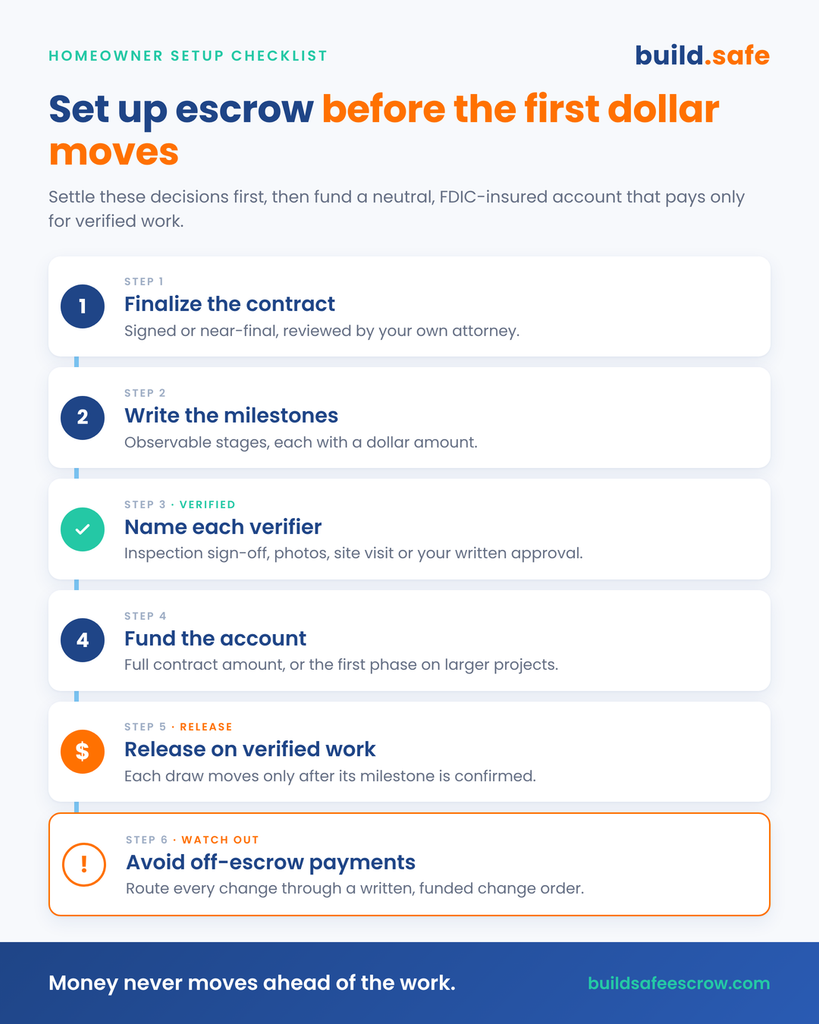
To set up a construction escrow account, agree on a written milestone schedule with your contractor, choose who verifies each milestone, fund a neutral FDIC-insured escrow account, and release money only as each stage is confirmed.
A construction escrow account is money held by a neutral third party, not by you and not by your contractor. The holder follows the payment schedule in your contract. Funds move in draws (staged payments). Each draw waits until a named person confirms a milestone: an observable stage of work, like “framing complete.”
Escrow enforces the contract. It does not replace it. So the work before you set up a construction escrow account is mostly about getting the contract and schedule clear.
Seven decisions to settle before you set up a construction escrow account
Call a provider once these are settled. Each one saves a round of back and forth.
- Contract status. Have the contract signed, or close to final. The escrow schedule mirrors it, so a moving contract means a moving schedule. Have your own attorney review it.
- The milestone schedule. Write a list of observable stages, each with a dollar amount. “Drywall hung and taped” works. “Interior progress” does not.
- The verifier for each milestone. Name who confirms each stage and how: a permit inspection sign-off, photo documentation, a site visit, or your written approval. Different stages can use different methods.
- Funding source and timing. Decide whether you deposit the full contract amount or, on a larger project, the first phase. If a loan is involved, ask your lender how its draws line up with the escrow schedule.
- The change-order rule. Agree that every change is written, priced and funded as a new milestone before the work starts. Verbal changes are where budgets drift.
- Lien-waiver handling. A lien waiver is a signed document. In it, a contractor or supplier gives up the right to claim against your property for an amount paid. Plan for conditional waivers with each draw request and unconditional waivers once payment clears.
- Final release conditions. Decide what “finished” means. Usually that is the final inspection plus a punch-list walkthrough. If your contract uses retainage (a percentage held back until the end), note it here.
If you can answer all seven in writing, you are ready.
The documents to gather first
Before you set up a construction escrow account, put this paperwork in one folder.
- The signed or near-final construction contract
- The written milestone schedule with dollar amounts
- Your contractor’s contact and business details
- Proof of your funding source, or your lender’s draw terms
- Permit information, if permits are required for the project
- Your agreed change-order and lien-waiver process, in writing
The milestone schedule matters most. It tells the escrow holder when money may move. For help building one, see our guide to a home renovation payment schedule.
Five questions to ask any escrow provider
You are choosing who holds your money. Ask the same questions of every option.
- Is the money in an FDIC-insured account, and how are larger balances structured? Standard FDIC coverage is $250,000 per depositor, per insured bank, for each account ownership category. If your project is bigger than that, ask exactly how the funds are held.
- How does verification work? Who confirms a milestone, what evidence they accept, and what happens if you and the contractor disagree.
- How quickly are releases processed once a milestone is verified? Get the answer in writing rather than assuming.
- What is the fee, and is it known up front? A flat setup and administration fee, known before the project starts, is easy to budget.
- What happens if the contractor stops work? The answer you want: unreleased funds stay in the account and can pay a replacement contractor.
Vague answers on verification or fees deserve a second call.
Bringing your contractor in without souring the relationship
Many owners worry that raising escrow signals distrust. It protects both sides, so say that.
Your contractor gets proof the money exists before buying materials. They get paid on verified milestones instead of chasing invoices.
Try a line like this: “I want to set up a construction escrow account. You will see the funds are there and get paid as each stage is signed off.” Most good contractors hear that as a sign of a serious client. If yours wants to read more first, share the contractor’s side of a construction escrow account.
Involve them in drafting the milestone schedule. A schedule both of you wrote is one both of you will follow.
Setup mistakes that weaken the protection
When owners set up a construction escrow account in a hurry, these gaps show up.
- Vague milestones. “Phase 2 done” invites an argument. Describe what anyone could see on site.
- Front-loaded dollar amounts. If the first milestone carries half the budget, money is still moving ahead of the work.
- No named verifier. When nobody is assigned, every release becomes a negotiation.
- Off-escrow side payments. Paying a “small extra” by check outside the account breaks the record. Route changes through the change-order rule.
- Skipping lien waivers. Without them, a subcontractor or supplier who was not paid may still have a claim against your property. Lien rules vary by state and locality, so confirm the details with your attorney.
From the field: a $148,000 addition, set up in the right order
Dana Reyes, a homeowner funding a $148,000 addition, nearly wired a large deposit the day she signed. Instead, she paused to set up a construction escrow account first.
She and her contractor wrote six milestones with dollar amounts, from foundation to final walkthrough. The building inspector’s sign-off would verify the foundation and framing stages. Dana’s written approval, backed by photos, would cover finishes. They agreed every change would become a new funded milestone.
Midway through, Dana added a skylight. It went in as its own priced milestone, funded before work started. Each draw arrived with a conditional lien waiver, and the unconditional waivers followed once payments cleared.
Funding was never in question, which made crews and materials easier for her contractor to schedule.
How escrow removes the risk at the source
Every decision above points at one rule: money never moves ahead of the work.
The deposit sits with a neutral holder, so it cannot disappear into another job. Milestones define what each dollar buys. Verification decides when it moves. Lien waivers close the loop on who has been paid. If work stops, the unreleased balance stays put for the next contractor.
Trusting your contractor is a feeling. A funded, verified schedule is protection. You can have both. For more owner questions answered, see our construction escrow FAQs.
Do you need an escrow account for remodeling a house?
You may not be required to use one, but escrow makes sense whenever a deposit or draw is large enough that losing it would hurt.
Lenders may set their own draw rules on financed projects. On a cash-funded remodel, the choice is often yours. Many owners set up a construction escrow account for additions, kitchens, whole-home renovations and custom builds. On those jobs, single payments can run into five or six figures. Rules vary by state and locality, so confirm any requirements with your attorney.
Frequently asked questions
How long does it take to set up a construction escrow account?
It depends mostly on you. If your contract, milestone schedule and verifier choices are settled, setup moves faster. Ask each provider for their process and expected steps before you commit.
What does it cost to set up a construction escrow account?
Fees vary by provider. Build Safe Escrow charges a flat setup and administration fee that you know before the project starts. Ask any provider for the full fee in writing.
Does my contractor have to agree before I set up a construction escrow account?
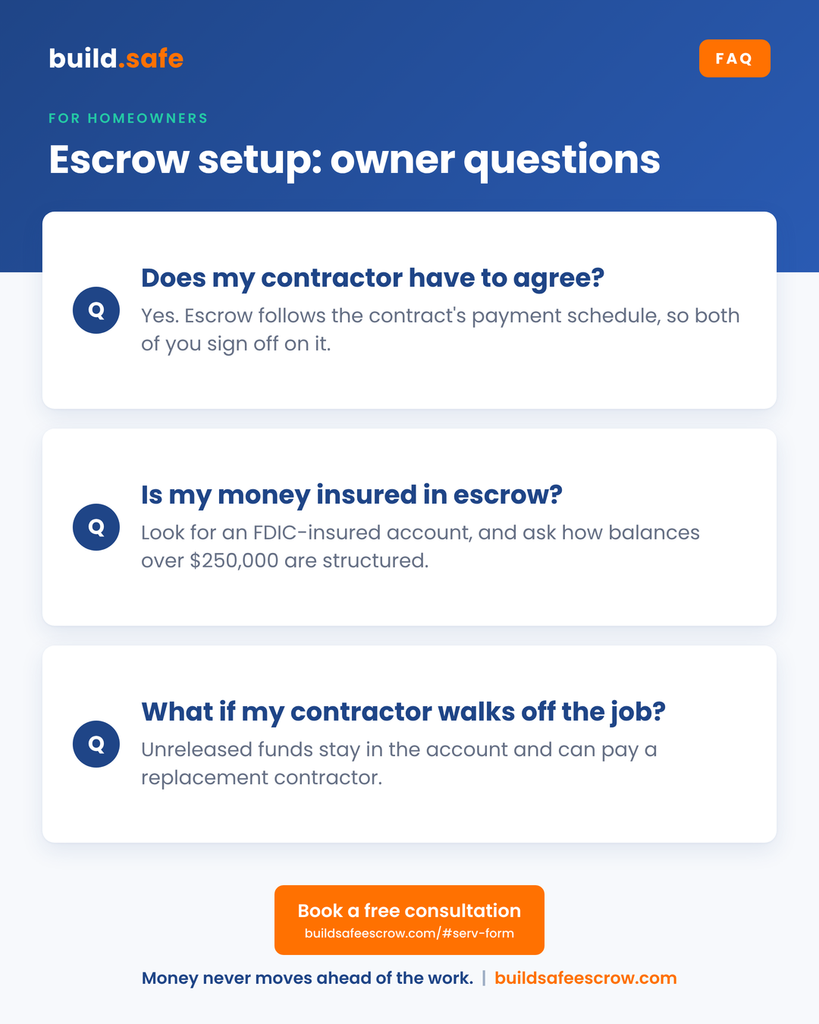
Yes. Escrow follows the payment schedule in your contract, so both parties need to agree to it. Most contractors welcome proof the funds exist.
Is my money insured while it sits in escrow?
Look for an FDIC-insured account. Standard coverage is $250,000 per depositor, per insured bank, for each ownership category. For larger balances, ask how the provider structures the funds.
What happens if my contractor walks off the job?
Funds that have not been released stay in the account. They can be used to pay a replacement contractor to finish the work. Talk to your attorney about your contract rights.
Can I change the milestone schedule after work starts?
Yes, through the change-order process you agreed on. Each change is written, priced and funded as a new milestone before that work begins.
Get the next step right
Get one short read each Friday on how construction money actually moves. Subscribe to The Build Brief.
Ready to set up a construction escrow account for your project? Schedule a free consultation with Build Safe Escrow. We will walk through your contract, milestones and verification plan with you. This guide is general information, not legal or financial advice; consult your own attorney or accountant about your situation.