
Table of Contents
- The Pen Is Already in Your Hand
- Why Good Contracts Still Go Wrong
- What should I check before signing a construction contract?
- The 9 Checks, In Order
- From the Field: Camila’s Addition
- How Escrow Removes the Problem at the Source
- FAQ
- Sign With the Money Protected
- References
The Pen Is Already in Your Hand
The hour before signing a construction contract is the last hour you have real leverage as a homeowner. The contractor has been friendly, the estimate looks reasonable, and the calendar says work can start in three weeks. Everything about the moment pushes you to sign.
Then the first check clears, and the leverage flips. Whatever you did not settle before signing a construction contract, you will be negotiating from behind.
This guide is for the property owner sitting at the kitchen table with a twelve-page agreement and a pen. Nine checks, in the order they matter, plus the one question that decides whether your deposit is ever at risk.
Why Good Contracts Still Go Wrong
Most renovation disputes do not start with a bad contractor, and most could have been prevented before signing a construction contract. They start with a contract that describes the work well and describes the money badly.
A typical residential agreement spends pages on scope, materials, and change orders. Then it handles payment in two lines: a deposit on signing, balance on completion. Sometimes there is a middle draw “at rough-in.” Nobody defines rough-in. Nobody says who confirms it happened.
The Federal Trade Commission tells homeowners to insist on a written contract that includes a payment schedule and a start and completion date. Good advice, and most contracts technically pass it. The problem is that a schedule of dates tells you when money leaves. It does not tell you what has to be true before it leaves.
So the deposit goes out on trust. The middle draw goes out on a text message that says “rough-in done.” The final payment goes out because the crew is standing in your driveway. At no point does anyone verify that the dollars and the work are in step.
That is the gap. Every check below is a way to close it before signing a construction contract, while you still can.
What should I check before signing a construction contract?
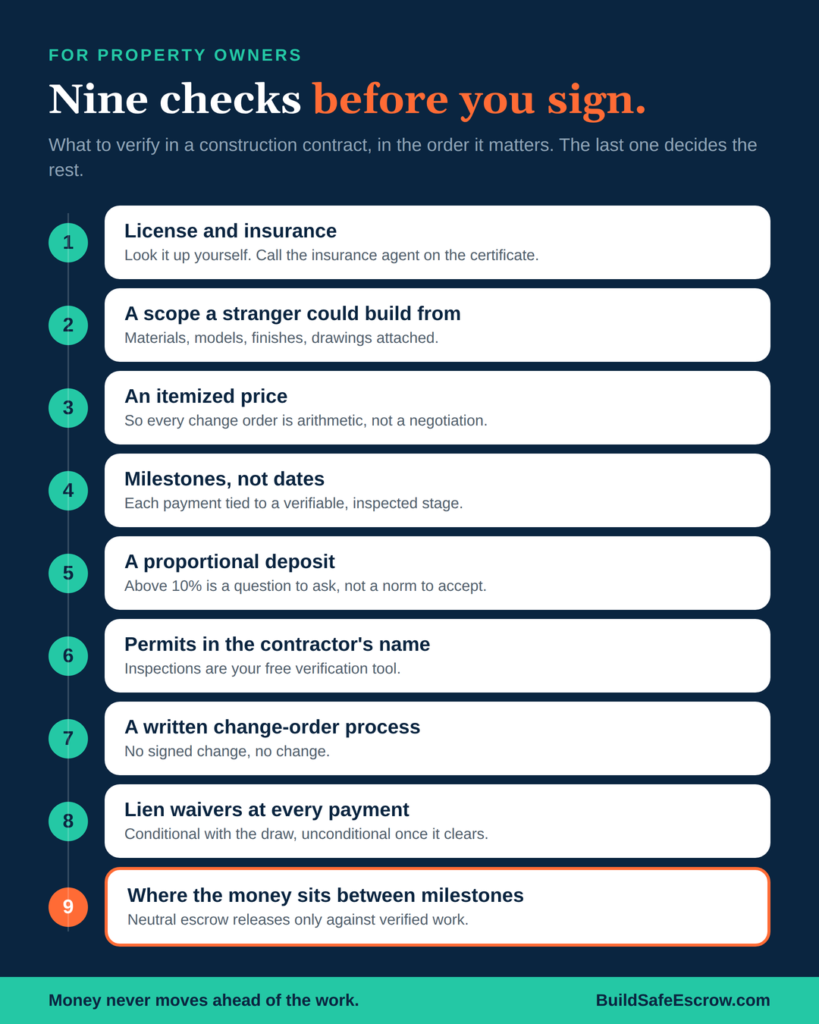
Before signing a construction contract, verify nine things: the contractor’s license and insurance, a written scope with drawings, an itemized price, a milestone-based payment schedule, a deposit that stays within legal and practical limits, who pulls permits, a change-order process, lien waiver requirements, and where the money is held until each milestone is verified.
That is the short answer. The rest of this article walks through each one and explains what “good” looks like, because a checklist you cannot evaluate is just a list.
The 9 Checks, In Order
License and insurance, verified by you. Before signing a construction contract, ask for the license number and look it up on your state’s licensing site, not the contractor’s website. In Florida that is the DBPR license lookup. Then ask for certificates of general liability and workers’ compensation insurance, and call the agent listed on the certificate. A certificate can be expired or altered. The agent will tell you in thirty seconds.
A scope you could hand to a stranger. The scope section should be specific enough that a different contractor could build from it. “Remodel master bath” fails. “Demo existing tile to studs, install Schluter waterproofing, 12×24 porcelain per allowance, Kohler Highline toilet, Moen Align fixtures in brushed nickel” passes. Attach drawings if there are any. Attach the finish schedule. If the contractor says details will be worked out later, the price will be worked out later too.
An itemized price, not a lump sum. Get this before signing a construction contract, not after. You are not trying to audit the contractor’s margin. You are trying to understand what a change costs when it comes. A lump-sum contract makes every change order a negotiation from zero. An itemized one makes it arithmetic.
A payment schedule tied to milestones, not dates. This is the check that matters most, so slow down here. Every payment in the contract should be triggered by a verifiable stage of completion, described in plain words. “Foundation poured and inspected.” “Rough plumbing and electrical passed inspection.” “Drywall hung and finished.” “Substantial completion with punch list.” A schedule that reads “30% on signing, 30% at midpoint, 40% on completion” has one real milestone in it, and it is the last one.
A deposit that stays proportional. In Florida, a contractor who takes more than 10% of the contract price as an initial payment on residential work must apply for permits within 30 days and start work within 90 days of permits being issued, or face a theft charge under Florida Statute 489.126. That statute exists because oversized deposits are where projects vanish. Whatever your state, treat a deposit above 10 to 15% as a question to ask, not a norm to accept. (Special-order materials are the honest exception. Ask for the supplier invoice and pay that amount specifically.)
Permits pulled by the contractor, in the contractor’s name. Settle this before signing a construction contract. If a contractor asks you to pull the permit as an owner-builder, they are shifting liability for the work onto you. Decline. The permit and the inspections that come with it are your best free verification tool, and they belong under the license of the person doing the work.
A written change-order process. No change order, no change. The contract should say that any change to scope or price is written, priced, signed by both parties, and added to the milestone schedule before the work is done. Verbal approvals in the driveway are how a $60,000 project closes at $78,000 with no paper trail.
Lien waivers at every payment. Under Florida’s construction lien law, subcontractors and suppliers who are not paid by your contractor can lien your property even after you have paid the contractor in full. The defense is a lien waiver: a signed release from each sub and supplier confirming they were paid for the work covered by that draw. Your contract should require a conditional waiver with each payment request and an unconditional waiver once the payment clears. If the contractor has never heard of this before signing a construction contract with you, that is information.
Where the money sits between milestones. This is the question almost nobody asks before signing a construction contract, and it is the one that decides everything else. If your deposit and draws sit in the contractor’s operating account, then checks 4 through 8 depend entirely on the contractor’s discipline. If the funds sit with a neutral third party that releases each milestone only after it is verified, the schedule enforces itself.
A word on what this list is not. It is not a way to catch a dishonest contractor. Honest contractors run into cash flow trouble, lose a key sub, or take on one job too many. The nine checks protect you from those outcomes too, because none of them depend on anyone’s intentions.
From the Field: Camila’s Addition
Camila, a homeowner in Coral Gables, was two days from signing a $145,000 contract for a second-story addition. The contractor was licensed, well reviewed, and recommended by a neighbor. The contract asked for 35% at signing.
She ran the nine checks before signing a construction contract. The license was current. The insurance agent confirmed coverage. The scope was solid and came with architect’s drawings. The payment schedule was the problem: signing, “framing complete,” “dry-in,” and completion, with no definition of any middle term and no mention of inspections or lien waivers.
Camila did not walk away. She asked for three changes before signing a construction contract she otherwise liked. The deposit dropped to 10%, with a separate line for the truss package paid directly against the supplier’s invoice. Each milestone was rewritten to reference the corresponding county inspection. And the full contract amount moved into a construction escrow account, with each milestone releasing to the contractor after verification.
The contractor agreed in an afternoon. His words: the escrow proved the money was real, and he had been burned before by owners who ran out of funds at drywall. Fourteen months later the addition passed final inspection, the last draw released the same week, and neither party ever had a reason to call a lawyer.
Same contractor. Same project. The only thing that changed was the structure around the money.
How Escrow Removes the Problem at the Source
Look back at the nine checks to make before signing a construction contract. Seven of them are about information: who the contractor is, what the work is, what it costs, who pulls permits. Two of them are about money: when it moves and where it sits.
The information checks reduce your risk. The money checks are what protect you when the information turns out to be wrong.
Construction escrow puts the full project budget into a secure, FDIC-insured account held by a neutral third party. The milestone schedule from check 4 becomes the release schedule. When a stage is completed and verified, that stage’s payment releases to the contractor. When it is not, the money stays where it is.
Notice what this does to the rest of the list:
- The deposit question (check 5) mostly disappears, because the contractor can see the entire budget is funded and no longer needs a large upfront payment as proof you are serious.
- The change-order process (check 7) has teeth, because an unsigned change cannot be funded from an account that only releases against the agreed schedule.
- Lien waivers (check 8) become a release condition instead of a favor you have to ask for.
Money never moves ahead of the work. That is the single rule underneath every check in this article, and escrow is how you write it into the deal rather than hoping for it. You can see how the milestone and release process is structured on our escrow services page, and the construction escrow FAQs cover what happens when a milestone is disputed.
Trust is a feeling. Structure is protection. The contract is where you choose which one you are relying on.
FAQ
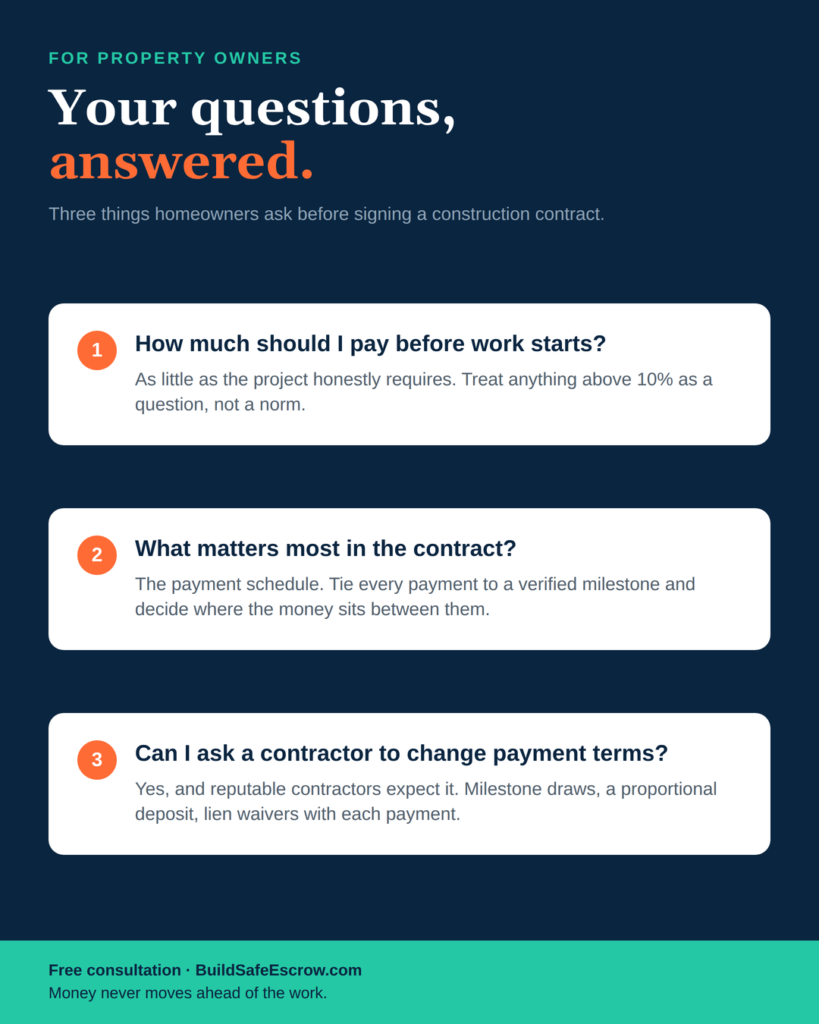
How much should I pay a contractor before work starts? As little as the project honestly requires. Ten percent is a common ceiling for residential work, and Florida law treats deposits above 10% as triggering specific permit and start-work deadlines. If special-order materials need funding, pay against the supplier invoice rather than adding to the deposit.
What is the most important thing to check before signing a construction contract? The payment schedule. Everything else in the contract describes intentions. The payment schedule describes when your money leaves and what has to be true first. Tie every payment to a verifiable milestone, and decide where the money sits between them.
Do I need a lawyer to review a residential construction contract? For a major project, a one-hour review by a construction attorney is inexpensive relative to the contract value and worth doing. This article gives you the checklist; it is information, not legal advice. Your own attorney can tell you how it applies in your state.
Can I ask a contractor to change the payment terms? Yes, and reputable contractors expect it. Before signing a construction contract, ask for milestone-based draws, a proportional deposit, and lien waivers with each payment. A contractor who refuses every one of those requests is telling you how the project will go.
What if the contractor says escrow will slow the project down? The opposite tends to happen. Funds are committed before day one, each release is tied to a defined stage, and the contractor never chases a check. Delays usually come from unfunded owners and undefined milestones, and escrow removes both.
Does construction escrow protect the contractor too? Yes. The contractor can see the full budget is funded and knows payment releases the moment a milestone is verified. That is why many contractors prefer it once they have used it.
Sign With the Money Protected
Run the nine checks before signing a construction contract. Then ask the last question out loud: where does my money sit between milestones?
If you want a structure that answers it for you, schedule a free consultation and we will walk through how escrow fits the contract in front of you. No obligation, no pressure, and a much calmer signing.
Get one short read each Friday on how construction money actually moves. Subscribe to The Build Brief.
References
- Federal Trade Commission, “Hiring a Contractor,” consumer.ftc.gov. https://consumer.ftc.gov/articles/hiring-contractor
- Florida Statutes § 489.126, “Moneys received by contractors.” https://florida.public.law/statutes/fla._stat._489.126
- Florida Statutes § 713.06, “Liens of persons not in privity; proper payments; notice to owner.” https://www.flsenate.gov/Laws/Statutes/2025/713.06
- Pinellas County, “Abandoned Residential Construction Projects: Know Your Rights.” https://pinellas.gov/wp-content/uploads/2022/06/Abandoned-Residential-Construction-projects-rack_card.pdf