

Change order payment problems have a special sting for contractors and specialty trades. The original contract usually gets paid; the extras, the moved wall, the upgraded panel, the surprise behind the drywall, turn into arguments, discounts, or write-offs. This guide is for builders, GCs, and subs who are tired of doing real work for maybe money.
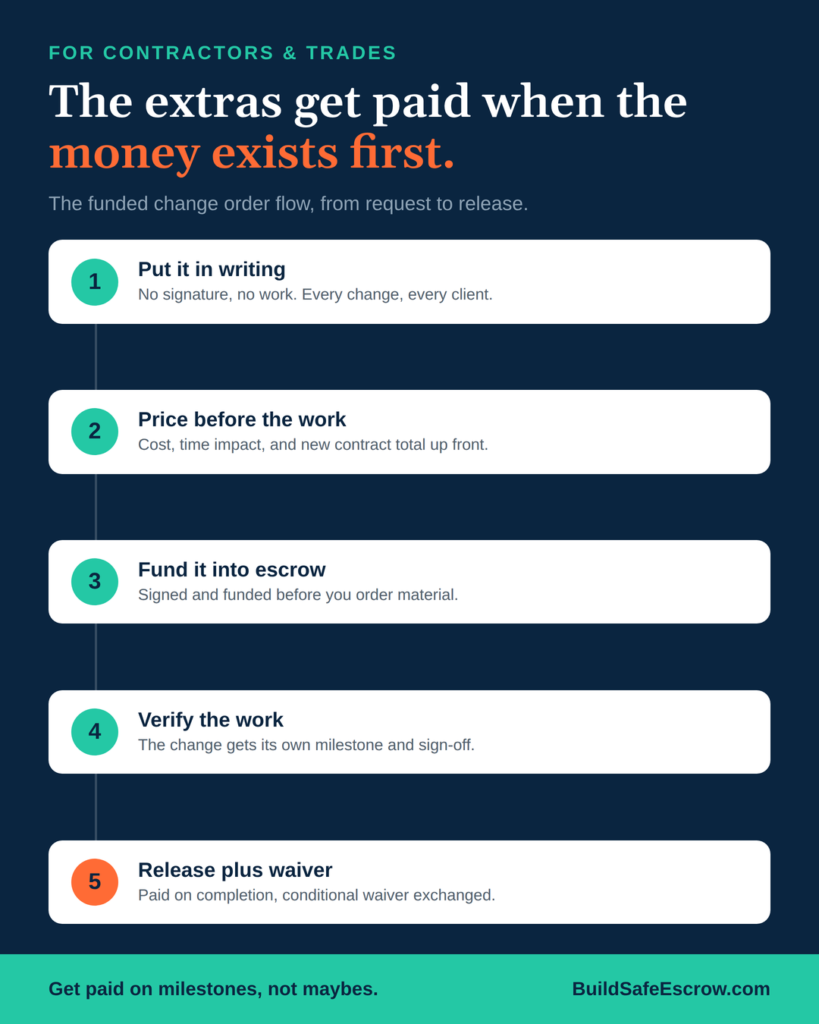
Table of Contents
- Why extras don’t get paid
- 1. No signature, no work
- 2. Price the change before the change
- 3. Fund the change, not just the paperwork
- 4. Give every change its own milestone
- 5. Protect your lien rights at every release
- A short field example
- How do I get a change order payment without a fight?
- How escrow removes the problem at the source
- FAQ
- Get paid on milestones, not maybes
- References
Every contractor knows the moment. You are mid-project, the client asks for one more thing, and the easiest answer in the world is “sure, we’ll take care of it.” You want to keep the job moving and the relationship warm. So the work happens and the paperwork doesn’t, and the bill arrives as a surprise.
Then comes the second conversation, the one about money, and now you are negotiating from the worst position in construction: the work is already done. Your leverage is gone, the client’s memory of what was agreed has softened, and the number you finally collect, if you collect it, is smaller than the number you earned.
Change orders are not the problem. Unstructured change orders are.
Why extras don’t get paid
The change order payment failure pattern repeats across trades and project sizes.
The approval was verbal. A nod on a job site is not a contract term. When the invoice lands, “I didn’t agree to that price” is not even always a lie; often no price was ever said out loud.
The price came after the work. When you bill for finished work, you are asking. When you price unstarted work, you are offering. The difference between those two postures is your margin.
The money was never set aside. The client budgeted the contract, not the changes. By the time your change order payment request arrives, the contingency is spent and your invoice is competing with their savings account.
It all settled at the end. Unresolved extras pile up until closeout, where they collide with punch lists and retainage in one big, ugly negotiation, which is the single worst place to argue about money.
Industry payment research keeps finding the same thing: change orders and slow approvals sit near the top of what drives construction payment disputes and cash flow stress. None of that is a character flaw. It is a structure gap.
1. No signature, no work
Rule one is absolute: no change work starts without a signed change order. Not for good clients. Not to keep the schedule moving.
A change order does not need to be elaborate. A one-page form works, and so does a text-to-email confirmation chain that states scope, price, and schedule impact and gets acknowledged in writing. What matters is that the agreement exists before the work does.
The rule feels awkward exactly once per client. After that it is just how you work, and clients respect contractors who run their paperwork like professionals. The awkward conversation up front replaces the hostile change order payment fight at the end.
2. Price the change before the change
Every change order states three numbers before anyone lifts a tool: the price, the time impact, and the effect on the overall contract value.
Pricing first protects both sides of the change order payment. The client decides with real information. Maybe the moved wall is not worth $9,400 to them, and you both just avoided a dispute. Meanwhile your margin survives, because you are quoting the work instead of defending an invoice.
Put your standard markup on changes in the base contract so it never lands as a surprise. The change order then applies terms everyone already agreed to.
3. Fund the change, not just the paperwork
Now the fix almost nobody uses, and the one that changes everything. A signed change order tells you the client agreed to pay. It does not tell you the client can pay.
So attach funding to signature: the change order amount is deposited into the project’s neutral escrow account when the change is approved. The money for your extra work now verifiably exists, sitting alongside the contract funds, before you order material or schedule labor.
A change order payment stops being a promise and becomes a scheduled release. There is a quieter benefit too, in that funding screens your changes for you. A client who signs but cannot fund is a dispute you just avoided doing the work for.
4. Give every change its own milestone
Do not let extras dissolve into the general pile of “stuff we did.” Each change order becomes its own milestone, or attaches to an existing one, with a definition of complete, its funded amount, and a verification step.
When the change work is done and verified, its release moves. Separately, on its own timeline. Not held hostage to closeout, not netted against a punch list argument, and not parked under “we’ll settle everything at the end.”
Handled this way, a change order payment is no longer the last money you see. It is just another verified release in the sequence.
5. Protect your lien rights at every release
Change work is real work. It carries the same mechanics lien rights as contract work, and the same waiver traps.
At each release, exchange a conditional lien waiver covering exactly the amounts being paid, and make sure your waiver language does not accidentally release rights for unpaid or disputed change work. An unconditional waiver signed while a change order payment is still outstanding can erase your leverage on that money entirely.
Keep your notice deadlines alive on change work too. In many states, preliminary notice and lien deadlines run from dates that change orders can shift. When in doubt, treat the change as new work and protect it like new work.
A short field example
Deshawn runs a six-person electrical contracting outfit. On a commercial build-out last year, the tenant’s “small adjustments” grew into $31,000 of change work: panel upgrades, relocated circuits, added data runs. All of it was approved with a wave of the hand. He collected $19,000 of it, four months late, after threatening a lien. The rest he ate.
This year, on a similar project, he worked under a funded structure. Every change went onto a one-page order with price and schedule impact, and nothing started until the client signed and the amount landed in the project’s escrow account. Each change carried its own verification step and released on completion against a conditional waiver.
Total change work: $27,500. Total collected: $27,500. Every change order payment arrived on schedule, and Deshawn spent zero days chasing it. One requested change never got funded, so Deshawn never built it, which he now counts as money earned too.
[MEDIA: Infographic, 4:5, placed here. Change order flow: request, written order with price, funded into escrow, work verified, release plus waiver. Alt text: “Infographic showing the five-step funded change order payment flow for contractors.”]
How do I get a change order payment without a fight?
To get a change order payment without a dispute, put every change in writing with a fixed price before the work starts, have the amount funded into neutral escrow at signing, and release it against verified completion like any other milestone.
The sequence matters more than any single step. Writing without pricing invites the end-of-job negotiation. Pricing without funding leaves you exposed to a client who agreed but cannot pay. Funding with verified release closes the loop, because the money exists before your work does and moves the moment your work is confirmed. That is the difference between billing and collecting.
How escrow removes the problem at the source
Strip away the paperwork and every change order payment dispute reduces to the same root: the work moved ahead of the money. You performed first and negotiated second.
Construction escrow inverts that. Project funds, contract and changes alike, sit in a secure, FDIC-insured account held by a neutral third party. Nothing you build is speculative, because the money for it was verified before you started, and nothing you finish waits on a client’s mood, because verified completion is the release trigger.
Owners are not the losers in this structure; they are the co-beneficiaries. They never fund a change they did not sign, and never pay for change work that was not verified. Which is why leading with escrow wins bids. You are offering the client protection while securing your own pay. Get paid on milestones, not maybes, on the contract and on every change after it.
See how staged releases work on our escrow services page, or get quick answers in our construction escrow FAQs.
This article is general information, not legal or financial advice. Lien rights, notice deadlines, and waiver rules vary by state, so consult a construction attorney for your specific situation.
FAQ
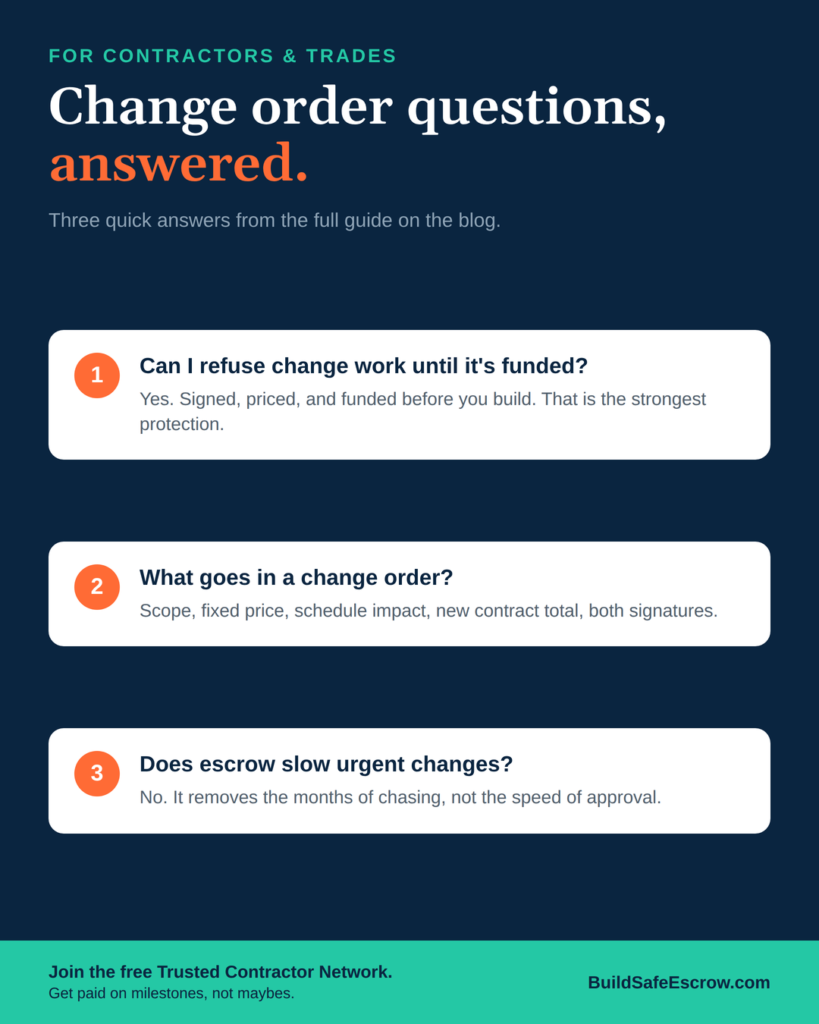
Can I refuse to do change work until the change order payment is funded? Check your contract, but in general you can and should require a signed, priced change order before performing extra work. Funding into escrow at signing is the strongest version of that protection.
What should a change order payment include? The scope of the change, the fixed price or agreed pricing method, the schedule impact, the new contract total, and both signatures. Ideally, add confirmation that the amount has been funded.
What if the client says the change was “included” in the original scope? This is exactly why the order is written and priced before the work. If a scope disagreement surfaces, it gets resolved before you spend labor and material on it, while you still have leverage.
Do change orders affect my lien rights? Yes. Change work generally carries lien rights, but deadlines and notice requirements can shift as contract value and timelines change. Protect change work the way you would protect new work.
Does escrow slow down urgent changes? No. A funded change can be approved and escrowed in the time it takes to sign the order. What escrow removes is not speed. It is the months of chasing that follow unfunded speed.
Get paid on milestones, not maybes
The extras should be your best-margin work, not your write-offs.
For everyone: Get one short read each Friday on how construction money actually moves: subscribe to The Build Brief.
For contractors and specialty trades: Build trust. Win more projects. Get paid on milestones, not maybes. Join our free Trusted Contractor Network.
References
- American Institute of Architects, contract documents overview (G701 Change Order): https://www.aiacontracts.com/
- Associated General Contractors of America: https://www.agc.org/
- Levelset, change orders and payment resources: https://www.levelset.com/
- FDIC, deposit insurance overview: https://www.fdic.gov/resources/deposit-insurance/