
You finished the job. You sent the invoice. Then came the silence.
Table of Contents
- The scene every contractor knows
- Why contractors wait to get paid
- How contractor payment protection actually works
- Six ways escrow gets you paid faster
- A short field example
- How escrow protects contractors at the source
- FAQ
- Get paid on milestones, not maybes
- References
The scene every contractor knows
Contractor payment protection is the difference between doing the work and actually getting paid for it. If you are a builder, a general contractor, or a specialty trade, you already know the gap between those two things. You poured the slab, framed the addition, wired the panel — and then you waited. And waited.
You are not alone, and you are not the problem. The problem is that most construction payments still run on a handshake. And the handshake is a liability. This post reframes something you may have gotten wrong about escrow: it is not a tool that slows you down or protects only the owner. Done right, contractor payment protection through escrow is the fastest, most reliable way you have to get paid in full, on time, on verified work.
Let’s walk through why the check goes missing — and how structure fixes it.
Why contractors wait to get paid
The wait is not random. It comes from a handful of predictable breakdowns. Name them, and you can design around them.
The money was never confirmed. Most contractors start work on a promise. You take a deposit, maybe. But you rarely see proof that the owner actually has the full project budget set aside. So you finance the job with your own cash and your own credit until draws arrive.
A draw is a scheduled release of funds tied to progress on the project. When draws depend on an owner’s mood, their bank, or their cash flow that month, your timeline is hostage to theirs.
Disputes freeze everything. One disagreement over scope or quality, and the owner stops paying — not just for the disputed item, but for everything. You are now funding the whole project while one line item gets argued.
Retainage stacks up. Retainage is the portion of each payment the owner holds back — often 5 to 10 percent — until the entire job is done. It is meant to protect the owner. In practice, it parks your profit in someone else’s account for months.
Slow paper, slow pay. Lien waivers, invoices, and approvals bounce between email inboxes. Every handoff adds days.
The owner simply runs short. Sometimes the money genuinely isn’t there anymore. It got spent, redirected, or was never fully committed. By the time you find out, you have already done the work.
Every one of these is a structure problem, not a character problem. Structure problems have structural fixes.
How contractor payment protection actually works
Here is the myth worth killing: that escrow is a brake. That it adds a layer between you and your money. The opposite is true.
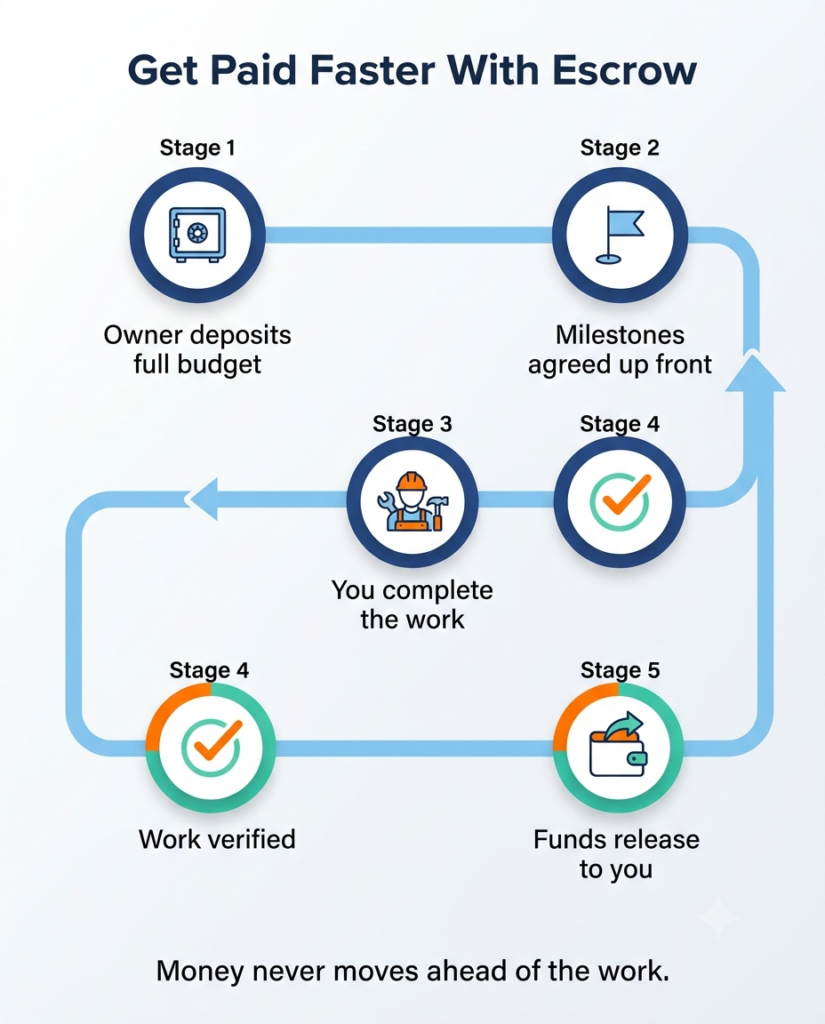
Escrow is a neutral, third-party account — FDIC-insured — that holds the project funds before the work begins. Build Safe Escrow is not a lender, not a contractor, and not on anyone’s side. We hold the money and release it in stages as each agreed milestone is completed and verified.
Read that again from your side of the table. The full budget is deposited before you lift a tool. The money is already there. It is confirmed. It is sitting in a secured account with your name on the release schedule. You are no longer working on spec, hoping the owner can pay when you finish. You are working against funds you can verify on day one.
That is what real contractor payment protection looks like. Not a promise. A funded account. Our escrow services exist to move the money question to the front of the job, where it belongs — so it never becomes an emergency at the end.
Six ways escrow gets you paid faster
This is the practical core. Six concrete benefits, each one a reason to ask for escrow on your next contract.
1. Funds verified up front. Before you break ground, the owner deposits the project budget into escrow. You get confirmation the money exists and is committed. No more financing the job on your own credit while you wait to see if the owner is good for it. This alone changes how you bid.
2. Milestone releases, not maybes. You and the owner agree on milestones before the work starts — foundation, framing, rough-in, finish. When a milestone is completed and verified, the funds release. Payment is tied to work, not to the owner’s calendar or cash flow. You get paid on milestones, not maybes.
3. Fewer disputes, faster resolution. Because the scope and the milestones are defined and documented up front, there is far less to argue about. Everyone agreed what “done” means before anyone got paid. When the work is verified, the money moves. Disputes shrink because the goalposts were set in concrete.
4. Faster final payment. No scrambling for the last check. The final milestone’s funds are already in escrow, waiting on verification. Complete the punch list, get it verified, get released. Retainage that used to vanish for months is defined, held neutrally, and scheduled — not parked in the owner’s account indefinitely.
5. Contractor payment protection that wins more bids. Here is the edge most contractors miss. When you propose escrow to a nervous owner, you are handing them peace of mind — their money is safe, released only on verified work. That makes you the safe choice, the professional in the room. Escrow is a selling point, not a concession. It helps you close.
6. Cleaner paperwork, built in. Waivers, approvals, and verification live in one process instead of scattered inboxes. That means fewer delays between “done” and “deposited.”
Notice the pattern. Every benefit points the same direction: the money is confirmed early and moves on proof of work. That is the whole idea.
A short field example
Consider a mid-size general contractor — call him Marco. Kitchen and primary-suite remodel, a good client, a fair price.
Marco used to run it the old way. Ten percent deposit, then invoice at the end of each phase and hope. On his last big job before escrow, the owner hit a cash-flow snag halfway through. Marco had already paid his framer and his electrician out of pocket. He carried $40,000 on his own line of credit for seven weeks while the owner “sorted things out.” He got paid eventually. The interest and the stress he never got back.
This time, Marco proposed escrow. The owner deposited the full remodel budget into a secured, FDIC-insured account before demolition. They set four milestones. Marco completed demo and rough-in, the work was verified, and the funds released in days — not weeks. When a disagreement came up over tile scope, it stayed contained to that one item. The rest of the money kept flowing on schedule because every other milestone was clearly met.
Marco financed nothing. He got paid faster. And the owner told two friends that Marco was the contractor who “made the money part feel safe.” That is contractor payment protection doing exactly what it should.
How escrow protects contractors at the source
Trust is a feeling. Structure is protection. The reason contractors get stiffed is that money is allowed to move ahead of the work — or, worse, the work is allowed to move ahead of the money.
Escrow fixes both by fixing the sequence. Money should never move ahead of the work — and you should never move ahead of the money. With escrow, you don’t have to. The funds are deposited and verified before you start. From your side, the protection is simple and total: the money is already there, waiting, released to you the moment your milestone is verified.
You stop being the bank for your own client. You stop chasing checks. You stop absorbing the owner’s cash-flow problems as your own risk. The account holds the money; a neutral third party verifies the work; the funds release. That is the entire mechanism, and it runs in your favor.
Want to see the mechanics in detail? Our construction escrow FAQs break down verification, milestones, and release timing step by step.
FAQs
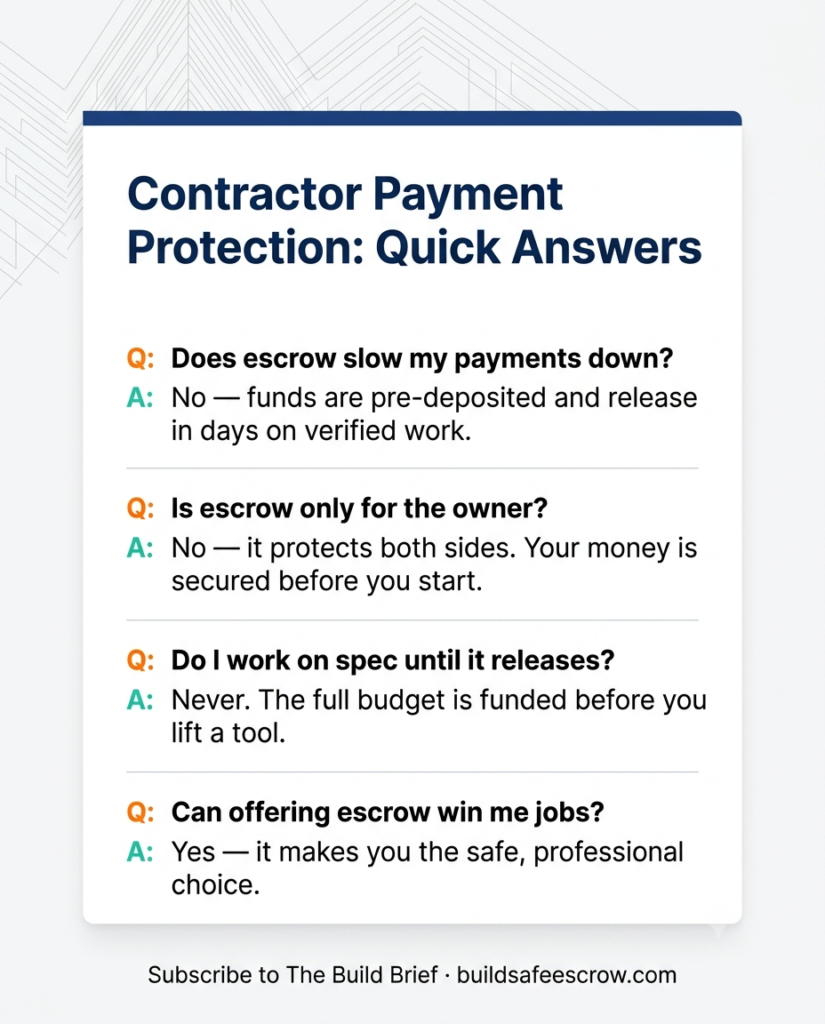
Does escrow slow down my payments? No — it usually speeds them up. The money is deposited before work starts. Once a milestone is verified, funds release in days. You are no longer waiting on the owner’s bank or cash flow.
Isn’t escrow just there to protect the owner? It protects both of you at once. The owner knows funds only release on verified work. You know the full budget is secured before you start. Neutral by design.
Do I have to work on spec until the escrow releases? No. That is the point. The funds are confirmed and held before you lift a tool, so you are never financing the job on your own credit.
What happens if there is a dispute? Because scope and milestones are agreed up front, most disputes stay small and contained to one item. The rest of your payments keep releasing on schedule.
Is my money actually safe in escrow? Funds are held in a secure, FDIC-insured account by a neutral third party — not the owner, not us as a stakeholder. Released only on verified milestones.
Can offering escrow help me win jobs? Yes. Proposing escrow signals professionalism and protects the owner’s capital. It makes you the safe, credible choice on the bid.
This article is information and structure, not legal or financial advice. Talk to your own attorney or accountant about your specific project and contracts.
Get paid on milestones, not maybes
If you write checks or chase them, one habit changes everything: put the money in front of the work.
Get one short read each Friday on how construction money actually moves — subscribe to The Build Brief.
Contractors and specialty trades: stop working on spec. Join the free Trusted Contractor Network. Build trust. Win more projects. Get paid on milestones, not maybes.
References
- Levelset / Procore — Construction Cash Flow & Payment Reports: https://www.levelset.com/
- Associated General Contractors of America (AGC): https://www.agc.org/
- U.S. Small Business Administration — managing business cash flow: https://www.sba.gov/
- FDIC — Deposit Insurance: https://www.fdic.gov/resources/deposit-insurance/