

The deposit cleared. The first few site visits went fine. Then the texts slowed, the calls stopped, and the job site went quiet. If your contractor has disappeared with your money, you are not alone — and more importantly, you are not without options. This guide walks through exactly what to do now to recover what you can, and how to make sure the next dollar you put toward a project is never exposed this way again.
Slow and failed payments are not a fringe problem in construction. Rabbet’s 2024 Construction Payments Report estimated that payment dysfunction added roughly $280 billion in costs across the U.S. construction industry in a single year. When money moves before work is verified, both sides carry risk — and homeowners who hand over large deposits up front carry the most.
First, slow down and document everything
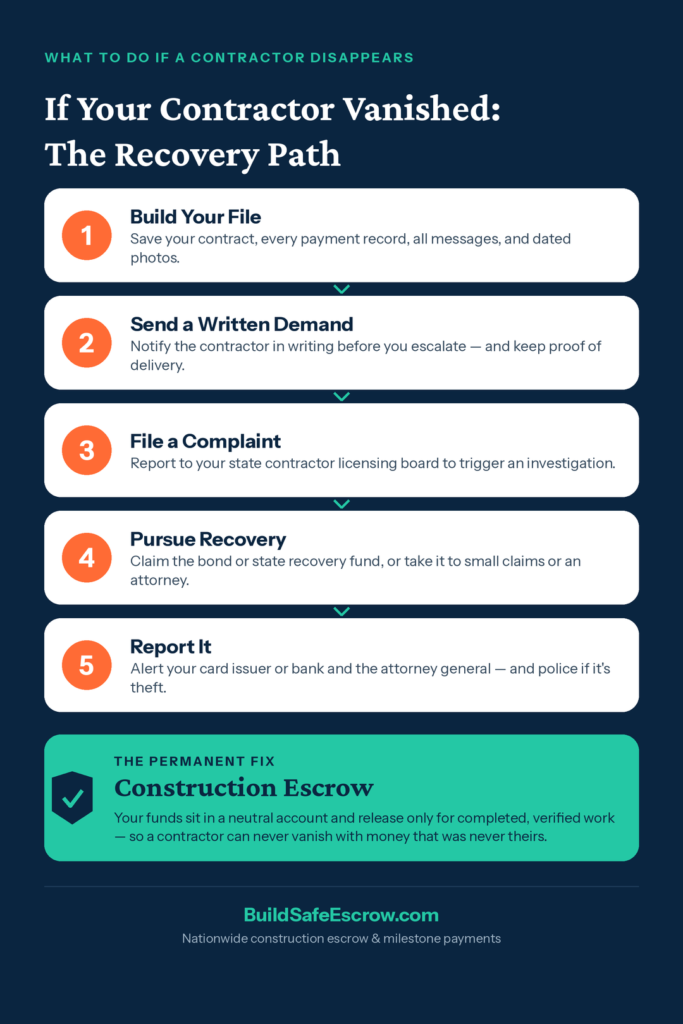
Before you make a single phone call in anger, build your file. Recovery — whether through a licensing board, a recovery fund, or a court — depends almost entirely on documentation. Gather these in one place:
- Your signed contract and any change orders.
- Every payment record: canceled checks, bank transfers, card statements, receipts.
- All communication: texts, emails, voicemails, and a written timeline of what was promised and when.
- Photos and video of the current state of the work, with dates.
- The contractor’s license number, business name, and any names of individuals involved.
This file is your leverage. It is also what nearly every recovery channel below will require before they can act.
Send a written demand before you escalate
A formal written demand sometimes works on its own. Many states require you to notify a contractor of intent to file against their bond before you actually do — and that notice alone is occasionally enough to bring a stalled contractor back to the table. Send it in writing, keep a copy, and use delivery you can prove. Resources like Angi’s guide on what to do when a contractor takes your deposit and runs lay out how to frame this step.
Know your recovery channels
There is no single button to press, but there are several real avenues. Most homeowners use more than one at the same time:
- State contractor licensing board: File a complaint. The board can investigate, discipline, and in some cases suspend or revoke a license — which gives a contractor a strong reason to respond.
- Contractor recovery or guaranty fund: Many states maintain a fund that reimburses homeowners for losses caused by a licensed contractor’s fraud or failure to perform. Caps and eligibility vary widely by state, and most require a court judgment first.
- Surety bond claim: If the contractor was bonded, you may be able to claim against the bond for your loss.
- Small claims court: For losses under your state’s small-claims ceiling, this is often the fastest, lowest-cost path and usually does not require a lawyer.
- Civil suit: For larger losses, an attorney can pursue a judgment — and that judgment is frequently a prerequisite for tapping a state recovery fund.
Report it — and protect your remaining money
If you paid by credit card or recent bank transfer, contact your card issuer or bank immediately about a chargeback or fraud alert; timing matters. File a complaint with your state attorney general’s consumer protection division. And if the contractor took payment and simply vanished without performing, that can rise to theft — a police report creates an official record and, in some jurisdictions, opens a criminal path. The Homes.com guide to getting money back from bad contractors covers how these channels work together.
How this never happens to you again: construction escrow
Every recovery channel above is a way to chase money that has already left your hands. The far better position is to never let it leave your hands until work is actually done. That is exactly what construction escrow does.
With escrow, your renovation funds sit in a secure, neutral third-party account. The money is released to your contractor in stages — only after each agreed milestone is completed and verified. A contractor cannot disappear with a deposit that was never theirs to take, because nothing is released until there is real, inspected progress to show for it. Good contractors welcome it: it proves they will be paid promptly and in full for work they complete, and it removes the trust gap that sinks so many projects. You can add an escrow arrangement even alongside a contract you have already signed.
If you are mid-project and uneasy right now, the single most protective move is to stop releasing money against promises and start releasing it against verified milestones. That switch can be made before the next payment goes out.
Frequently Asked Questions
Can I get my money back if my contractor disappeared?
Often, yes — partially or fully — but it depends on documentation and your state’s rules. Your main channels are the state licensing board, a contractor recovery or guaranty fund, a surety bond claim, small claims court, and a civil suit. Many homeowners pursue several at once. A written contract and complete payment records dramatically improve your odds.
Is it theft if a contractor takes a deposit and never does the work?
It can be. Taking payment with no intent or effort to perform may qualify as theft or fraud in many jurisdictions, especially if no work was done within a defined period. Filing a police report creates an official record and may open a criminal path in addition to your civil options.
What is a contractor recovery fund?
It is a state-run fund — financed by contractor licensing fees — that reimburses homeowners for losses caused by a licensed contractor’s fraud, dishonesty, or failure to perform. Reimbursement caps and eligibility rules vary by state, and most funds require you to obtain a court judgment against the contractor first.
How fast do I need to act on a credit card or bank payment?
Quickly. Chargeback and fraud-alert windows are time-limited, so contact your card issuer or bank as soon as you suspect a problem. The sooner you flag it, the more options the institution typically has.
How does construction escrow prevent this from happening again?
Escrow holds your funds in a neutral third-party account and releases them only after each milestone is completed and verified. A contractor cannot walk away with money that was never released to them, which removes the up-front deposit risk entirely.
Can I add escrow to a project I already started?
Yes. In most cases you can add an escrow agreement alongside an existing contract. You set a milestone schedule for the remaining work, and future payments are released only as those stages are verified — protecting every dollar that has not yet been paid out.
Don’t let the next deposit be the one that disappears. Build Safe Escrow holds your renovation funds in a secure, neutral account and releases them only for completed, verified work — nationwide. Schedule a free consultation to protect your project before the next payment goes out.