
The dust had barely settled when Melissa realized her dream renovation had slipped into a nightmare.
Her new kitchen—planned with bright cabinets, open shelving, and a long farmhouse island—was supposed to be finished by Thanksgiving. She had vetted the contractor online; checked reviews; even spoke to a past client. Everything looked solid.
But after she sent the first payment, the rhythm changed.
The steady updates slowed.
The crew stopped showing up consistently.
Then the excuses began: supplier issues; a sick family member; “we’ll be there next week.”
Weeks turned into silence. The contractor vanished. Her funds were gone long before the work was done.
Melissa did what many homeowners do—everything “right”… except for one thing: she didn’t protect her payments. And that one detail is where most homeowners lose thousands.
If you want to avoid renovation scams in 2026, it begins with understanding how scams actually form; how contractors (even well-intentioned ones) get in trouble; and how to structure your renovation in a way that puts your money in a safe place until the work is truly complete.
Let’s walk through the new rules homeowners must follow to protect their renovation, their funds, and their peace of mind.
Why Renovation Scams Are Rising in 2026
Renovation scams don’t always start with malicious intent. Sometimes the contractor goes out of business. Sometimes they run out of cash mid-project. Sometimes life happens—accidents, health issues, deportations, unexpected shutdowns—and the homeowner becomes collateral damage.
But the rise in home renovation scams has clear drivers:
1. Renovation demand is at an all-time high
More projects mean more inexperienced or unlicensed contractors entering the market.
2. Economic pressure is squeezing small construction businesses
When cash flow is tight, many rely on deposits from one client to finish another job. This “robbing Peter to pay Paul” cycle collapses easily.
3. Social media ads make it easy for scammers to look legitimate
Anyone can promote a polished profile; the homeowner sees professionalism, not risk.
4. Homeowners assume a contract alone protects them
But paperwork doesn’t protect funds once they leave your account.
5. Payment structures haven’t modernized
Many projects still rely on large upfront payments and blind trust.
To avoid renovation scams, homeowners must shift from the old trust-based method to a verified, protected structure.
The 5 Red Flags Homeowners Miss Most Often
Here’s what we see every week: homeowners call us after a problem arises. And almost every time, the red flags were visible long before money changed hands.
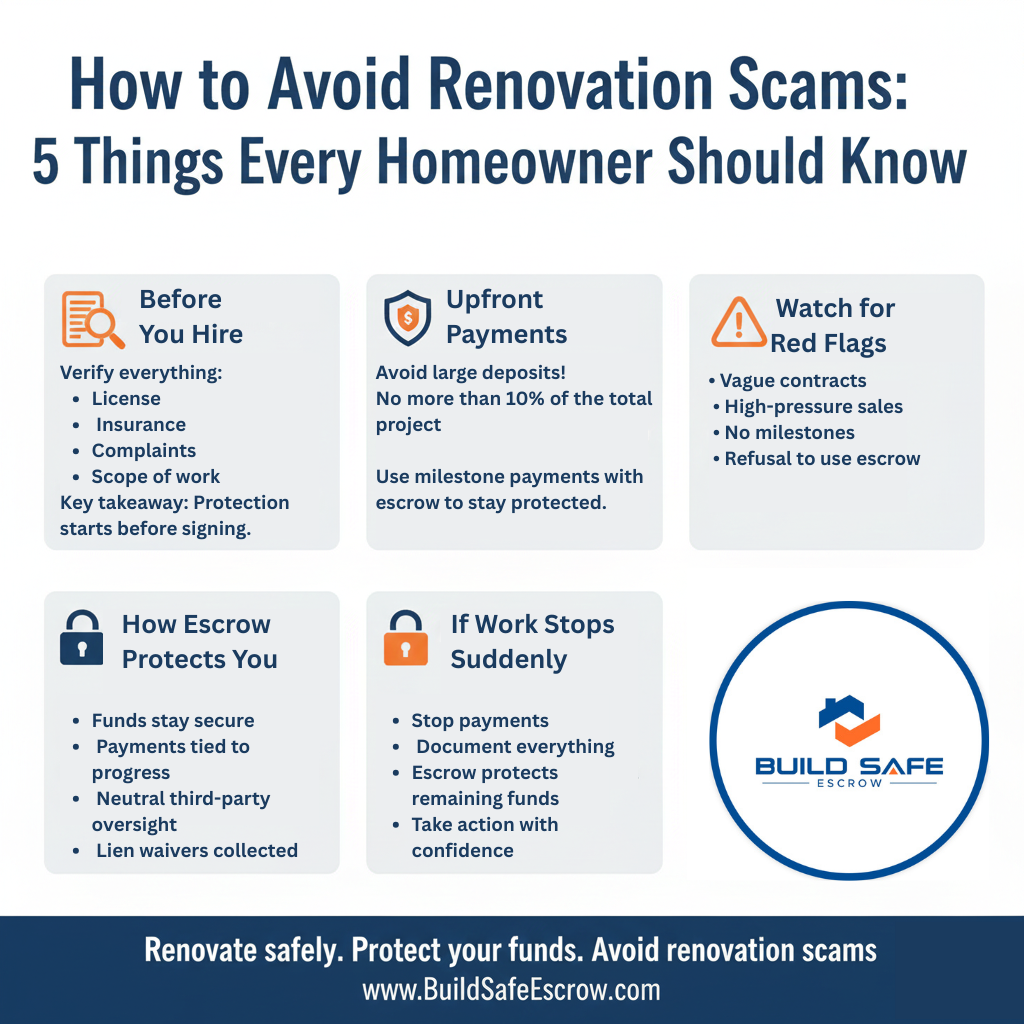
1. Large upfront deposits with no milestone schedule
If a contractor needs 30–50% upfront, it means the project is being financed by you—not by completed work.
This is the #1 driver of disputes.
2. A vague or incomplete scope of work
Without specifics, everything becomes debatable later:
“Was this included?”
“I thought you were painting the cabinets.”
“Flooring wasn’t part of this stage.”
Ambiguity breeds conflict.
3. No lien waiver process
This leaves homeowners vulnerable to surprise liens, even after paying.
4. Pressure to “pay today to get started”
Urgency is a classic scam tactic.
5. Contractor refuses a neutral third party
When a contractor doesn’t want funds secured until work is verified, it’s a red flag.
A reputable professional works comfortably with transparency and accountability.
Spotting these early helps homeowners avoid renovation scams before they start.
The New Rules for Safe Renovations in 2026
To protect your renovation, homeowners should follow these modern rules—designed to bring clarity, structure, and financial protection to every project.
Rule 1: Never send large upfront payments without financial protection
Old model: pay a deposit, hope for the best.
New model: funds are secured through an escrow account until each milestone is complete.
When payments are tied to verified work and held by a neutral party, homeowners gain leverage; contractors gain reliability; disputes disappear.
Rule 2: Tie every payment to clear, verifiable milestones
Milestone payments represent fairness; the contractor gets paid for progress; the homeowner pays only when work is confirmed.
No more paying $20,000 for demolition alone.
No more chasing a contractor who hasn’t delivered.
Milestones create measurable progress—and measurable accountability.
Rule 3: Use a neutral third party to hold renovation funds
This is where construction escrow changes everything.
Instead of paying the contractor directly:
- funds go into an FDIC-insured escrow account;
- the agent only releases payment once work for that milestone is done;
- both parties see transparent updates;
- lien waivers are collected;
- everyone stays aligned.
Escrow isn’t just a safeguard against home renovation scams; it’s a structure that keeps honest contractors honest and protects them from cash-flow disputes too.
Rule 4: Verify licensing, insurance, and permits before work begins
Many scams hide behind missing paperwork.
Before any work starts:
- verify the contractor’s license;
- confirm insurance coverage;
- ensure permits are pulled for all required work.
If a contractor avoids permitting conversations, it’s a warning sign.
Rule 5: Collect lien waivers at each payment
A homeowner can pay every invoice on time—and still face legal issues later from unpaid subcontractors or suppliers.
Lien waivers:
- protect your property from claims;
- confirm everyone involved has been paid properly;
- provide a clean trail for closing out your project.
Any modern renovation process must include lien waivers as part of milestone payments.
How Escrow Turns High-Risk Renovations Into Protected Projects
Construction escrow sits quietly in the background; yet it transforms the entire renovation experience.
Here’s what happens when homeowners secure their funds:
1. Funds stay protected until work is actually done
No milestone = no payment.
2. Contractors get paid faster and more consistently
They don’t have to chase money; work flows smoothly.
3. Both sides know exactly what happens at each stage
Clarity replaces confusion; timelines stay intact.
4. Disputes are reduced dramatically
Escrow creates accountability without tension.
5. Homeowners feel confident and in control
They no longer fear losing money or leverage.
This is how homeowners truly avoid renovation scams—by building a structure where scams can’t survive.
Real Story Snapshot: The Homeowner Who Did Everything Right
A couple in Florida hired a reputable contractor to add a second-story bedroom suite. The contract looked clean; pricing fair; the contractor had decades of experience.
But halfway through, the contractor suffered a serious accident.
He could no longer run his business.
The crew dispersed.
The project froze mid-construction.
The homeowners weren’t scammed intentionally—but the outcome was the same:
tens of thousands of dollars paid; no recourse; no funds left for another builder to finish.
Unexpected events derailed the project; the payment structure left them exposed.
Escrow isn’t just about protecting from bad actors; it protects against life’s unpredictability.
And that’s the part most homeowners never see coming.
A Simple Checklist to Avoid Renovation Scams in 2026
Use this before signing any agreement:
- Get a detailed, itemized scope of work
- Require clear milestones with defined progress points
- Secure all renovation funds in escrow
- Confirm contractor licensing and insurance
- Ensure permits will be pulled
- Require lien waivers with each payment
- Document every change in writing
- Never release funds early
- Avoid contractors who pressure you to pay quickly
- Research past complaints or lawsuits
Following this checklist will help homeowners avoid renovation scams and maintain control of both the project and budget.
Renovations Don’t Need to Be a Gamble
You don’t need to renovate with fear; you don’t need to hope everything turns out fine; and you certainly don’t need to gamble with your savings.
The tools exist today to create a transparent, safe renovation—from start to finish.
And escrow is the foundation of that safety.
When you secure your funds; define your milestones; and build accountability into the process; your contractor can focus on what they do best: delivering quality work.
If you’re ready to avoid renovation scams and protect your project with confidence, Build Safe Escrow is here to guide you every step of the way.
5 FAQs: How to Avoid Renovation Scams
How can I avoid renovation scams before I hire a contractor?
Start by verifying the contractor’s license, insurance, and history of complaints. Ask for a detailed, itemized scope of work, and insist on a milestone payment schedule. The most effective way to avoid renovation scams is to secure your funds in a neutral escrow account so you never pay for work that hasn’t been completed.
How much should I pay upfront to protect myself?
Short answer: Never more than 10% of the total project. Homeowners should avoid large upfront deposits. Instead of paying 30–50% at the start, use construction escrow so funds stay protected until each milestone is completed. This structure helps you avoid renovation scams by preventing early payments that leave you without leverage.
What are the most common signs of a renovation scam?
Red flags include:
requests for large deposits;
vague or incomplete contracts;
pressure to pay immediately;
refusal to use a third-party escrow;
no clear timeline or milestones.
Spotting these early is key to helping homeowners avoid renovation scams.
How does escrow help prevent home renovation scams?
Escrow places your renovation funds in an FDIC-insured account managed by a neutral third party. Payments are released only when verified work is completed. This eliminates the risk of paying for unfinished work and protects both homeowners and contractors from disputes.
What should I do if a contractor disappears or stops showing up?
Document everything: emails, texts, photos, invoices, and progress. Stop all payments immediately. If your funds were not protected through escrow, you may need to pursue legal action or file a complaint. If you used escrow, your remaining funds stay secure until the issue is resolved, which is one of the strongest ways to avoid renovation scams and prevent financial loss.
- Home Renovation Cost in 2026: What Owners Should Budget, State by State
 What a renovation really costs in 2026, why the same kitchen is priced differently in Texas and New York, and how owners keep every dollar tied to finished work.
 - Construction Escrow for Contractors: How It Works and How You Get Paid
 Escrow from the contractor’s seat: proof the money exists before you start, a milestone schedule you help write, and payment that arrives on verification instead of on a promise.
 - How Construction Escrow Works: A Simple Guide for Property Owners
 A plain walkthrough of how construction escrow works for homeowners funding a renovation or build: where the money sits, when it moves, and what happens if a contractor stops.
 - Construction Escrow for Property Managers: How It Works, Simplified
 A plain walkthrough of construction escrow for property managers: how funds are held, how milestones get verified, and how the whole thing becomes a report your owners can read.
 - Property Manager Vendor Payments: How to Pay Contractors Across a Portfolio Without Carrying the Risk
 A property manager’s guide to paying contractors and vendors across a portfolio without becoming the one who absorbs the risk: verified releases, lien protection, and a structure that keeps owner funds separate and accountable.