
There’s a quiet truth anyone who has ever renovated a home eventually faces; the moment you hand over that first payment, you’re stepping into a game with no referee. The rules are blurry, the timelines shift, surprises appear out of nowhere, and you’re expected to trust that everyone will play fair. Most of the time, people do. But when things go wrong in construction, they don’t go wrong a little; they go wrong in a way that tears through savings, destroys progress, and leaves families living in half-finished homes wondering what happened.
Ask any homeowner who’s lost money to a contractor who disappeared. Ask any contractor left holding the bag because a client refused to pay the final invoice. Ask any HOA stuck between bids, special assessments, and frustrated unit owners. Construction is one of the only major industries where tens or hundreds of thousands of dollars can move with almost no oversight.
Florida knows this problem well.
And with new policy discussions around tax reforms, increased building incentives, and a wave of development coming—this gap is about to get bigger.
This is where the “referee” comes in.

The Missing Position on the Field
Every major financial transaction has a neutral party overseeing the flow of money.
Real estate has title and escrow.
Law has trust accounts.
Insurance has adjusters.
Even sports have referees.
But construction?
Construction uses trust and hope.
A homeowner pays a deposit, and the money becomes immediately exposed. A contractor begins a project relying on future payments; if a homeowner delays or disputes them, the contractor is stranded mid-build.
Everyone is vulnerable because no one is protecting the money.
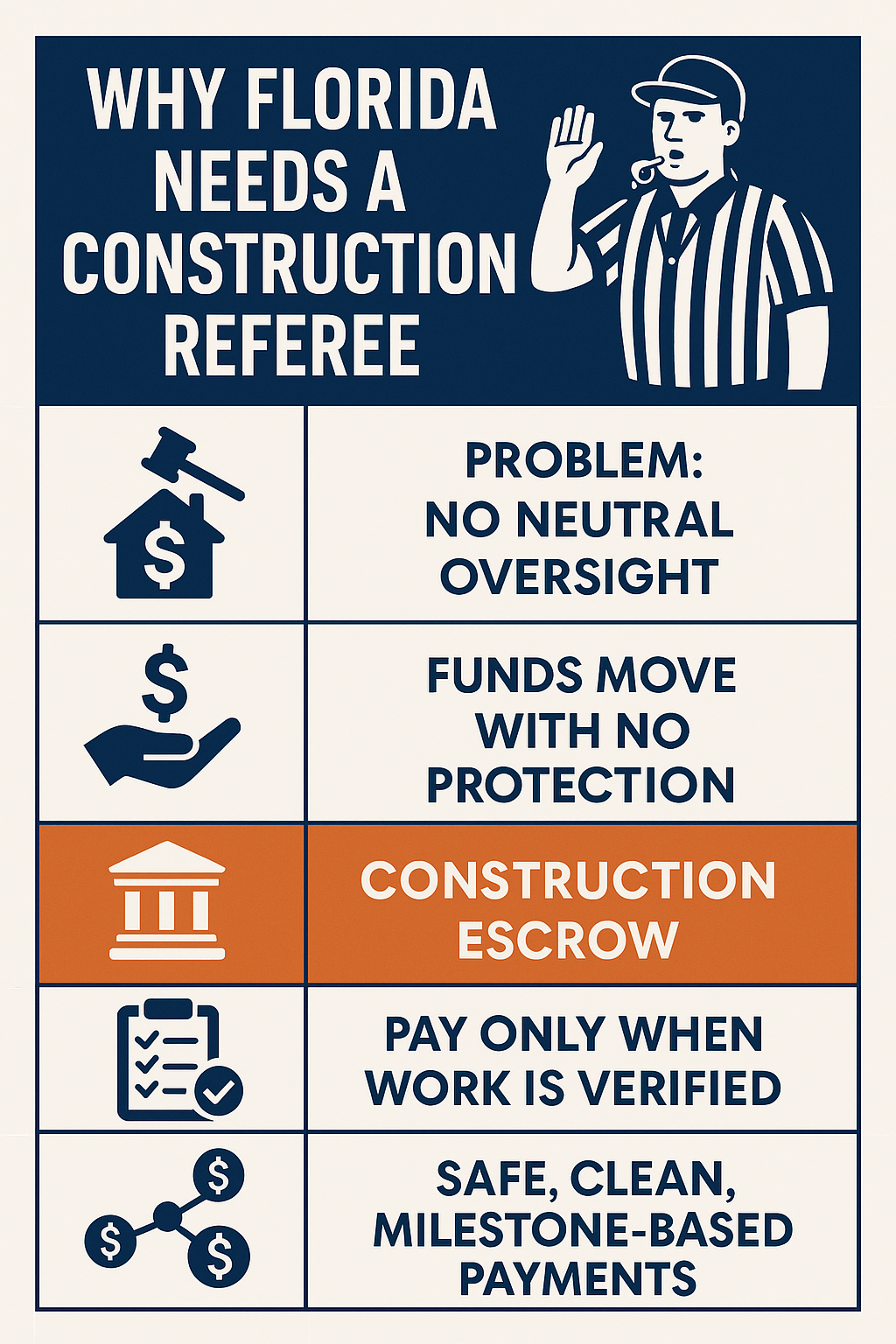
A construction escrow account solves this problem. It acts exactly like a referee: neutral, structured, disciplined, and designed to make sure every play is fair.
Why Florida Needs This Now
Florida is experiencing one of the biggest construction and renovation surges in the country. Population growth, coastal upgrades, new condo safety legislation, and a stronger demand for modernized housing are pushing homeowners and contractors into more projects than ever before.
Add to that the Governor’s recent push to eliminate property taxes; if that becomes reality, it will ignite a new wave of remodels, rebuilds, additions, and investment purchases.
More construction means more opportunity.
But it also means more risk.
Historically, fraud complaints spike during construction booms. When money is moving fast, bad actors move faster. Even good contractors can suddenly face financial strain; supply chain issues, health emergencies, economic shocks, and labor shortages can put a reputable company under in a matter of weeks.
The question is simple:
If Florida is planning for explosive growth, where is the protection for the people funding it?
Escrow is the missing piece.
A Construction Referee Makes the Game Fair
Here’s what an escrow referee changes:
1. Transparency replaces guesswork
Milestones are set upfront. Everyone signs. Everyone knows when money is released and why.
2. Homeowners stay protected from fraud and abandonment
Funds are held safely and released only when work is verified.
3. Good contractors get paid faster and with less friction
Proper milestone verification means payment delays disappear.
4. Disputes decrease dramatically
When expectations are documented and managed by a neutral third party, there’s less room for confusion.
5. HOAs and condo associations gain accountability
Large special-assessment projects stop turning into financial nightmares.
This isn’t just a tool; it’s a system. A referee. A protector of everyone on the field.
What Happens When There Is No Referee
Florida has seen this story too many times:
A homeowner signs a contract, pays a large deposit, and the contractor disappears or gets overwhelmed by too many projects. Thousands of dollars vanish. Permits are left open. Homes sit unfinished. Families live in chaos.
On the contractor side, the story is just as painful.
Clients stop paying at the 80% mark; excuses roll in; projects stall; small businesses collapse.
Without oversight, without neutral protection, the construction field becomes a place where both sides lose.
Florida Can Lead the Nation—If We Modernize the Rules
Construction escrow isn’t new; it’s just new to construction.
It’s the same mechanism that keeps real estate transactions clean, fair, and safe.
If Florida wants to modernize its housing policies, improve consumer protection, encourage ethical contractors, and reduce fraud—it must adopt escrow as a standard practice.
Not as an option.
Not as an upgrade.
As a requirement for major projects, the same way real estate requires title and escrow.
A state that protects its homeowners and its contractors is a state that builds a stronger economy.
The Future: A Safer, Smarter Florida Construction Landscape
Imagine this:
Every renovation, every remodel, every condo repair, every new build starts the same way—by securing funds in a neutral, FDIC-insured account. Milestones are verified. Payments are fair. Contractors are rewarded for excellent work. Homeowners are protected from the unexpected.
No more chaos.
No more blown budgets.
No more abandoned projects.
No more finger-pointing.
Just clear steps, clean money movement, and a referee ensuring the game is fair for everyone.
Final Thoughts: It’s Time to Update the Rulebook
Florida is evolving. The laws are evolving. The economy is evolving.
But the way construction money moves?
It’s stuck in the past.
To build the future safely, Florida needs a construction referee.
And escrow is that referee.
Ready to protect your renovation or construction project? Call us today 855-611-3532 or send us an email info@BuildSafeEscrow.com
FAQ: Construction Escrow as Florida’s New Standard
What exactly is construction escrow?
Construction escrow is a neutral, secure account where renovation or construction funds are held and released only when each milestone is verified as completed. It protects both homeowners and contractors by preventing premature payments, fraud, and payment disputes.
Why does Florida need construction escrow right now?
Florida is entering a massive construction and renovation boom; tax reform discussions, new condo safety requirements, and increased development are moving money faster than ever. Without neutral oversight, fraud and abandoned projects spike. Escrow acts as a safeguard to keep these transactions clean and fair.
How does escrow help homeowners?
It keeps their renovation funds protected until work is actually completed. Homeowners no longer risk losing deposits, getting abandoned mid-project, or paying for work that wasn’t done. Escrow adds transparency and accountability to every step.
How does escrow benefit contractors?
Contractors receive payments faster and with fewer delays because milestones are pre-approved and tied to a clear, structured schedule. Escrow also helps them win more jobs by offering clients peace of mind and eliminating late or withheld payments.
Is construction escrow required by law in Florida?
Not yet. That’s exactly why this conversation matters. As Florida modernizes its housing and development policies, construction escrow is the missing protection that should be adopted as a standard—just like title and escrow in real estate.
Does using escrow slow down a project?
No. Escrow actually speeds up progress. With clear milestones, transparent expectations, and verified disbursements, projects move forward with fewer disputes and less downtime caused by payment issues or misunderstandings.
Who oversees the escrow account?
A neutral third-party escrow agent—like Build Safe Escrow—manages the account, verifies milestones, collects lien waivers, handles disbursements, and ensures everyone follows the agreed-upon structure.
What types of projects should use construction escrow?
Any renovation or construction project involving multiple payments: home remodels, additions, new builds, condo/HOA projects, commercial upgrades, and repairs connected to special assessments.
How are milestones decided?
Milestones are agreed upon by all parties at the beginning of the project. They can be based on phases of work, inspections, materials delivered, or any measurable progress point. Escrow ensures payments only follow proof of completion.
Can escrow prevent disputes?
Yes—dramatically. By creating a neutral system for payments, setting clear expectations, and ensuring documentation for each step, escrow resolves most issues before they ever become disputes.
Keep Learning: Explore Our Construction Escrow Blogs
- Home Renovation Cost in 2026: What Owners Should Budget, State by State
 What a renovation really costs in 2026, why the same kitchen is priced differently in Texas and New York, and how owners keep every dollar tied to finished work.
 - Construction Escrow for Contractors: How It Works and How You Get Paid
 Escrow from the contractor’s seat: proof the money exists before you start, a milestone schedule you help write, and payment that arrives on verification instead of on a promise.
 - How Construction Escrow Works: A Simple Guide for Property Owners
 A plain walkthrough of how construction escrow works for homeowners funding a renovation or build: where the money sits, when it moves, and what happens if a contractor stops.
 - Construction Escrow for Property Managers: How It Works, Simplified
 A plain walkthrough of construction escrow for property managers: how funds are held, how milestones get verified, and how the whole thing becomes a report your owners can read.
 - Property Manager Vendor Payments: How to Pay Contractors Across a Portfolio Without Carrying the Risk
 A property manager’s guide to paying contractors and vendors across a portfolio without becoming the one who absorbs the risk: verified releases, lien protection, and a structure that keeps owner funds separate and accountable.
 - Tenant Improvement Allowance Escrow: Who Holds the Money, and When It Releases
 A commercial tenant’s guide to the TI allowance: why the money usually arrives last, what that does to your build-out, and how escrow puts the landlord’s contribution and your contractor’s draws on the same verified schedule.
 - Before Signing a Construction Contract: 9 Checks Every Homeowner Should Make
 A homeowner’s checklist for the hour before you sign: the nine things to verify in a construction contract, and the one clause that decides whether your deposit is ever at risk.