
When Doing Everything “Right” Still Goes Wrong
Imagine this: You’ve saved for years to remodel your home. You research carefully, read reviews, check licenses, even walk through past projects your contractor has completed. By all accounts, you’ve nailed every step of your renovation due diligence checklist.
The work begins with excitement. Then, halfway through, life throws a curveball. Your contractor has a medical emergency. Or maybe the contractor’s long-time supplier shuts down, causing major financial strain. Or perhaps the property owner themselves faces a sudden crisis—like needing funds elsewhere—and the project grinds to a halt.
You didn’t skip a single step of due diligence, but you’re still stuck with unfinished work and vulnerable funds.
That’s the uncomfortable truth: even when you follow a renovation due diligence checklist perfectly, it doesn’t guarantee your project will reach the finish line. That’s why construction escrow is the “seatbelt” every homeowner needs.
1. Why Renovation Due Diligence Matters
Renovations are high-stakes. They involve not just money, but time, safety, and emotion. Hiring the wrong contractor can lead to:
- Cost overruns that drain your budget.
- Unfinished work that leaves your home in chaos.
- Legal disputes that drag out for months or years.
That’s why a renovation due diligence checklist is essential. It’s your first layer of defense—your way of making sure the contractor you hire is qualified, trustworthy, and financially stable.
But here’s the catch: diligence only helps you choose the right contractor at the start. It doesn’t protect your money once the project is underway.
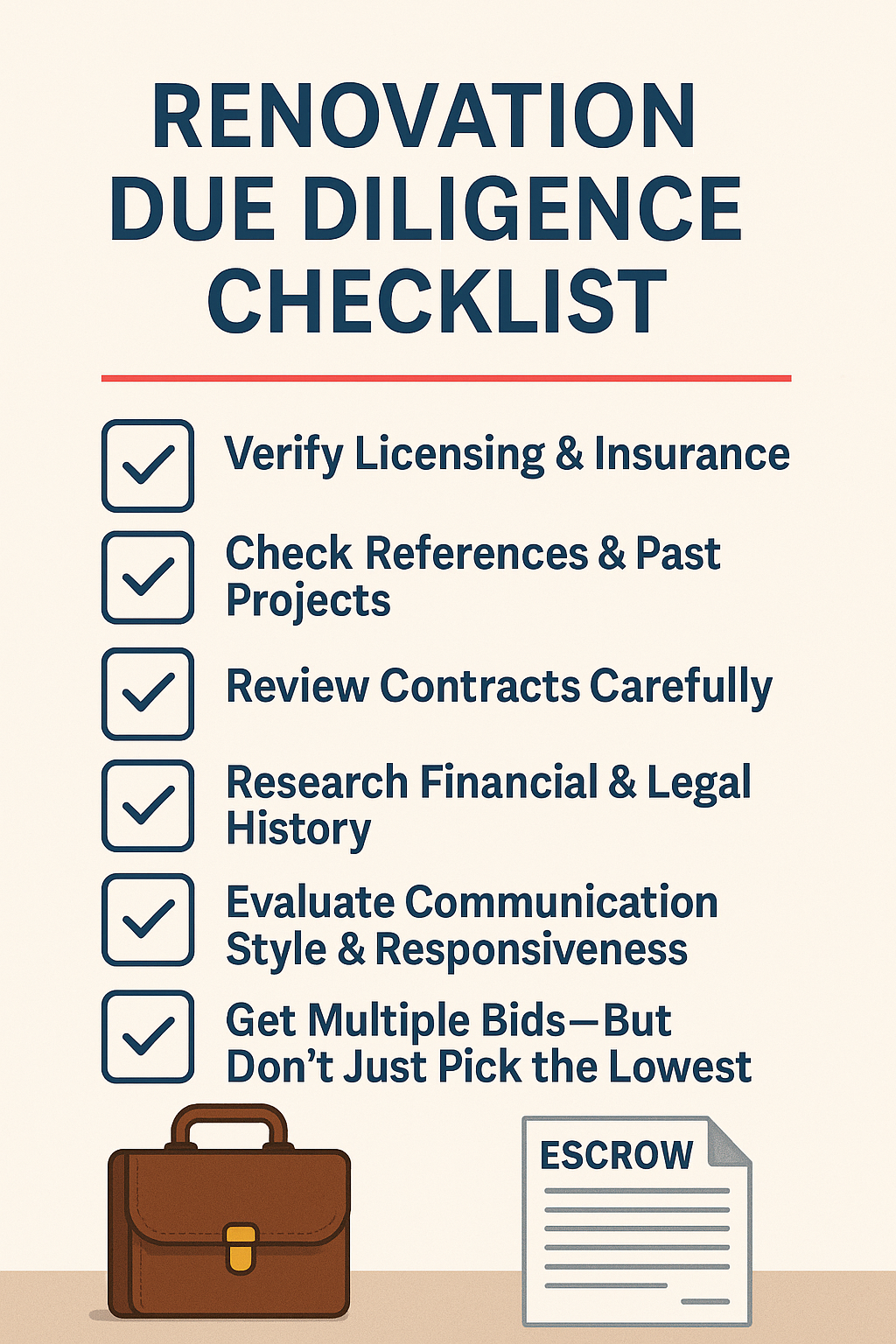
2. The Homeowner’s Renovation Due Diligence Checklist
Before you sign a contract or hand over a deposit, run through this renovation due diligence checklist step by step:
✅ Verify Licensing & Insurance
Confirm your contractor holds an active state license. Ask for proof of general liability and workers’ compensation insurance. If they hesitate, walk away.
✅ Check References & Past Projects
Call at least three former clients. Ask:
- Did the contractor finish on time and on budget?
- Were there any disputes, and how were they resolved?
- Would they hire the contractor again?
✅ Review Contracts Carefully
Look for detailed scope of work, timeline, and payment terms. Avoid vague agreements or “handshake deals.” Read What to Look for in Construction Contracts (and What to Ask Before You Sign)
✅ Research Financial & Legal History
Search for liens, lawsuits, or bankruptcies tied to the contractor’s business. Public records often reveal red flags hidden behind polished websites.
✅ Evaluate Communication Style
Contractors who dodge questions before the project will likely dodge accountability later. Consistent, clear communication is non-negotiable.
✅ Get Multiple Bids
Compare at least three estimates. Be wary of bids far lower than the others—cheap can quickly become costly.
Pro Tip: Always demand written agreements. Verbal promises don’t hold up when disputes arise.
This checklist is powerful—but still not bulletproof.
3. The Hidden Risks That Due Diligence Can’t Cover
Even after carefully following a renovation due diligence checklist, some risks remain outside your control:
- Contractor emergencies: illness, injury, family loss.
- Business instability: supplier shutdowns, cash flow issues, sudden bankruptcy.
- Property owner crises: needing funds elsewhere, divorce, job loss.
- Industry volatility: material shortages, price spikes, or economic downturns.
The truth is, due diligence helps you avoid bad contractors, but it can’t protect you from bad luck.
That’s where escrow comes in.
4. Why You Shouldn’t Pay More Than 10% Down
One of the most overlooked parts of the renovation due diligence checklist is payment structure. Too many homeowners hand over 30%, 40%, even 50% upfront—essentially giving away leverage before work even starts.
Here’s what you need to know:
- Reputable contractors don’t need huge deposits. They operate with credit lines and working capital.
- Standard practice is a small deposit (no more than 10%) to secure scheduling, followed by milestone-based payments.
- Large deposits put you at risk if the contractor delays, disappears, or faces financial trouble.
Paying a modest deposit—and securing the rest in escrow—ensures your money only moves as progress is verified.
5. Escrow: The Safety Net You Didn’t Know You Needed
Even the most detailed renovation due diligence checklist leaves one question unanswered: How do you actually protect your money once construction begins?
The answer is construction escrow.
Here’s how it works:
- Your funds are deposited into a neutral, FDIC-insured escrow account.
- Payments are only released when milestones are completed and verified.
- Both you and your contractor can see the payment schedule, ensuring full transparency.
Benefits for Homeowners
- Protection from fraud or unfinished work.
- Peace of mind knowing funds are secure.
- Leverage to ensure milestones are met.
Benefits for Contractors
- Proof that funds are available.
- Faster trust-building with clients.
- Reduced disputes over payment.
Escrow doesn’t just protect your money—it protects the relationship between owner and contractor.
6. Putting It All Together
Think of your renovation as a road trip. Your renovation due diligence checklist is the map—it shows you the best route and helps you avoid wrong turns. But the map can’t prevent accidents. That’s why you wear a seatbelt.
Escrow is that seatbelt. It doesn’t matter how skilled your contractor is or how careful you are—accidents can happen. With escrow, your funds stay safe, your project stays on track, and your investment is protected.
Due Diligence + Escrow = Real Protection
Doing due diligence is smart. It’s essential. It’s non-negotiable. But don’t stop there. The most responsible homeowners go beyond research and references. They secure their funds with escrow.
So as you prepare for your next remodel, remember:
- Follow the renovation due diligence checklist to hire wisely.
- Don’t pay more than 10% down.
- Protect the rest with escrow—your financial safety net.
Because when it comes to your dream home, trust is important—but protection is priceless.
👉 Ready to protect your renovation funds?
Contact Build Safe Escrow for a free consultation. Learn how Build Safe Escrow helps homeowners protect their money and finish projects with confidence.
📞 Call us at (855) 611-3532
🌐 Visit www.buildsafeescrow.com
Ready to Go Deeper? Grab Our Free Guides:
🏡 For Property Owners:
Renovate Smarter: How to Protect Your Project Funds
Discover how to avoid common renovation pitfalls, protect your money, and choose the right contractor with confidence.
📥 Download the free guide
👷 For Contractors:
Win More Jobs with Escrow: A Contractor’s Guide to Securing Projects and Payments
Learn how offering escrow-backed bids can help you stand out, get paid faster, and build a reputation for professionalism.
📥 Download the contractor guide
➕ More Resources from Build Safe Escrow:
🚧 How to Protect Your Construction Funds, Even with a Great Contractor
📄 The One Agreement That Can Save Your Renovation—and You Don’t Need a Lawyer to Use It
🛑 Construction Disputes Are Costly—Here’s How Escrow Solves Them
📄 What to Look for in Construction Contracts (and What to Ask Before You Sign)
Renovation Due Diligence Checklist – FAQs
What is a renovation due diligence checklist, and why do I need one?
A renovation due diligence checklist is a set of steps you take before hiring a contractor to ensure they are qualified, trustworthy, and financially stable. It’s your first line of defense against common risks like budget overruns, unfinished work, and legal disputes. Following the checklist helps you make an informed decision and avoid hiring the wrong person for the job.
What are the key steps in the due diligence checklist?
Some of the most crucial steps include:
Verifying licenses and insurance to ensure the contractor is legitimate.
Checking references and past projects to assess their track record.
Carefully reviewing contracts to avoid vague terms.
Researching their financial history for any red flags like liens or bankruptcies.
Getting multiple bids to compare costs and approaches.
If I follow the checklist, am I fully protected?
While a due diligence checklist is essential, it’s not a complete safety net. It helps you choose a good contractor at the start, but it can’t protect you from unexpected events once the project is underway. Things like a contractor’s medical emergency, business instability, or even an economic downturn can still put your project and your funds at risk.
Why should I avoid paying a large upfront deposit?
Paying a large deposit, such as 30% or more, gives away your leverage before the work has even begun. Reputable contractors typically don’t need huge deposits, as they operate with working capital. A small deposit (no more than 10%) is standard practice. Handing over a large sum puts you in a vulnerable position if the contractor delays, disappears, or faces financial problems.
How does construction escrow provide extra protection?
Construction escrow acts as a secure, neutral third party that holds your renovation funds. Your money is placed in an FDIC-insured account, and payments are only released to the contractor when pre-agreed-upon milestones are completed and verified. This protects you from fraud and unfinished work, while also providing your contractor with the assurance that funds are available for their work. It’s the financial safety net that covers the risks your due diligence checklist can’t.