Introduction: A Renovation That Suddenly Stopped
Most homeowners who begin a renovation imagine delays, dust, and maybe the occasional surprise expense. What they rarely imagine is a renovation disaster caused by something no one could predict.
This true story began like many others.
A family hired a contractor with an excellent reputation. The company had been operating for more than 50 years, a respected family-owned construction business known throughout the community. The homeowners felt confident they had chosen the right team.
Contracts were signed.
A deposit was paid.
Work began.
For the first few weeks, the renovation moved forward normally. Demolition was completed. Materials were ordered. Subcontractors began their work.
Then, suddenly, everything stopped.
The general contractor — the person running the entire project — unexpectedly passed away.
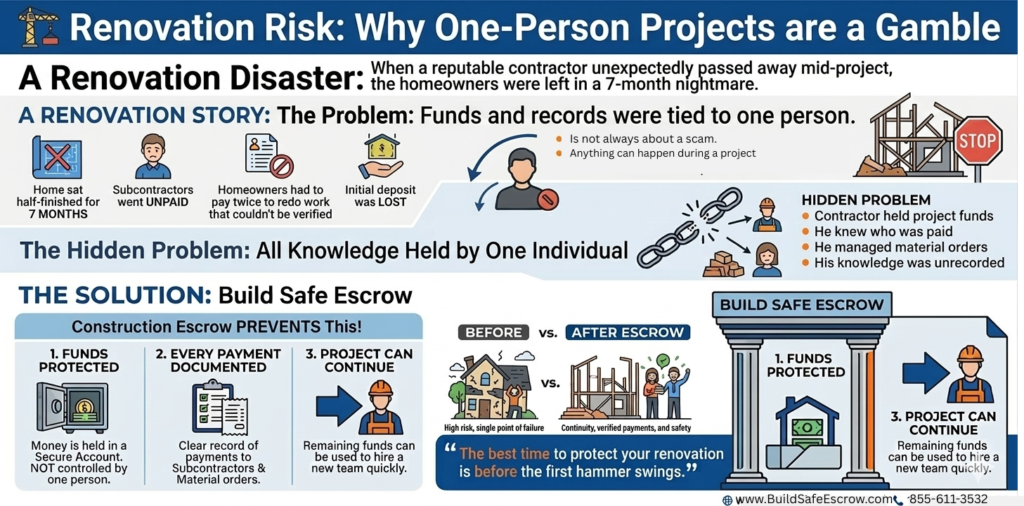
What followed became a renovation disaster that left the homeowners stuck for seven months.
When the Person Running Everything Is Gone
In many construction projects, the general contractor is not only responsible for managing the work but also for managing the flow of money.
In this case, the contractor was responsible for:
- Holding the project deposit
- Paying subcontractors
- Purchasing materials
- Coordinating inspections
- Managing the construction timeline
When he passed away, the structure of the entire project collapsed.
His family inherited the business but had not been involved in the daily operations. They were suddenly responsible for a company with multiple ongoing projects — yet they had very little information about the details of each one.
The contractor had been the person who knew:
- Which subcontractors had been paid
- What materials had been ordered
- How much of the homeowner’s money remained
- What work had been completed
Without him, the project entered a state of total uncertainty.
What began as a renovation quickly turned into a renovation disaster.
The Renovation That Sat Still
The homeowners initially believed the company would reorganize and resume work.
They waited.
They called.
They sent emails.
But answers were slow and often unclear.
Subcontractors began contacting the homeowners asking about payment. Some had been partially paid. Others had not been paid at all.
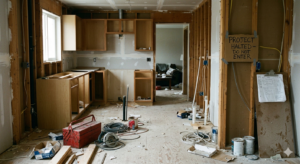
Meanwhile, the home sat in a half-finished state.
Walls had been opened.
Materials had been partially installed.
Construction debris remained throughout the house.
The project had no clear manager and no clear financial records.
Days turned into weeks.
Weeks turned into months.
For seven months, the renovation remained completely stalled.
What had once been an exciting home improvement project had turned into a stressful renovation disaster.
The Hard Decision to Walk Away
Eventually, the homeowners had to face a difficult reality.
The original contractor’s company could not restart the project.
The homeowners decided they had to move forward with a new construction team.
But when the new contractor inspected the property, they discovered another serious problem.
There was very little documentation showing what had actually been completed.
There were no clear records confirming:
- Which subcontractors had been paid
- Which materials had been installed correctly
- Which inspections had been completed
- Whether permits had been properly managed
Because of the uncertainty surrounding the previous work, the safest option was to redo large portions of the project.
This meant the homeowners had to:
- Pay for work that had already been done once
- Purchase new materials
- Hire a new contractor to rebuild parts of the renovation
The renovation had officially become a full renovation disaster.
The Hidden Problem Behind This Renovation Disaster
Many people assume renovation disasters happen because of fraud or dishonest contractors.
But that was not the case here.
The contractor had built a reputable business over decades. The company had served the community for generations.
The problem was something far more common.
Life happened.
Construction projects depend heavily on individuals. When one person controls the project schedule, the relationships with subcontractors, and the project funds, unexpected events can quickly bring everything to a halt.
This renovation disaster was not caused by bad intentions.
It was caused by the absence of a financial structure that could survive unexpected events.
How This Renovation Disaster Could Have Been Prevented
There is a tool that is becoming more common in modern construction projects: construction escrow.
Construction escrow separates the project funds from the contractor.
Instead of the contractor holding the money, the funds are placed in a neutral third-party escrow account and released only as agreed project milestones are completed.
If the homeowners in this story had used escrow, the renovation disaster could have been avoided.
How Escrow Protects Homeowners From a Renovation Disaster
1. The Project Funds Stay Protected
With escrow, the contractor does not control the entire project budget.
Funds remain in a secure account and are released gradually as work is completed.
If something unexpected happens, the remaining funds remain protected.
2. Every Payment Is Documented
Escrow creates a clear record of the project’s financial activity.
Homeowners can see exactly:
- What work has been completed
- What payments have been released
- What funds remain available
This transparency prevents confusion during unexpected situations.
3. The Project Can Continue
If a contractor can no longer continue the project, escrow allows homeowners to pause payments and hire a new contractor.
Instead of losing control of the funds, the homeowners can simply continue the project with a new team.
In situations like this one, escrow could turn a renovation disaster into a manageable transition.
Why Renovation Disasters Are Becoming More Common
Home renovation projects today often involve:
- Larger budgets
- Multiple subcontractors
- Long project timelines
- Complex permitting requirements
When large amounts of money move through a single contractor, the financial risk increases significantly.
Unexpected events such as illness, accidents, business closures, or economic instability can quickly turn a project into a renovation disaster.
This is why many homeowners are now looking for safer ways to structure construction payments.
Protecting Your Renovation Before It Starts
Renovations represent more than construction work. They represent personal dreams, financial investments, and months of planning.
But as this true story shows, even well-established companies can face unexpected events.
A renovation disaster does not always come from dishonesty.
Sometimes it simply comes from the unpredictability of life.
By placing renovation funds in escrow and releasing payments only as work progresses, homeowners can ensure their projects remain protected even when unexpected events occur.
Because the best time to protect your renovation is before the first hammer swings.
FAQ: Avoiding a Renovation Disaster
What is a renovation disaster in construction?
A renovation disaster occurs when a remodeling project becomes stalled, financially damaged, or structurally compromised due to poor planning, missing funds, contractor issues, or unexpected events.
How can homeowners prevent a renovation disaster?
Homeowners can reduce the risk of a renovation disaster by using construction escrow, milestone-based payments, written contracts, and proper documentation for every phase of the project.
What happens if a contractor cannot finish a renovation?
If a contractor cannot complete the work, homeowners may need to hire a new contractor. Without proper financial safeguards, this can increase costs significantly.
What is construction escrow?
Construction escrow is a system where project funds are held by a neutral third party and released only when agreed milestones are completed. Learn more at Build Safe Escrow.
Is escrow common in residential construction?
Escrow and milestone-based payment systems are becoming more common as homeowners seek stronger financial protection for renovation projects.
A renovation should improve your home, not become a renovation disaster.
Before starting your next project, make sure your renovation funds are protected with a structure designed to handle the unexpected.
Build Safe Escrow protects renovation funds and releases payments as real progress is made.
Learn how to safeguard your renovation before construction begins:
Visit:
https://buildsafeescrow.com
Or speak with our team to understand how escrow can protect your next project.
protect
your
renovation
money