Issue 12 · Weekly · Published August 7, 2026
The Money Is in the Wrong Account.
Three seats this week, one rule: money never moves ahead of the work. An HOA board holding $512,000 of its neighbors’ money. A drywall sub waiting on his last 10%. A homeowner staring at a 60% deposit demand. Different accounts — same question.
By Ana Barajas · 2 min read
A note from the desk
“Before any project goes wrong on paper, it goes wrong in a bank account — a deposit sitting in the contractor’s, retainage sitting in the owner’s, assessments sitting in operating. The failure is the address.”
The one question that sorts all three
Ask it of any construction payment and the risk shows itself: whose account is the money sitting in right now? A homeowner’s deposit sits in the contractor’s account before a shovel hits dirt — the owner is exposed. A sub’s retainage sits in the payer’s account months after the work passed inspection — the sub is financing the wait. An HOA’s special assessment sits in the association’s operating account — the board is one cash-flow gap away from a commingling problem.
Three different seats, and in every one of them the money is positioned wrong: ahead of the work, behind the work, or pooled where it can leak. This week’s three pieces walk each seat through its own version of the fix — deposit caps and milestone schedules for owners, step-down clauses and prompt-pay clocks for trades, segregation and lien waivers for boards.
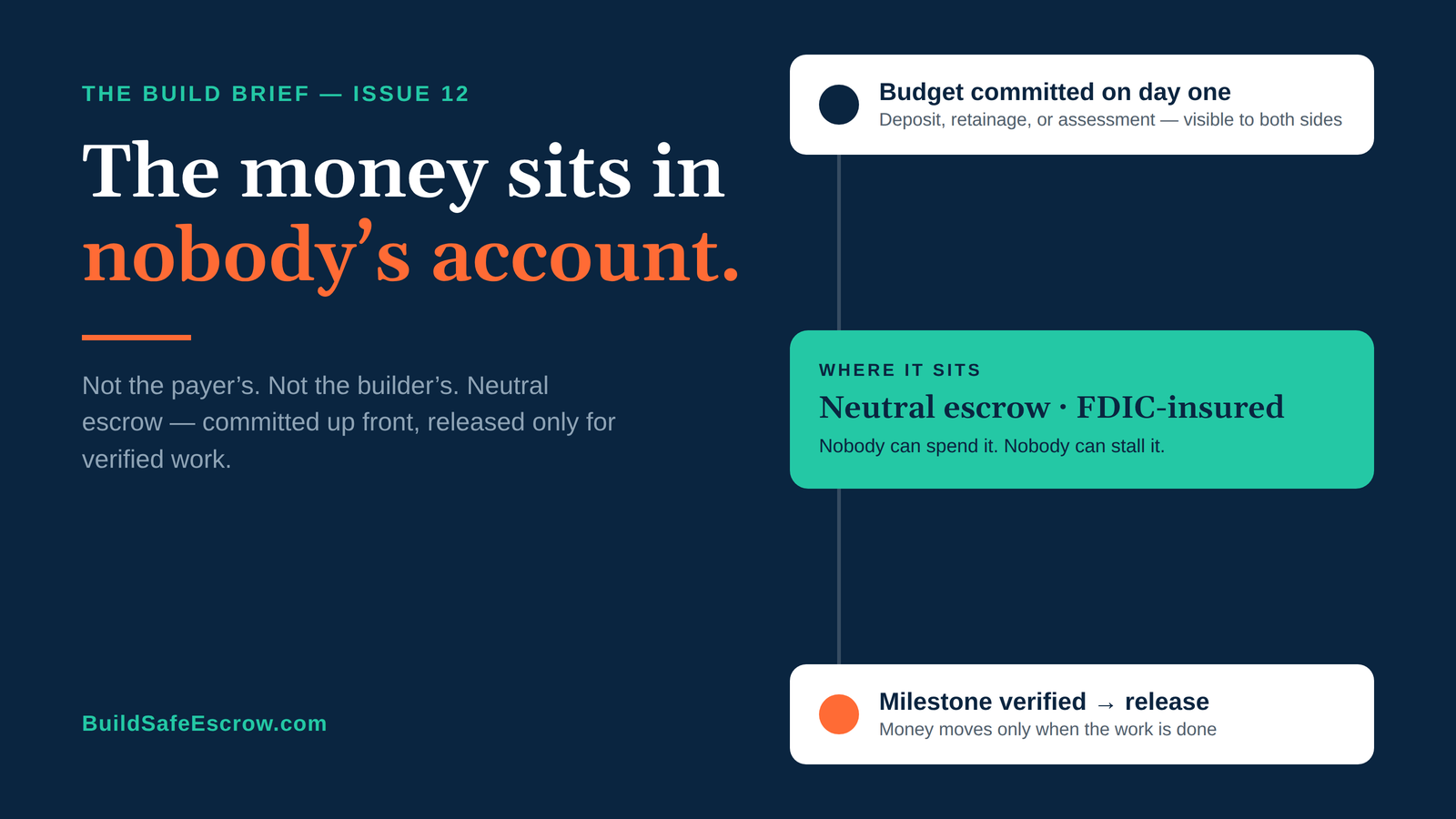
But the deep fix is identical everywhere: put the money in nobody’s account. A neutral, FDIC-insured escrow account holds the full budget where both sides can see it, and releases it only as each milestone is completed and verified. The address stops being the risk.
The Core Idea
Whose account is the money in? If the answer is “the party with an incentive to hold it,” the structure is wrong. Neutral holding, verified milestones, defined releases — money never moves ahead of the work, and it never lags behind it either.
$31.1 billion
What U.S. community associations set aside in 2025 alone for long-term infrastructure and capital repairs — out of $124.2 billion in total assessments (Foundation for Community Association Research, 2025 Statistical Review). That’s the pool special assessment projects spend, and every dollar of it has to sit somewhere between collection day and verified work. This week’s HOA piece is about making sure “somewhere” is a neutral account.
Two sides of the same structure
For those getting paid
Retainage is the money you already earned that you’re not allowed to have yet — and on a 9% margin, a 10% hold means the job is done and you haven’t earned a dollar. This week’s trades piece, Retainage in Construction, covers the step-down clause owners actually say yes to, the state caps and prompt-pay clocks that turn a favor into a citation, and the escrowed-retainage structure that releases your last 10% on your scope’s verified acceptance — not the landscaper’s.
For those writing the checks
Two very different check-writers this week, same exposure. Homeowners: Contractor Asking for Money Upfront? gives you the number that’s normal (10–20%, capped by law in some states), the demands that mean walk, and three scripts to restructure a deposit without losing a good contractor. Boards: HOA Special Assessment Projects is our first piece written for the seat holding the neighbors’ money — segregation on day one, milestones with verification, lien waivers with every release, and the one-page answer for the annual meeting.
From the field: the roof paid for in five verified stages
Alvin is the treasurer of a 64-unit condo association that passed a $512,000 special assessment for a full roof replacement. The winning contractor’s standard terms: 35% at signing. The board’s counter: the full budget in a neutral escrow account, visible to the contractor, released in five verified stages — mobilization, tear-off, dry-in, shingle completion by building, final inspection with lien waivers.
The contractor’s project manager admitted it was the first job in years he hadn’t opened wondering whether the association could actually pay. And when two owners questioned the spending at the annual meeting, Alvin’s answer was a one-page release log from the escrow account. The meeting moved on in four minutes.
Three things worth knowing
- A deposit is a signal. 10–20% with a milestone schedule is normal; 50%+ in cash or Zelle is not a negotiation — it’s a warning. (Money upfront)
- Retainage is negotiable. It’s a contract term, not a law of nature — ask for the step-down, track it as a receivable, and never sign an unconditional waiver for money you haven’t received. (Retainage)
- Boards answer with a log. Segregate the assessment, verify every milestone, collect waivers with every release — and the annual meeting takes four minutes. (HOA assessments)
Put the money in nobody’s account.
Whether you’re a board protecting an assessment, an owner structuring a deposit, or a trade tired of financing the wait, Build Safe Escrow holds the funds in a neutral, FDIC-insured account and releases them only for completed, verified work — nationwide. Contractors and trades: join the free Trusted Contractor Network and get paid on milestones, not maybes.