
Few trades feel the cash-flow squeeze of a large job as sharply as HVAC contractors. By the time a big install is underway, an HVAC contractor has often already spent tens of thousands of dollars — rooftop units, air handlers, ductwork, controls, refrigerant, lift rental, crew time — long before a single payment arrives. On commercial buildouts and multi-unit projects, that gap between cash out and cash in is exactly where profit quietly disappears.
The problem isn’t the work — it’s the timing of the money
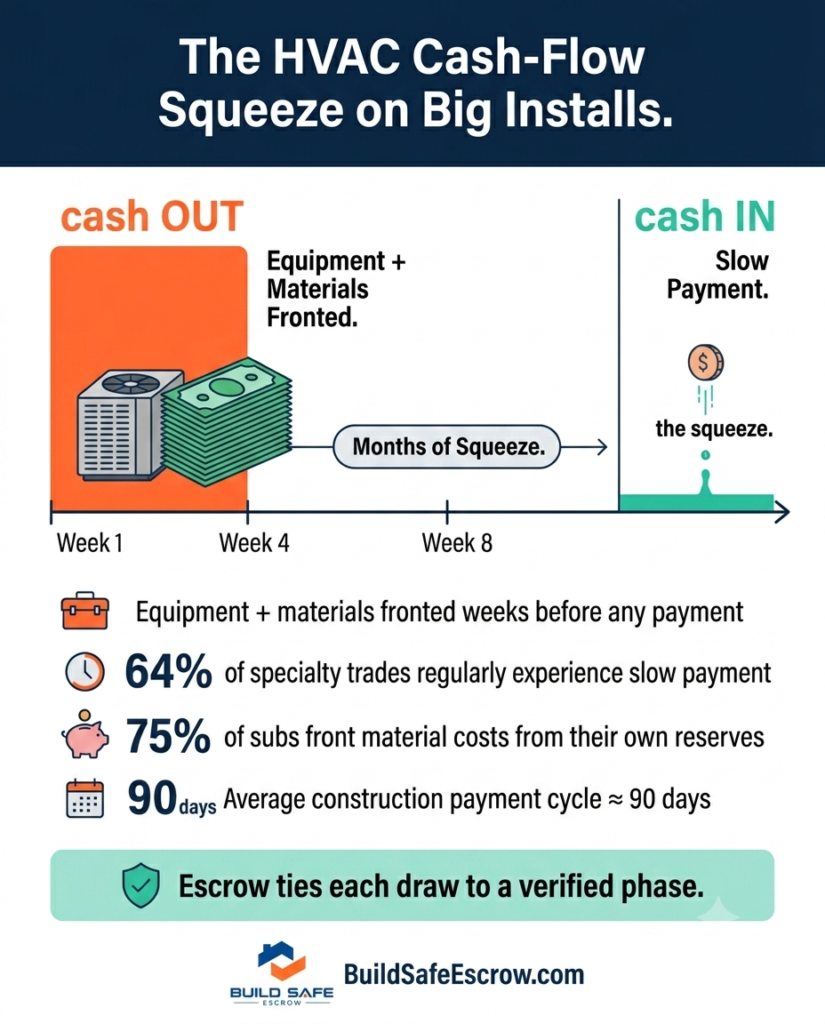
HVAC contractors sit at the high-equipment-cost end of the trades. Unlike a job that is mostly labor, a large install requires you to purchase and stage expensive equipment up front. You front that cost, then wait. And the waiting is not a rare misfortune — it is the industry norm. The Billd 2025 National Subcontractor Market Report found that 64% of specialty-trade contractors regularly experience slow payment, and that 75% front material costs out of their own cash reserves while they wait. Rabbet’s 2024 data put the average construction payment cycle at roughly 90 days — double the 45-day threshold analysts consider healthy.
Run that math on a single large HVAC project. You buy the equipment in week one. You install through weeks two and three. You invoice. Then you wait 60, 90, sometimes more days while your capital sits frozen in someone else’s building. Meanwhile you have payroll, your next equipment order, and your own suppliers to pay. That is how a profitable job on paper becomes a cash-flow emergency in practice — and why so many capable shops cap the size of jobs they will take.
The hidden costs of fronting big installs
- Financing drag: Every week your money is tied up, you are effectively lending it interest-free — or paying real interest on a line of credit to cover the gap.
- Lost opportunity: Capital locked in one slow-paying job is capital you cannot deploy on the next one. Cash-flow risk is a top reason trades turn down otherwise good work.
- Dispute exposure: When final payment is the only thing standing between you and the money you already spent, a single disagreement over a punch-list item can hold your entire margin hostage.
- Equipment risk: Materials staged on site that you have paid for but not been paid for are your exposure until that draw clears.
How construction escrow closes the gap
Construction escrow restructures when and how you get paid so your money is never left exposed. Before the job starts, the project funds are deposited into a secure, neutral third-party account. You can confirm the money is there before you order a single unit. Then payments are released to you in draws tied to verified phases of the work — not to a client’s mood, a developer’s disbursement cycle, or a 90-day accounting queue.
For a large HVAC install, that might look like a draw when equipment is delivered and staged, another when rough-in and duct runs pass inspection, and a final draw when the system is commissioned and verified. Each draw is released promptly once that phase is confirmed. You are no longer floating the whole job on your own balance sheet and praying the final check clears.
Why this lets you take bigger jobs with confidence
The reason most HVAC shops stay small is not capability — it is capital. The bigger the install, the bigger the up-front equipment outlay and the longer the wait. Escrow removes that constraint. When the funds for every phase are secured before you begin and released as you complete each stage, you can quote larger commercial and multi-unit projects without betting the company’s cash reserves on getting paid eventually. You protect your margin, keep your crew paid, and stop letting the calendar decide whether a job was worth taking.
On a trade where the equipment bill lands before the first payment, controlling the timing of the money is controlling the business. Escrow gives you that control.
Frequently Asked Questions
Why do HVAC contractors lose money on large installs?
Because the equipment and materials for a big install are expensive and must be purchased up front, while payment often arrives weeks or months later. That long gap between cash out and cash in ties up capital, drives financing costs, and exposes your margin to disputes over the final payment.
How long do contractors typically wait to get paid?
Rabbet’s 2024 data put the average construction payment cycle at roughly 90 days, and found 82% of contractors wait more than 30 days. Billd’s 2025 survey found 64% of specialty trades regularly experience slow payment, with 75% fronting material costs from their own reserves.
How does escrow help with equipment-heavy jobs?
Project funds are secured in a neutral account before work begins, so you can confirm the money is there before ordering equipment. Draws are then released as each phase is verified — for example, equipment staged, rough-in passed, system commissioned — so your capital isn’t frozen waiting on a single end-of-job payment.
Can escrow draws be structured around HVAC phases?
Yes. The milestone schedule is set to match the project. For an HVAC install that commonly means a draw at equipment delivery and staging, one at rough-in and inspection, and a final draw at commissioning — each released once the phase is completed and verified.
Does escrow let me take on larger projects?
It removes the main constraint, which is capital exposure. When funds for each phase are secured in advance and released as you complete the work, you can quote larger commercial and multi-unit installs without risking your cash reserves on getting paid eventually.