

Table of Contents
- When a subcontractor missed deadlines, the whole job feels it
- Why subcontractors fall behind (it is rarely just one thing)
- A subcontractor missed several key deadlines. What is this an example of?
- What to do when a subcontractor missed deadlines: the order matters
- Prevent the next delay with a milestone-based subcontract schedule
- Field example: one late framing crew, two different outcomes
- How escrow keeps money tied to verified work for both sides
- FAQ: subcontractor missed deadlines
- References
Your subcontractor missed deadlines again, and the owner is calling you about it. If you are a builder or general contractor who hires and pays subs, you know this squeeze well. The drywall crew was due Monday. It is Thursday, the tapers are idle, and the owner wants to know why the next draw should go out.
You sit in the middle. You pay the sub, and you get paid by the owner. When one trade slips, both conversations get harder at once.
The good news: this is one of the most common problems in construction, and most of it is preventable. The fix is a clear process and a payment structure that rewards finished work.
When a subcontractor missed deadlines, the whole job feels it
One late trade rarely stays one late trade. Framing slips, so inspections slip. Inspections slip, so drywall slips. Then the finish trades you booked weeks ago move on to other jobs.
Each day costs you. You carry general conditions, which are the site costs that run whether work happens or not: supervision, temporary power, equipment rental, insurance. You may also face liquidated damages in your prime contract. Those are a fixed daily amount, agreed in advance, that you owe the owner if the project finishes late. The AIA describes them as a rate “intended to be a reasonable estimate” of the harm a delay causes.
So when a subcontractor missed deadlines on your job, the cost lands on you first. Your instinct is to hold the next check. Sometimes that is allowed. Sometimes it backfires.
Why subcontractors fall behind (it is rarely just one thing)
Before you act, find the cause. When a subcontractor missed deadlines, the reason shapes the response. The right response to an overbooked crew is different from the right response to a missing change order.
- Overbooked crews. The sub took three jobs that peaked the same week. Your job lost the coin toss.
- Upstream delays. The trade before them finished late, or the area was not ready. The sub showed up to a site they could not work.
- Late payment upstream. If the owner pays you late, and you pay the sub late, the sub may not make payroll or buy material. A starved sub slows down. Many subcontracts include a pay-when-paid clause, which ties the sub’s payment to yours. Our guide on how pay-when-paid clauses delay every check walks through that chain.
- Unclear scope. Nobody wrote down who sets the blocking or who hauls the debris. The work stalls while people argue.
- Material delays. Long lead items, supplier backorders, or a rejected submittal.
- Missing change orders. The owner added work and the sub was told to proceed. But nobody signed a change order (the written agreement that changes scope, price, or time). The sub is waiting to get paid for the extra before committing more crew.
Notice how many of these start outside the sub’s control. Missed dates still count. But you need the cause on paper before you send a notice.
A subcontractor missed several key deadlines. What is this an example of?
It is generally an example of a schedule (time-of-performance) breach of the subcontract, which may or may not be material depending on the contract terms, such as time-is-of-the-essence language and notice and cure provisions, and on the actual impact; confirm the specifics with an attorney.
A breach is a failure to do what the contract requires. Missing agreed dates is a breach of the schedule terms. Whether it is material, meaning serious enough to justify bigger remedies like termination, depends on several things:
- Time is of the essence. This phrase in a contract means deadlines are a core part of the deal, not a target. When it is present, a missed date carries more weight.
- Notice and cure provisions. Most subcontracts require you to give written notice of the problem and a set window to fix it before you take major action.
- Impact. Did the delay push the critical path, trigger liquidated damages, or cost you money you can show?
- Excusable delay. If the delay came from the owner, weather, or another trade, the sub may be entitled to more time.
Rules vary by state and by contract. Whenever a subcontractor missed deadlines on a job you run, read your subcontract first. Then talk with your attorney before you withhold, backcharge, or terminate.
What to do when a subcontractor missed deadlines: the order matters
Jumping straight to termination is the most expensive mistake. Work the steps in order. Each one builds the record you need for the next.
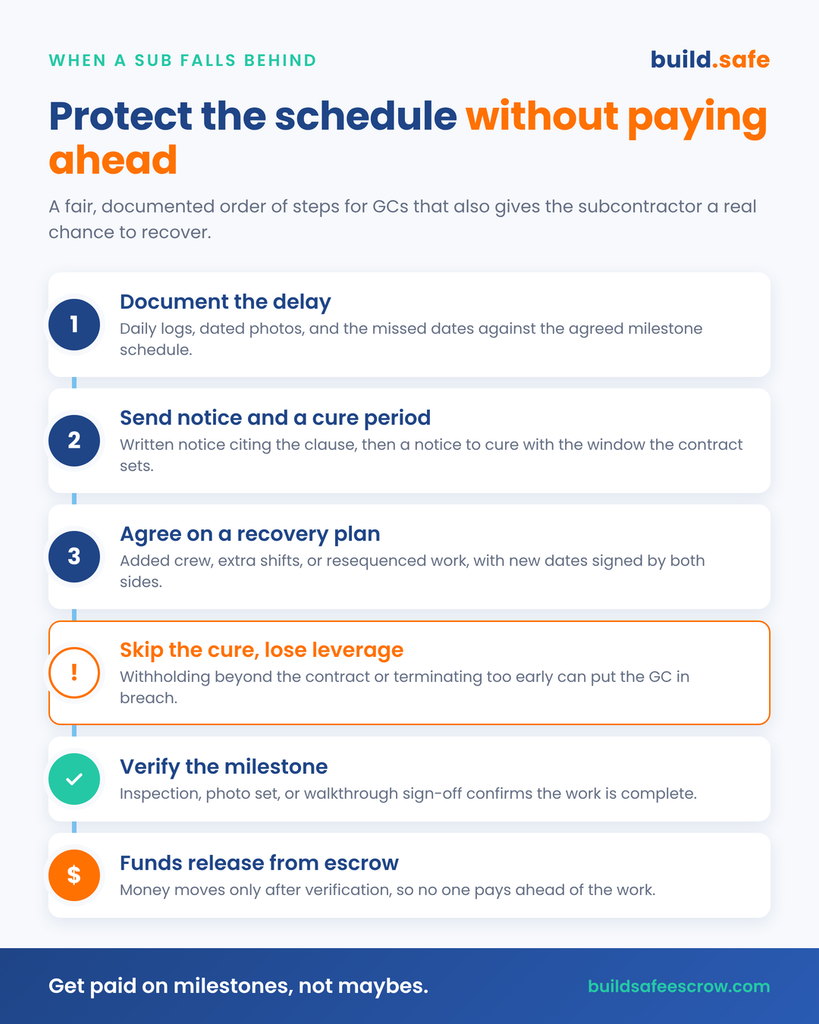
- Document everything. Daily logs, dated photos, look-ahead schedules, and emails. Write down what was due, what was done, and why the sub says they are late.
- Send written notice. A short letter that names the missed dates, cites the schedule clause, and asks for a recovery plan. Keep it factual and calm.
- Give a notice to cure. A notice to cure is a formal written demand to fix a specific default within a set period. Follow your subcontract’s exact requirements on timing, delivery, and content. Skipping this step can weaken every remedy after it.
- Agree on a schedule recovery plan. Ask the sub for added crew, extra shifts, or a resequenced work order. Put the new dates in writing and get a signature.
- Withhold only what the contract allows. Holding payment for work the sub has already completed can put you in breach yourself. Withhold for unfinished work, documented defects, or amounts the contract permits. Nothing more.
- Backcharge with records. A backcharge is a deduction from the sub’s payment to cover costs you paid because of their failure. Levelset calls it “an offset for unexpected costs” and notes that “proper and meticulous documentation is key.” Follow the notice steps in your subcontract before you deduct.
- Supplement the crew. Many subcontracts let you bring in another crew for part of the scope after notice, and charge the cost back. Check the clause and give notice first.
- Terminate as a last resort. Termination for default is slow, costly, and often disputed. Use it only after the notice and cure process has run, and only with legal advice.
Even after a subcontractor missed deadlines, fair process protects the sub too. A sub who gets clear notice, a real chance to cure, and payment for verified work has every reason to recover the schedule.
Prevent the next delay with a milestone-based subcontract schedule
The best time to prevent another case where a subcontractor missed deadlines is before the next subcontract is signed. A milestone-based schedule breaks the scope into defined, checkable stages, each with a date and a payment amount.
Good milestones share a few traits:
- Observable. “Rough-in complete and inspected,” not “50 percent done.”
- Dated against the master schedule, with float shown so both sides see the cushion.
- Priced. Each milestone carries a dollar amount, so payment follows progress.
- Verified by a named method: inspection, photo set, walkthrough sign-off.
Add a clear change order process with turnaround times. Agree on what counts as an excusable delay. Spell out notice requirements in plain words. Our post on milestone payments in construction covers how to structure the stages.
When dates and dollars line up, a slipping sub shows up on paper early. You talk about it in week two, not week eight.
Field example: one late framing crew, two different outcomes
Marcus Reyes, a fictional general contractor, hired a framing sub, Dana Whitfield, on a $92,000 subcontract for a custom home. The schedule called for four milestones of $23,000 each. By the second milestone, Dana’s crew was eight days behind. The subcontractor missed deadlines, and the owner’s draw was due anyway.
In the first version of this story, Marcus pays the second $23,000 on the original date anyway. The owner had funded the draw, and he wanted to keep the peace. Dana’s crew then gets pulled to another job. Marcus has paid half the contract for about a third of the work. His leverage is gone, and the owner is asking hard questions.
In the second version, the subcontract is milestone-based and the funds sit in escrow. Marcus documents the delay, sends a notice to cure, and the second payment stays put until the inspector signs off. Dana knows the $23,000 is there, so she adds two framers for a week to close the gap. The milestone is verified, the funds release, and the job is three days behind instead of eight.
Same sub. Same delay. Different structure.
How escrow keeps money tied to verified work for both sides
Trust between a GC and a sub is a feeling. Structure is what protects you when that feeling gets tested. Escrow turns one into the other.
With construction escrow services, a neutral third party holds the project funds and releases them in stages, only when each agreed milestone is completed and verified. Money never moves ahead of the work.
For you, the GC:
- You never pay ahead of the work, so an overpayment cannot strand you.
- A missed milestone means funds stay in place, with no argument about who holds them.
- Your records line up with the release history, which helps when the owner asks.
For the subcontractor:
- They can see that the money for their milestone exists before they mobilize.
- Release depends on verified completion, not on someone’s mood or cash flow.
- Late payment upstream stops starving their crew, because the funds were set aside at the start.
Payment reputation matters in both directions. Rabbet’s 2025 Construction Payments Report found that “91% of GCs factor an owner’s payment reputation into bids,” and “88% declined to bid in the last year due to slow-pay reputations.” Good subs size up the GCs they work for in much the same way. Funded, predictable payment helps you hire the crews who keep dates.
If a subcontractor missed deadlines under this structure, nothing would need to be clawed back. Escrow does not replace your subcontract, your notice process, or your attorney. Build Safe Escrow gives both sides a referee who is not on anyone’s side. If you have questions about how releases work, the construction escrow FAQs cover the basics.
FAQ: subcontractor missed deadlines
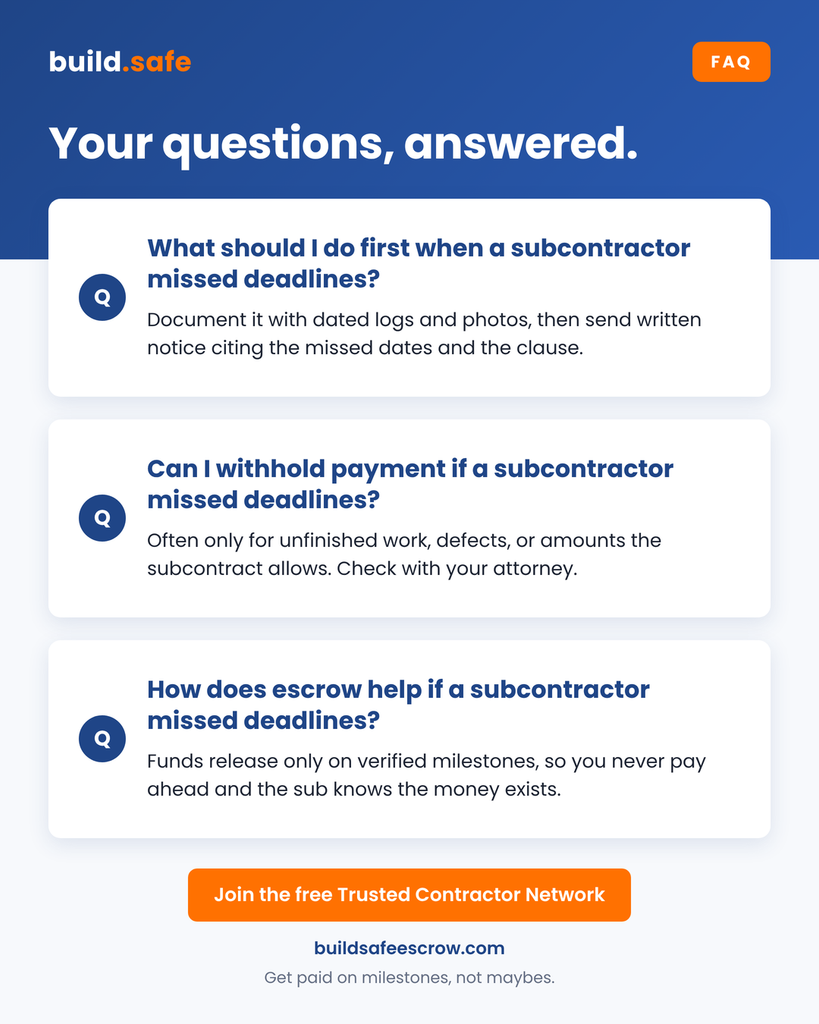
What should I do first when a subcontractor missed deadlines?
Document the delay with dated logs and photos, then send written notice that names the missed dates and the contract clause. Ask for a recovery plan before you consider bigger steps.
Can I withhold payment if a subcontractor missed deadlines?
Often only for unfinished work, documented defects, or amounts the subcontract allows. Withholding payment for completed work can put you in breach. Check your contract and ask your attorney.
What is a notice to cure?
It is a formal written demand that a party fix a specific default within a set time. It is often the first formal step after a subcontractor missed deadlines. Most subcontracts require one before termination. Follow the exact terms in your contract.
Are liquidated damages passed down to subcontractors?
Only if your subcontract says so. Many subcontracts include a flow-down clause that passes the prime contract’s terms to the sub. Rules vary by state and contract, so confirm with an attorney.
How does escrow help if a subcontractor missed deadlines?
Funds release only on verified milestones, so you never pay ahead of the work. The sub can see the money is set aside, which gives them a reason to recover the schedule.
Get paid on milestones, not maybes
Get one short read each Friday on how construction money actually moves: subscribe to The Build Brief.
Build trust. Win more projects. Get paid on milestones, not maybes. Join the free Trusted Contractor Network and show owners and subs that your money moves only when the work does.
References
- AIA Contract Documents, Construction Contracting Basics: What to Know About Liquidated Damages
- Levelset, What are back charges in construction?
- Rabbet, 2025 Construction Payments Report