
Table of Contents
- Why money stalls before it reaches the trades
- What is a joint check agreement?
- When should a subcontractor ask for a joint check agreement?
- Six terms that make the agreement worth signing
- The mistakes that cost subs and suppliers real money
- General contractors and owners gain from joint checks too
- Field example: a tile sub, a supplier and two names on every check
- Escrow settles the payment question before work starts
- FAQ
- Your next job can start with the money already in place
- References
A joint check agreement is often the only thing standing between a supplier’s invoice and a payment that never arrives. If you run a specialty trade or sell materials to one, you already know the feeling of being last in line. The owner pays the general contractor, the general contractor pays the sub, and somewhere along the way your share gets spent on someone else’s problem.
General information only, not legal advice. Payment and lien rules vary by jurisdiction; confirm with your attorney before you sign or endorse anything.
Why money stalls before it reaches the trades
Construction money moves down a ladder. Every rung is a chance for it to stop.
A general contractor receives a draw and uses part of it to cover a different job. A subcontractor gets paid for labor and materials, then pays payroll first and the supplier later. Nobody plans to shortchange anyone. Cash gets tight and the party furthest from the owner waits longest.
Three things make this worse for specialty trades and material suppliers:
- You have no contract with the owner. Your paper runs to the party above you, so your leverage depends on that party staying solvent and honest.
- Your materials are already installed. Tile on the wall or wire in the conduit cannot be repossessed.
- Lien rights are a blunt tool. A mechanics lien (a legal claim against the property for unpaid work or materials) has strict notice rules and deadlines. It can also sour a relationship you want to keep.
Misread paper is a big driver here. Arcadis tracks large North American construction disputes, and its 2025 report lists parties failing to understand or comply with their contractual obligations as the second top cause. The average dispute in that group lasted 12.5 months in 2024. Those are big projects, not a typical tile job. The lesson still scales down: unclear payment terms take a long time to untangle.
What is a joint check agreement?
A joint check agreement is a written contract in which the paying party agrees to, or is permitted to, pay with checks made out to two parties at once, such as a subcontractor and its supplier, so neither can cash it without the other.
A joint check is a check payable to two or more payees. A bank needs both endorsements to deposit it. That one feature changes the dynamics. The subcontractor cannot divert the supplier’s share, because the supplier has to sign before the money moves.
The usual setup has three parties:
- The payer, often the general contractor (sometimes the owner).
- The first payee, usually the subcontractor who holds the contract with the payer.
- The second payee, usually the sub’s material supplier or a lower-tier sub.
The same tool can work one level up. An owner can issue a joint check to the general contractor and a key sub. The logic stays the same: two names, two signatures, one shared check.
Levelset notes there is no standard joint check agreement, so terms vary widely. Some agreements obligate the payer to issue joint checks. Others only permit it. That single word decides whether you have a promise or a courtesy.
When should a subcontractor ask for a joint check agreement?
Ask for one when a supplier will not extend credit without it, when your materials are a large share of the contract, or when you have doubts about how reliably the general contractor pays.
Suppliers often raise it first. A distributor that has been burned before may require a joint check agreement before it ships a big order on credit. Saying yes can be what gets you the material and the terms you need.
It also makes sense when you are new to a general contractor, when the job is large compared with your working capital, or when you carry heavy material costs that you would otherwise float. For more ways to protect your own receivables, see our guide to subcontractor payment protection.
Six terms that make the agreement worth signing
A vague joint check agreement can do more harm than none. Get these points in writing:
- Parties and project. Name the payer, each payee and the specific project. One job per agreement keeps the money from blending.
- Covered invoices and amounts. List which invoices, purchase orders or materials the joint checks cover, with a dollar cap. Anything not listed is not covered.
- Obligation or permission. State plainly whether the payer must issue joint checks or only may. Payees want “must.” Payers usually prefer “may.”
- Who issues and when. Say who writes the check, how it ties to each pay application, and how fast it goes out after approval.
- Endorsement and delivery. Spell out who receives the check first, how many days each party has to endorse, and how the funds get split. Add that endorsing is an acknowledgment of payment only for the amount on that check.
- Overpayment, disputes and lien effect. Cover what happens if a check exceeds the amount owed, how disagreements get resolved, and how the agreement interacts with lien and waiver rights.
That fifth point matters more than most people realize. The next section explains why.
The mistakes that cost subs and suppliers real money
Most joint check problems come from assumptions, not bad faith.
Assuming it covers every dollar. A joint check agreement covers what it says. If your freight charges or a late add-on order are not listed, they ride on the sub’s regular payment.
Endorsing before you see your share. A supplier sometimes signs over a joint check to the sub, trusting the sub to forward its share. That rebuilds the exact risk the check was meant to remove. Agree on the split before anyone signs.
Ignoring the joint check rule. Many courts apply a presumption that a payee who endorses a joint check has been paid everything due through that date. Levelset gives the example of a supplier owed $100,000 who deposits an $85,000 joint check and may lose its claim to the remaining $15,000. A written term saying endorsement acknowledges only the check amount is the usual protection. How this plays out varies by jurisdiction, so confirm with your attorney.
Treating it like a lien waiver. A joint check agreement and a lien waiver are separate documents. Signing one can affect the other. Read both together.
Skipping the signatures. Get every party to sign, including the general contractor. A promise from the sub that “the GC agreed” is not the same thing.
General contractors and owners gain from joint checks too
A joint check agreement is not a one-sided tool. Joint checks help the paying side as well.
A general contractor that pays suppliers through two-party checks lowers the chance that an unpaid supplier files a lien on the owner’s property. That keeps the owner calm and the project moving. It also helps the GC keep good suppliers willing to ship to its subs.
Owners benefit from cleaner lien exposure and fewer surprise claims at closeout. Everyone gets a paper trail that shows where each dollar went. The costs are real too: more paperwork per draw, slower checks and the chance of disputes over the split. Weigh both sides with your own advisors.
Field example: a tile sub, a supplier and two names on every check
Lucia Bennett runs a four-person tile company. She signs a $96,000 subcontract with a general contractor for a custom home. Her tile and setting materials come from Marcus Reyes, credit manager at a stone and tile distributor. The material order totals $38,000.
Marcus will not ship $38,000 on open credit to a two-year-old company. He asks for a joint check agreement. Lucia, Marcus and the general contractor all sign the joint check agreement. It covers two named invoices: $22,000 for the first shipment and $16,000 for the second. It says endorsement acknowledges payment only for the amount on each check.
The job runs in two pay applications:
- Pay app 1: $40,000. The GC issues a $22,000 joint check to Lucia’s company and the distributor, plus an $18,000 check to Lucia for labor.
- Pay app 2: $56,000. The GC issues a $16,000 joint check, plus a $40,000 check to Lucia.
Totals reconcile: $22,000 + $16,000 = $38,000 in materials. $18,000 + $40,000 = $58,000 in labor. Together that is $96,000.
One snag shows up. Late in the job Lucia orders $3,500 of extra trim and freight that was never added to the agreement. That invoice is not covered, so Marcus bills Lucia directly and she pays it from her labor money. Because his agreement limited what each endorsement acknowledged, Marcus never risked giving up that $3,500 when he signed the second joint check.
The structure worked. It did not answer one question, though: was the GC’s money there in the first place?
Escrow settles the payment question before work starts
A joint check agreement controls who can cash a check. It cannot make the check exist. If the owner’s funds run dry or the general contractor’s draw gets spent elsewhere, two names on a check that never gets written protect nobody.
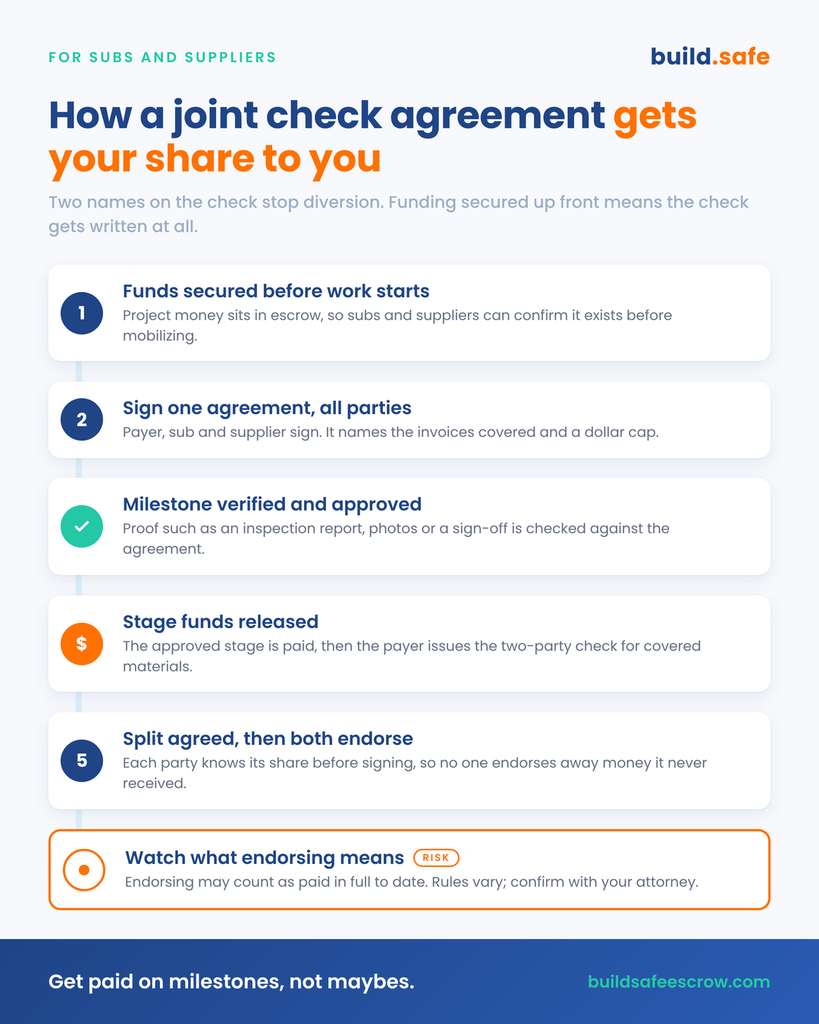
Escrow handles the step that comes earlier. With construction escrow services, project funds sit in a secure, FDIC-insured account held by a neutral third party. The Escrow Agreement lists the milestones and the proof each one needs, such as an inspection report, photos or a sign-off. When a milestone is completed, verified and approved under the agreement, the funds for that stage are released. If a request is not approved, the money stays in escrow. The agreement also sets up a dispute-resolution process that seeks to avoid litigation, and either party can bring in a mediator.
For a sub or a supplier, that changes the conversation. You can ask whether the money is funded and what the release conditions are before you mobilize a crew or ship a truck. Trust between parties is a feeling. Escrow turns it into structure: money never moves ahead of the work, and the work never starts without money behind it.
Build Safe Escrow is a referee, not a player. It does not draft joint check agreements or issue joint checks unless the Escrow Agreement says so, and it does not give legal advice. You can still use a joint check agreement alongside escrow. Your attorney can tell you how the two fit on your project. Our construction escrow FAQs cover the basics of how releases work.
FAQ
Does a joint check agreement replace my lien rights?
Not by itself. It can affect them, especially when you endorse a check. Rules vary, so confirm with your attorney.
Who usually asks for a joint check?
Most often the supplier. Sometimes the general contractor offers joint checks to keep its own lien exposure low.
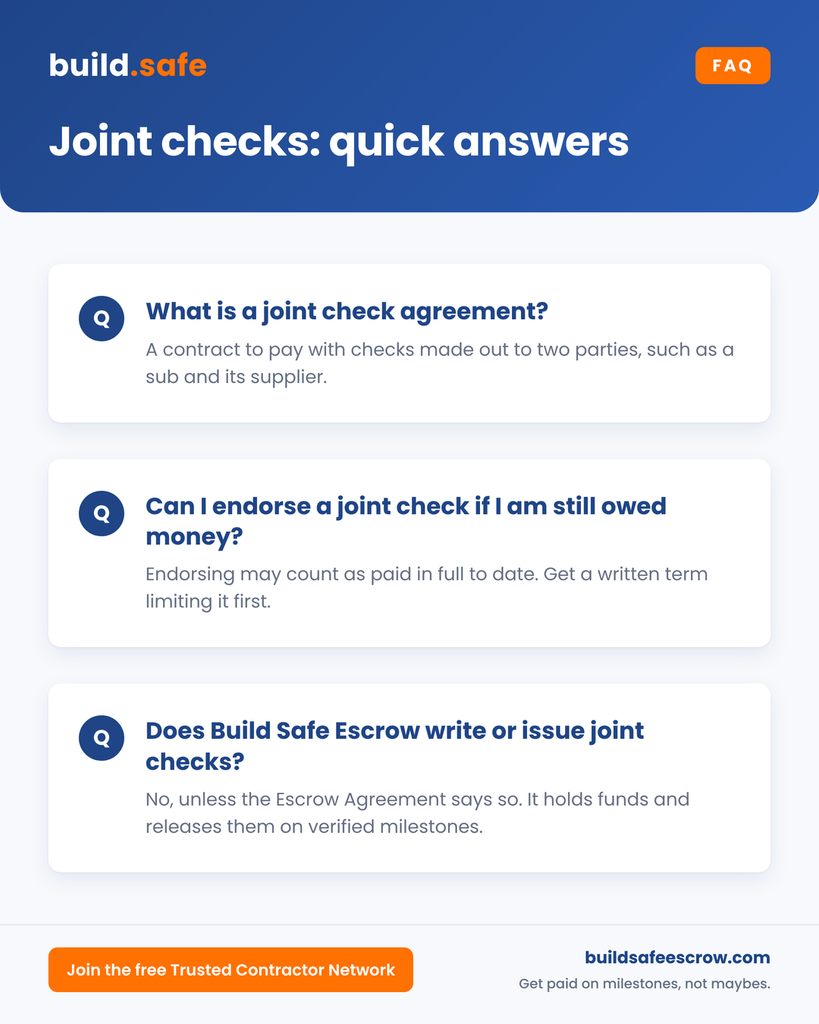
Can I endorse a joint check if I am still owed money?
You can, but endorsing may be treated as proof you were paid in full through that date. Get a written term that limits the acknowledgment first.
Does the general contractor have to agree?
Yes. The payer issues the check, so it needs to sign. Get every party’s signature on the same document.
Does Build Safe Escrow write or issue joint checks?
No, not unless the Escrow Agreement says so. Build Safe Escrow holds funds and releases them on verified milestones.
Your next job can start with the money already in place
Get one short read each Friday on how construction money actually moves: subscribe to The Build Brief.
Specialty trades, subs and suppliers: join the free Trusted Contractor Network. Build trust. Win more projects. Get paid on milestones, not maybes.
References
- Arcadis, Construction Disputes in Motion: Speed, Agility, and Adapting to Change (15th Annual Construction Disputes Report, North America, 2025)
- Scott Wolfe Jr, Levelset, What Is A Joint Check Agreement? (Free Form Template) (updated April 18, 2023)
- Scott Wolfe Jr, Levelset, Joint Check Agreements: Rule Can Limit Suppliers Claim For Further Payment (updated April 20, 2020)