

Table of Contents
- Payments and progress drift apart for ordinary reasons
- When should you stop paying a contractor?
- Can I stop paying a contractor for unfinished work?
- Six signals that earn a pause on the next payment
- Pause professionally so the job survives
- Withholding without cause hurts honest contractors, and you
- Some situations need an attorney, not a script
- Field example: Rachel’s kitchen stalls at the cabinets
- Escrow decides the payment question before the job starts
- FAQ
- Make the next payment a verification step, not a gut call
- References
The invoice says the next draw is due, but the kitchen looks the same as it did two weeks ago, and you wonder whether it is time to stop paying a contractor who has gone quiet. Homeowners land here all the time: a deposit is gone, the crew shows up less often, and the phone rings out. You want the work finished. You also want to stop sending money into a project that is not moving.
This article is general information, not legal advice. Contract and payment rules vary by location; confirm your options with your own attorney before you act.
Payments and progress drift apart for ordinary reasons
Most home projects run on a payment schedule, a list of amounts tied to stages of the job. The trouble starts when the schedule is written around dates or vague phases instead of finished, checkable work.
Drift happens for reasons that are often not sinister:
- The contractor took on too many jobs and is spreading one crew across all of them.
- Materials are back-ordered, so the work stalls while the invoices keep coming.
- A deposit was used to cover another job’s costs, which leaves your job underfunded.
- Changes were agreed out loud, and now nobody agrees on the price.
Some drift is a cash flow problem. Some is a warning sign. When you are deciding whether to stop paying a contractor, both look the same from the driveway.
When should you stop paying a contractor?
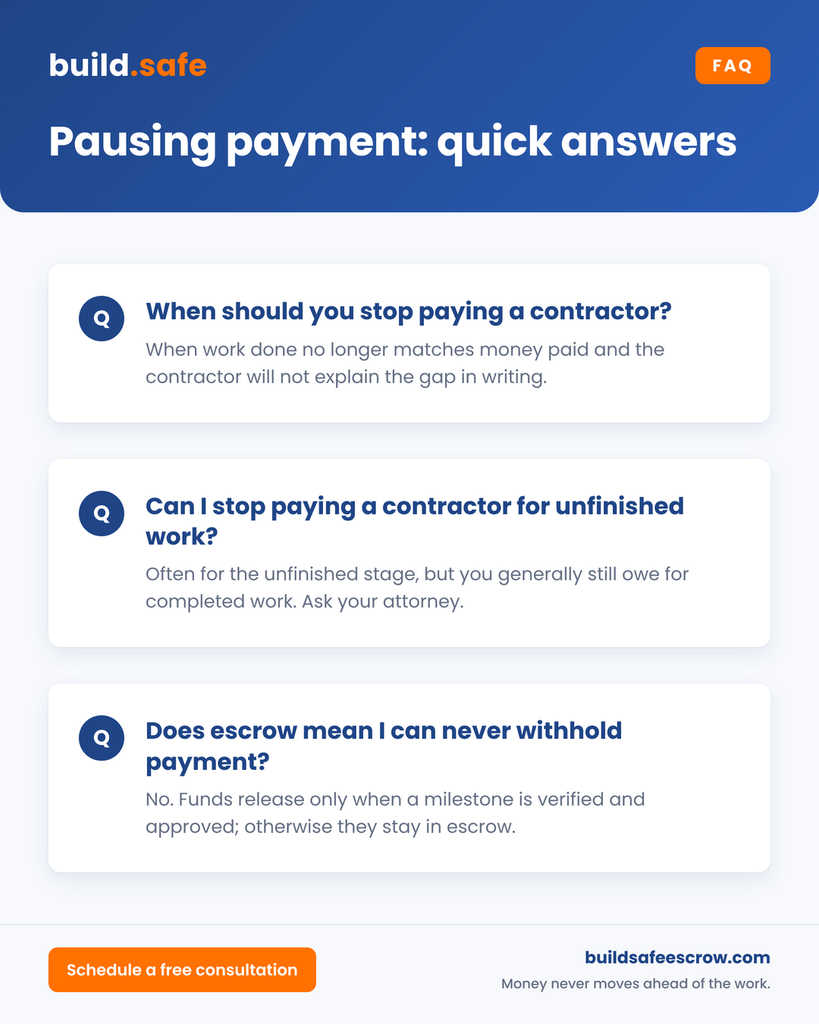
You should stop paying a contractor, or more precisely pause the next payment, when the work completed no longer matches the money already paid and the contractor will not explain the gap in writing.
That is the core test: paid versus done. If you have paid for 50% of the job and roughly 50% is visibly finished, you are on schedule even if the crew is slow. If you have paid for 50% and the job is 20% done, every new payment widens a gap you may never recover.
A pause is not the same as firing anyone. It means you hold the next draw until the work catches up or the contractor gives you a credible plan. Your contract decides how much room you have, so read it before you say anything.
Can I stop paying a contractor for unfinished work?
In many cases you can hold payment for work that is not done, but you generally still owe for work that is completed as the contract defines it.
Most contracts tie each payment to a stage. If that stage is not finished, the payment is often not yet due. Withholding money for work that was finished, though, can put you in breach, which means you broke the contract first. Rules vary widely, so treat this as a question for your attorney, not a guess.
Six signals that earn a pause on the next payment
One late morning is not a pattern. These signals, especially two or more together, can justify a decision to stop paying a contractor until the work catches up:
- Work behind the payment schedule. The draw being requested covers a stage that is visibly unfinished.
- Missed deadlines with no communication. Delays happen. Silence about them is the problem.
- No-shows after a deposit. Searches like “contractor takes money no show” exist for a reason. If the crew vanished after the deposit cleared, stop and document before paying more.
- Materials not on site. You paid for cabinets or windows, and nothing has been delivered or ordered in your name.
- Warnings from subcontractors or suppliers. A sub or supplier calls to say they have not been paid. In many places an unpaid sub or supplier may be able to file a mechanic’s lien, a legal claim against your property for unpaid work or materials.
- Change orders with no paper. New work or new prices show up on the invoice without a signed change order, the written document that records a change in scope, price or time.
Pause professionally so the job survives
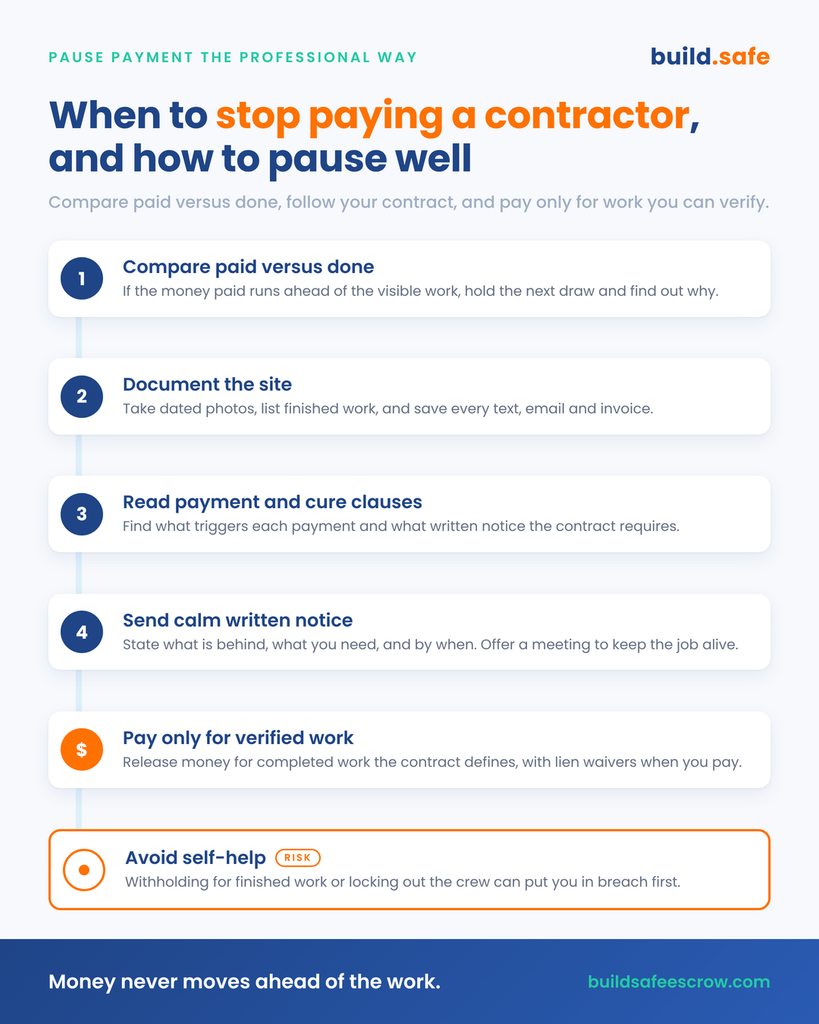
When you stop paying a contractor in anger, the job usually dies with the relationship. A measured pause keeps the door open. Work through these steps in order:
- Document the site. Take dated photos of every room, list what is finished, and save texts and emails. The FTC recommends keeping contracts, change orders, payment records and a log of calls together.
- Read the payment clause. Find what triggers each payment and whether work must be inspected or approved first.
- Read the termination and cure clauses. A cure clause gives the other side a set number of days to fix a problem after written notice. Many contracts require that notice before you can withhold or terminate.
- Send written notice. State what is behind, what you need, and by when. Keep it factual and calm. The FTC suggests sending follow-ups to phone calls by certified mail with a return receipt.
- Pay only for verified completed work. If part of a stage is done, ask whether the contract lets you pay for that part. Get a lien waiver, a signed release saying a party has been paid, from the contractor and any subs or suppliers when you do pay.
- Keep the job alive. Offer a meeting. Ask for a revised schedule. A contractor who gets clear terms often comes back to finish.
- Avoid self-help. Changing the locks, hiring a replacement crew, or removing their tools before following the contract’s process can make you the party in breach.
Withholding without cause hurts honest contractors, and you
Fairness runs both ways. Most contractors are honest, and many run on thin margins. They buy materials and pay crews before you pay them. When a homeowner decides to stop paying a contractor for finished work over a vague feeling, the contractor may not be able to make payroll.
It also backfires on you. A contractor who is not paid for completed work may stop, file a lien, or claim damages. The decision to stop paying a contractor should rest on facts you can show, not on frustration. If you cannot point to a gap between paid and done, talk before you withhold.
Some situations need an attorney, not a script
A professional pause solves a lot. Before you stop paying a contractor in these situations, talk to a licensed attorney:
- The contractor has threatened a lien or legal action.
- A lien or notice has already been recorded against your home.
- You are thinking about terminating the contract.
- Large sums are involved, or the contractor has disappeared with a deposit.
- You are unsure whether the contract’s notice and cure steps apply.
Disputes are slow and costly. Arcadis, in its 2025 Construction Disputes Report for North America, found the average construction dispute it tracked lasted 12.5 months in 2024. Those are large commercial disputes, not typical home projects, but the lesson carries over: preventing a dispute beats winning one.
Field example: Rachel’s kitchen stalls at the cabinets
Rachel Morales signed a $48,000 kitchen remodel. The payment schedule looked like this:
- Deposit: $4,800
- Demolition and rough plumbing and electrical: $12,000
- Cabinets installed: $14,400
- Countertops and appliances: $9,600
- Final completion: $7,200
Demolition and rough work went well, so Rachel had paid $16,800. Then the contractor requested the $14,400 cabinet draw. Only half the cabinets were set. The crew had missed six working days without a call, and the cabinet supplier phoned to say its invoice was unpaid.
Rachel did not want to stop paying a contractor who had done good work so far. She also did not want to fund a stalled job. She photographed the kitchen and found the cure clause in her contract: seven days after written notice. She sent a calm letter listing the unfinished cabinets, the missed days, and the supplier’s call.
The contractor came back within the week. They walked the job together, agreed half the cabinets were done, and Rachel paid $7,200 once the supplier signed a lien waiver. When the rest were installed and checked, she paid the other $7,200. Her total paid reached $31,200, with $16,800 left for countertops, appliances and the final payment.
It worked. It also cost Rachel two tense weeks of guessing and drafting letters at midnight.
Escrow decides the payment question before the job starts
Rachel’s story ended well because she was careful about when to stop paying a contractor and when to pay. Escrow makes that care part of the structure from day one.
With construction escrow services, the project funds sit with a neutral third party in a secure, FDIC-insured account. The Escrow Agreement lists the milestones and what counts as proof, such as photos, an inspection report or a sign-off. When a milestone is completed and verified, and the release is approved under the agreement, the money moves. If a payment request is not approved, the funds stay in escrow.
That changes the question. You no longer ask “should I stop paying a contractor this week?” You ask “has this milestone been verified?” Both of you agreed on the answer key before work began.
Trust is a feeling. Structure is protection. Escrow turns the feeling into the structure.
It protects the contractor too. They can see the money is deposited and waiting, so a finished milestone gets paid without chasing. If there is disagreement, the agreement sets up a dispute-resolution process that seeks to avoid litigation, and either party can bring in a third-party mediator.
Money never moves ahead of the work. For more on how releases are verified, see our construction escrow FAQs. If you are still setting up your job, our guide to a home renovation payment schedule shows how to tie each draw to finished work.
FAQ
Is it legal to stop paying a contractor who stopped showing up?
It depends on your contract and local rules. Many contracts require written notice and a cure period first. Ask your attorney before you withhold.
How much should I pay a contractor up front?
There is no single right number, and some rules cap deposits. The FTC lists a demand to pay everything up front as a warning sign.
Can I stop paying a contractor for partly done work?
You can often hold the unfinished part. If the contract allows partial payment, verify the work and get a lien waiver.
What if a supplier says they were not paid?
Take it seriously. Ask the contractor for proof of payment and a lien waiver from the supplier before your next payment.
Does escrow mean I can never withhold payment?
No. Funds are released only when a milestone is verified and approved. If a request is not approved, the money stays in escrow.
Make the next payment a verification step, not a gut call
Get one short read each Friday on how construction money actually moves: subscribe to The Build Brief.
Planning a remodel or worried about a job underway? Schedule a free consultation and see how milestone escrow keeps your money and your project moving together.
References
- Federal Trade Commission, Hiring a Contractor, consumer guide, March 2014.
- Arcadis, Construction Disputes in Motion: 15th Annual Construction Disputes Report, North America edition, 2025.
- Federal Deposit Insurance Corporation, Understanding Deposit Insurance, updated April 1, 2024.