

Table of Contents
- What is retainage in construction?
- Why subcontractors carry the heaviest retainage load
- What 10% retainage does to your cash flow
- Seven ways to protect your retainage before you sign
- When does retainage have to be released?
- From the field: the drywall sub who waited 14 months
- How escrow changes retainage in construction
- Retainage in construction FAQs
Retainage in construction is money you already earned that someone else is still holding. You finished your scope in March. The building opens in December. Your last 10% sits in another company’s account the whole time.
If you’re a specialty trade or subcontractor, you know the feeling. You’re often among the first crews on site, sometimes gone by month four, and still last in line when the final check gets cut. Most of that wait is negotiable, though, and a growing share of it is now regulated.
What is retainage in construction?
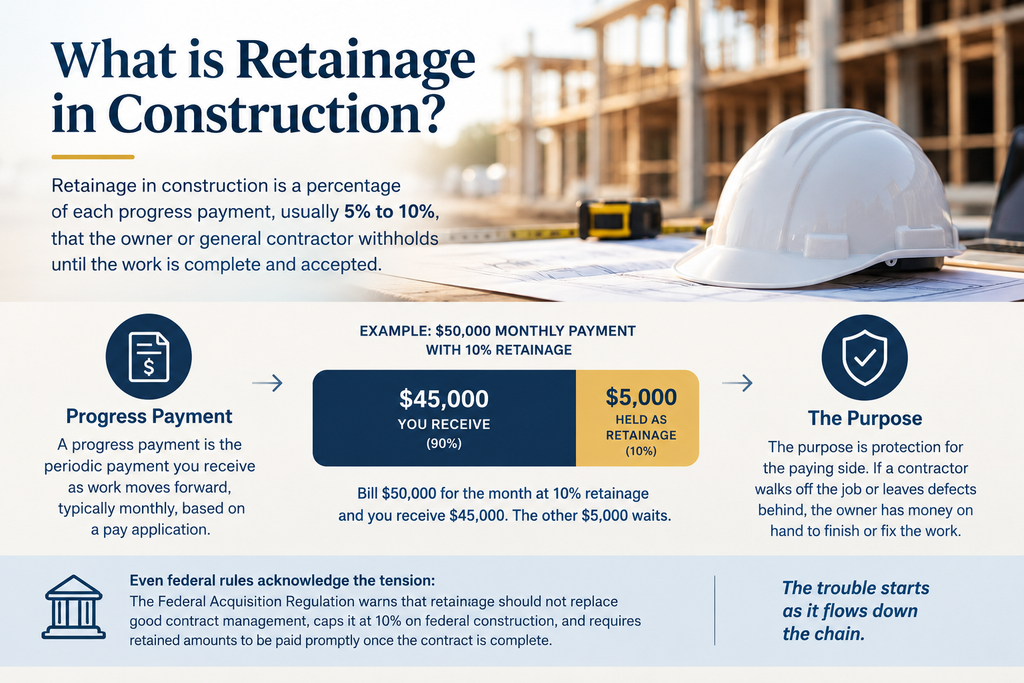
Retainage in construction is a percentage of each progress payment, usually 5% to 10%, that the owner or general contractor withholds until the work is complete and accepted.
A progress payment is the periodic payment you receive as work moves forward, typically monthly, based on a pay application. Retainage (also called retention) comes off the top of each one. Bill $50,000 for the month at 10% retainage and you receive $45,000. The other $5,000 waits.
The purpose is protection for the paying side. If a contractor walks off the job or leaves defects behind, the owner has money on hand to finish or fix the work. That’s a fair goal. Even federal rules acknowledge the tension: the Federal Acquisition Regulation warns that retainage should not replace good contract management, caps it at 10% on federal construction, and requires retained amounts to be paid promptly once the contract is complete.
The trouble starts as it flows down the chain.
Why subcontractors carry the heaviest retainage load
Retainage in construction makes a certain kind of sense at the top of the contract chain. By the time it reaches the trades, it gets heavier and slower.
- Release is tied to the whole project, not your scope. Many subcontracts hold your retainage until final completion of the entire building. For a site-work or foundation sub, that can mean a year or more after the crew leaves.
- Pay-when-paid clauses stack on top. A pay-when-paid clause says the GC pays you after the owner pays the GC. Applied to retainage, one late closeout upstream freezes everyone below it.
- The GC may hold a higher percentage than the owner does. Some subcontracts withhold 10% while the prime contract holds 5%. In several states that is no longer allowed.
- “Complete” is never defined. Without a written definition, a punch list (the final list of small fixes before acceptance) can grow for months, and your money waits on items outside your trade.
- Nobody pays you for the wait. The money usually earns you no interest while it sits.
None of this requires bad faith from anyone. The way retainage in construction is usually structured puts the waiting on the people with the thinnest cash cushion.
What 10% retainage does to your cash flow
Say you hold a $400,000 electrical subcontract at 10% retainage. That’s $40,000 of earned money sitting upstream until closeout. If your net margin is 8%, your profit on the entire job is about $32,000. The amount being held is bigger than everything you’ll make on the project.
Until it’s released, you have financed the job with your own labor, materials, and payroll. Spread that across five or six active jobs and you can see why retainage in construction is one of the most common reasons a busy, well-run trade business still runs short of cash.
Seven ways to protect your retainage before you sign
The best time to fix retainage in construction is before the subcontract is signed. After that, you’re negotiating from the back of the line.
- Know your state’s retainage law. More than 30 states now regulate retainage on private work in some form, according to ConsensusDocs. New York now voids any provision in a private contract over $150,000 that requires more than 5% retainage (a summary of the December 2025 amendment). California capped private-project retention at 5% for contracts signed on or after January 1, 2026. Rules differ widely elsewhere, so check the law where the project sits, not where your shop is.
- Ask for release by scope. Negotiate for your retainage to be paid when your own scope is complete and accepted, sometimes called line-item or early release. A foundation sub shouldn’t wait on paint touch-ups.
- Cap it and step it down. Push for 5%, or for 10% that drops to zero once the job reaches 50% complete.
- Match the owner’s percentage. Add a clause stating the GC won’t withhold more from you than the owner withholds from the GC.
- Define “complete” and start a clock. Write down exactly what triggers release (substantial completion of your scope, a signed-off punch list) and how many days payment follows. Vague triggers are where months disappear.
- Protect your lien rights while you wait. A mechanics lien is a legal claim against the property for unpaid work. Lien and notice deadlines often run from your last day on site, not from the day retainage comes due. Track those dates separately, and talk to a construction attorney in your state before one passes.
- Ask where the retainage actually sits. Is it in a separate account, or mixed into the GC’s operating cash? That answer tells you how safe it is if the job goes sideways.
When does retainage have to be released?
It depends on your contract and your state, but most rules tie release to substantial or final completion and then give the paying party a set number of days to pay.
Substantial completion means the work is finished enough to be used for its intended purpose, even if small punch-list items remain. Many states set a payment window after that point, commonly 30 to 60 days. Many also require a GC to pass retainage down to subcontractors within days of receiving it.
If your subcontract is silent on retainage in construction terms, the prime contract and state law usually fill the gap. You often won’t see the prime contract, so ask the GC for the retainage and payment sections before you sign.
From the field: the drywall sub who waited 14 months
Keisha runs a drywall and framing company outside Atlanta. She signed a subcontract on a four-story mixed-use project: $310,000, 10% retainage, released “upon final completion and owner acceptance of the project.”
Her crew finished in month five. The project closed out in month nineteen, after a dispute between the owner and the curtain-wall installer held up the certificate of occupancy. Keisha’s $31,000 sat upstream for fourteen months. Her work passed inspection the first time.
What would have changed the outcome? A release trigger tied to her own scope, or a step-down at 50%. Better still, a structure where the retained money was set aside in a neutral account from day one, visible to her, instead of living inside someone else’s cash flow.
Her next three bids all carried a retainage clause she wrote herself.
How escrow changes retainage in construction
Retainage exists because the paying side needs protection. Subcontractors need protection too. Construction escrow gives both at once.
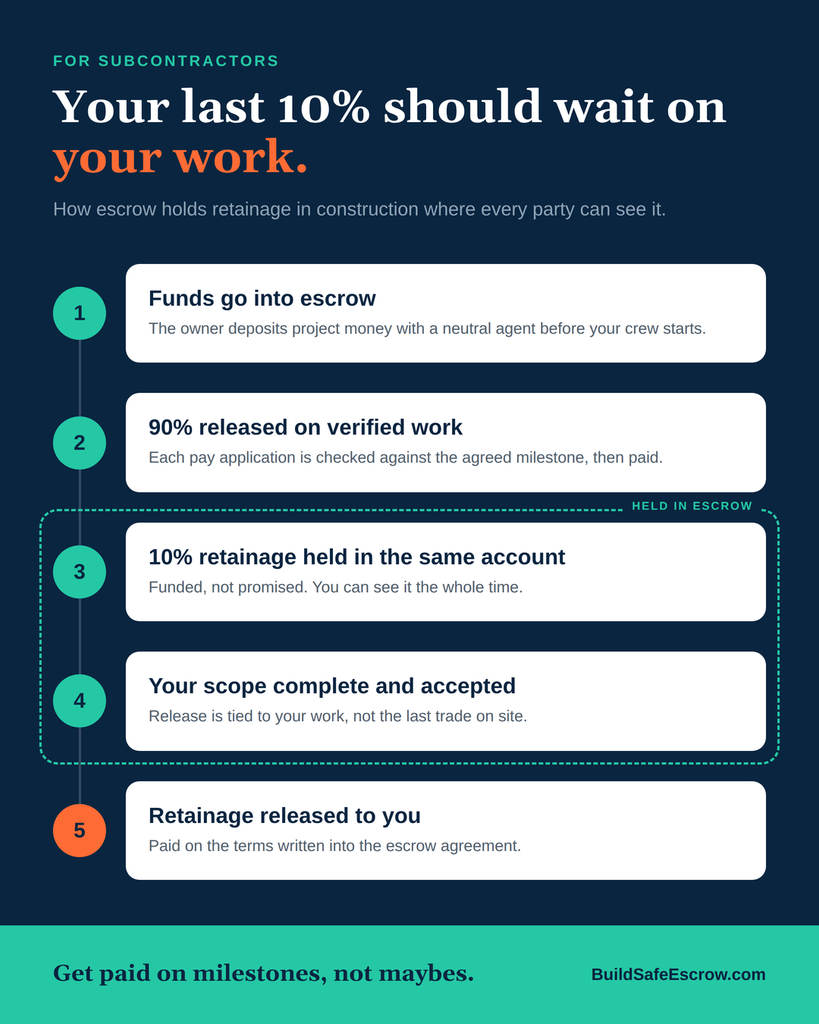
With a neutral escrow agent, project funds are deposited before work starts and held in a secure account. Money is released as each agreed milestone is completed and verified. Any retainage the parties agree to can be held there as well, visible to every party, with release conditions written into the escrow agreement instead of left to one company’s discretion.
For a subcontractor, that changes a few things:
- The money exists. Outside escrow, retainage in construction is often just a line on a pay application. In escrow, it’s funded.
- Release follows a rule. When the milestone is verified, the funds move.
- Nobody holds it as leverage in a dispute that has nothing to do with your work.
The owner keeps full protection, because funds only release against verified work. Money never moves ahead of the work, and it doesn’t have to lag far behind it either.
Public projects already use this model. Ohio, for example, requires retainage on state construction contracts of $15,000 or more to be deposited in escrow with a financial institution and released with interest at substantial completion (Ohio Facilities Construction Commission). Private projects can adopt the same structure by agreement. You can see how it works on our construction escrow services page.
Trust is a feeling. Structure is what gets you paid.
Retainage in construction FAQs
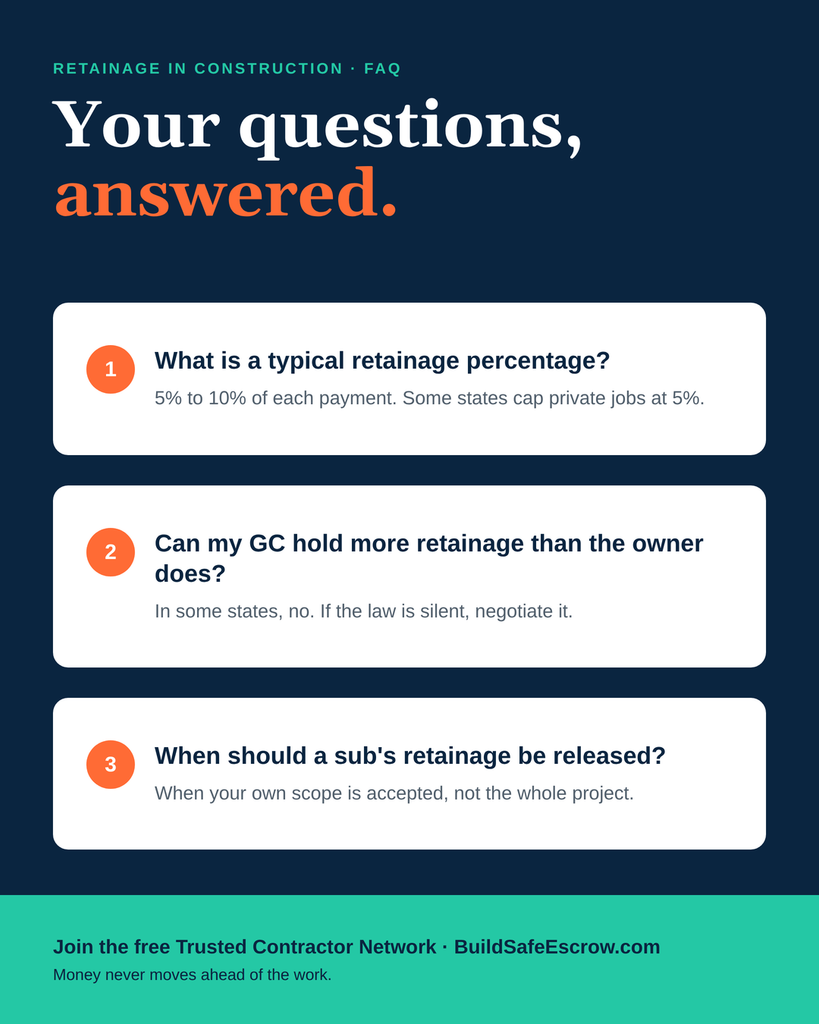
What is a typical retainage percentage? Most contracts hold 5% to 10% of each progress payment. Federal construction caps it at 10%, and a growing number of states cap private projects at 5%.
Can a general contractor hold more retainage from me than the owner holds from them? In some states, no: the statute bars a contractor from withholding a higher percentage from subs than the owner withholds from the contractor. Where the law is silent, negotiate a matching clause.
Does retainage earn interest? Usually not, unless your contract or state law says so. Some states require retainage on public projects to sit in interest-bearing escrow, with the interest going to the contractor.
When should a subcontractor’s retainage be released? Ideally when your own scope is complete and accepted. Without that clause, release is often tied to the whole project, which can add months or years.
Why does retainage in construction exist at all? It gives the owner a financial backstop if work is abandoned or defective. The goal is fair; the long, open-ended wait is what hurts subs.
Can escrow replace retainage? It can reduce the need for it. When funds sit with a neutral party and release against verified milestones, owners stay protected without holding earned money for as long.
Get paid on milestones, not maybes
Build trust. Win more projects. Get paid on milestones, not maybes. Join the free Trusted Contractor Network and get in front of owners who fund their projects in escrow before your crew shows up.
Get one short read each Friday on how construction money actually moves. Subscribe to The Build Brief.
This article is general information, not legal advice. Retainage rules vary by state and by contract, so talk to a construction attorney about your specific situation.
References
- FAR 32.103, Progress payments under construction contracts (Acquisition.gov)
- Retainage: What Contractors Need to Know and Helpful Strategies (ConsensusDocs)
- New York Further Tightens 2023 Retainage Law (Troutman, January 2026)
- Retainage/Escrow Best Practices (Ohio Facilities Construction Commission)