
Table of Contents
- The check that changes everything
- How much deposit should I give a contractor?
- Why contractors ask for money before the work
- What the law says in 11 states
- What a deposit is actually paying for
- Six ways to protect yourself when paying contractors upfront
- The red flags that mean walk away
- From the field: a deck in Austin
- How escrow removes the deposit question
- FAQ
- References
The check that changes everything
Paying contractors upfront is the single largest financial risk in a renovation, and it happens before anyone picks up a tool. A contract slides across the table. The payment line says 40 percent at signing. On a $60,000 kitchen, that is $24,000 to someone you met two weeks ago.
You hesitate. You should. And you can do something about it.
This guide covers what a deposit should be, what it legally covers, what the rules are in eleven states, and how to fund a project so that the deposit question never comes up at all. Written for owners weighing paying contractors upfront, though contractors will find the state table useful too.
How much deposit should I give a contractor?
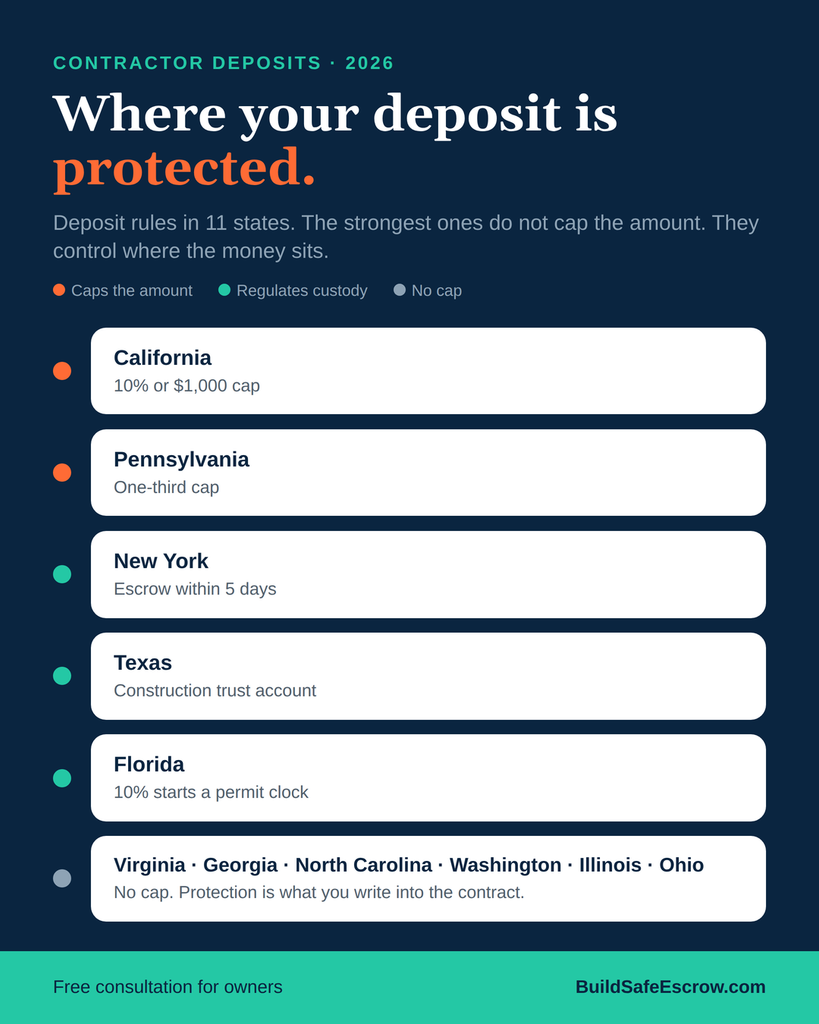
Ten percent of the contract price or less is the healthy standard for residential work, with a documented exception for special-order materials, and several states set a legal cap at or near that number.
That is not a homeowner’s wish. It is what state regulators recommend and, in a growing number of places, require. California caps home improvement deposits at 10 percent or $1,000, whichever is less. Virginia’s Board for Contractors recommends about 10 percent, or roughly 30 percent when custom-made items have to be ordered. Florida sets no cap but puts a contractor on a legal clock the moment a deposit passes 10 percent.
Industry practice on paying contractors upfront runs wider, from 10 percent to a third. Anything past a third with no custom-order justification is unusual. Anything past half is the pattern deposit laws were written to catch.
A useful way to think about it: the deposit should match the contractor’s real startup cost. Reserving a crew, pulling permits, ordering the first materials. On most jobs that is a small fraction of the total, and it is the reason established contractors with healthy cash flow rarely need a large one.
Why contractors ask for money before the work
Most requests for paying contractors upfront are not fraud. They come from four ordinary pressures.
Cash flow. Small contractors run thin. Materials for your job get bought before your job pays. Your deposit funds that gap, and it often funds the previous client’s gap too.
Material orders. Custom cabinets, specialty windows, and imported stone require payment on order, sometimes 50 percent, sometimes all of it. A contractor who has to front $15,000 of cabinets has a legitimate reason to ask you to cover them.
Commitment. A deposit proves you are serious. Contractors lose weeks every year to owners who sign, then vanish.
Habit. “A third up front” is folklore in the trades. Many contractors ask for it because their mentor did, not because they have calculated what they need.
None of those reasons require the deposit to sit in the contractor’s operating account, unsecured, before work begins. That is the part worth changing.
What the law says in 11 states
Rules on paying contractors upfront vary more than most owners expect. Some states cap the amount. Some regulate where the money is held. Most set no limit at all and rely on general consumer-protection law. Here is where the states in our series stand as of 2026. Verify current statutes with your own attorney, and note that these rules mostly cover residential home-improvement work, not new construction or commercial projects.
| State | Deposit rule | Where it comes from |
|---|---|---|
| California | Capped at 10% of the contract or $1,000, whichever is less. Violations are a misdemeanor. | Business & Professions Code §7159 |
| Nevada (for reference) | Same 10% or $1,000 rule, with a special-order materials exception. | NRS 624.940 |
| Pennsylvania | Capped at one-third of the contract price, plus the cost of special-order materials, on contracts over $5,000. | Home Improvement Consumer Protection Act, 73 P.S. §517.9 |
| New York | No cap on the amount. Any payment collected before substantial completion must go into an escrow account within five business days, or be covered by a bond. | Gen. Bus. Law §771; Lien Law §71-a(4) |
| Texas | No cap. On homestead improvements over $5,000, all owner payments must be held in a construction trust account separate from the contractor’s operating funds. Misuse is a felony. | Property Code §162.006 |
| Florida | No cap. If the deposit exceeds 10%, the contractor must apply for permits within 30 days and start work within 90 days of permit issuance, or face criminal penalties that scale with the amount. | Fla. Stat. §489.126 |
| Virginia | No statutory cap. The Board for Contractors recommends about 10% (about 30% for custom items) and requires the contract to state the down payment and the progress-payment schedule. | 18VAC50-22-260; DPOR Statement of Consumer Protections |
| Georgia | No cap. Written contract and licensed contractor required over $2,500; general consumer-protection law applies. | Georgia Fair Business Practices Act |
| North Carolina | No cap. General contractor license required for projects of $40,000 or more. | N.C. Gen. Stat. §87-1 |
| Washington | No cap. Contractors must be registered and bonded, and must give a written disclosure notice on residential projects over $1,000. | RCW 18.27 |
| Illinois | No cap. Written contract required for home repair over $1,000, and a consumer rights pamphlet must be provided. | Home Repair and Remodeling Act, 815 ILCS 513 |
| Ohio | No cap. General consumer-protection law applies; local licensing varies by city. | Ohio Consumer Sales Practices Act |
Two patterns stand out.
First, the states with the strongest protection are not the ones that cap the amount. They are the ones that regulate custody. New York and Texas let a contractor ask for whatever the owner will agree to, then require that the money sit somewhere the contractor cannot spend it until the work is done. That is escrow by statute.
Second, in eight of these eleven states, the law offers you nothing on the amount. Whatever protection you have, you build into the contract yourself.
What a deposit is actually paying for
Ask a contractor to itemize what paying contractors upfront covers and the conversation changes. A legitimate deposit covers three things.
- Mobilization. Scheduling the crew, staging the site, delivering the dumpster. A few hundred to a few thousand dollars.
- Permits. Application fees and the time to pull them. Usually under 2 percent of the contract.
- Special-order materials. The real number. Custom cabinetry, windows, doors, stone, and appliances often require payment at order. This is the one line that can justify a larger upfront figure, and it should be documented with the supplier’s invoice.
What a deposit should not cover is labor that has not happened, materials that have not been ordered, or the contractor’s overhead on other jobs. If the deposit is bigger than those three lines add up to, the extra is not a deposit. It is a loan you are making, unsecured, at zero interest.
Six ways to protect yourself when paying contractors upfront
If you are paying contractors upfront, structure it. Every one of these is standard practice, and a good contractor will not resist any of them.
- Cap it at 10 percent, or at the itemized startup cost. Whichever is larger, with the special-order invoice attached.
- Put the payment schedule in the contract. Every payment tied to a named milestone: rough-in complete, cabinets set, final inspection passed. “Progress payments as needed” is not a schedule.
- Pay special-order materials to the supplier, not the contractor. Many suppliers will invoice you directly. The material is then yours, whatever happens to the contractor.
- Never pay cash. A check or transfer creates a record. Cash creates a dispute.
- Collect a lien waiver with every payment. A lien waiver is the contractor’s written confirmation that the payment covers the work invoiced and that no lien claim survives it. Get a conditional waiver with the check and an unconditional one once it clears.
- Hold back the final 10 percent until the punch list is done. Not “almost done.” Done, inspected, and signed off.
Do all six and paying contractors upfront at 10 percent becomes a manageable risk. Skip them and even a small deposit is a bet.
The red flags that mean walk away
Some requests around paying contractors upfront are not negotiation. They are exit signals.
- A demand for more than 50 percent before any work starts, with no custom-order justification.
- A demand for 100 percent upfront. No legitimate contractor needs this.
- Cash only, or a discount for cash.
- Pressure to pay today because “the price goes up tomorrow.”
- A refusal to itemize what the deposit covers.
- A refusal to put a milestone schedule in writing.
- A license that does not check out with the state board. Every state in the table above has a public lookup.
Any one of these is reason to slow down. Two together is reason to find another contractor.
From the field: a deck in Austin
Gabriel learned about paying contractors upfront the practical way. He hired a contractor to build a covered deck on his home in Austin, Texas. Contract price: $38,000. The contractor asked for half at signing, explaining that the steel and composite decking had to be ordered.
Gabriel asked for the supplier invoice. It came to $11,400. He offered to pay that amount directly to the supplier and a $2,000 mobilization deposit to the contractor. The contractor agreed within a day. Gabriel had, without knowing it, structured the deal the way Texas trust-fund law already expects.
Three weeks in, the contractor’s crew stopped showing up. Another job had gone sideways and taken his attention with it. Gabriel had paid $13,400 total, and $11,400 of it sat in a warehouse in his name. He hired a second contractor, who used the materials Gabriel already owned and finished the deck for $22,000.
Total cost: $35,400, under the original contract price. Had he paid the original $19,000 to the contractor’s operating account, most of it would have gone to the other job. Same contractor, same problem. The difference was where the money sat.
How escrow removes the deposit question
Every fix above is a way of managing the risk of paying contractors upfront. Construction escrow removes the reason to pay upfront at all.
Here is how it works. The full contract amount goes into a neutral, FDIC-insured escrow account before work begins. The contractor can see the project is funded. That is a stronger signal than any deposit, because it proves the money exists and that it is committed to this job. The contractor and owner agree a milestone schedule. As each milestone is completed and verified, that stage’s payment is released, typically within days.
The contractor gets what paying contractors upfront was meant to provide: certainty that the money is real, and fast payment for each stage of work. The owner gets what the deposit put at risk: control over funds until work is verified. Neither side has to trust the other, because the structure does the trusting.
In New York and Texas, the law already points in this direction. Everywhere else, escrow is how you get the same protection by agreement. Our escrow services page explains how a milestone schedule is built, and the construction escrow FAQs answer the questions owners ask most before their first project.
Money should never move ahead of the work. Paying contractors upfront is the moment it usually does.
FAQ
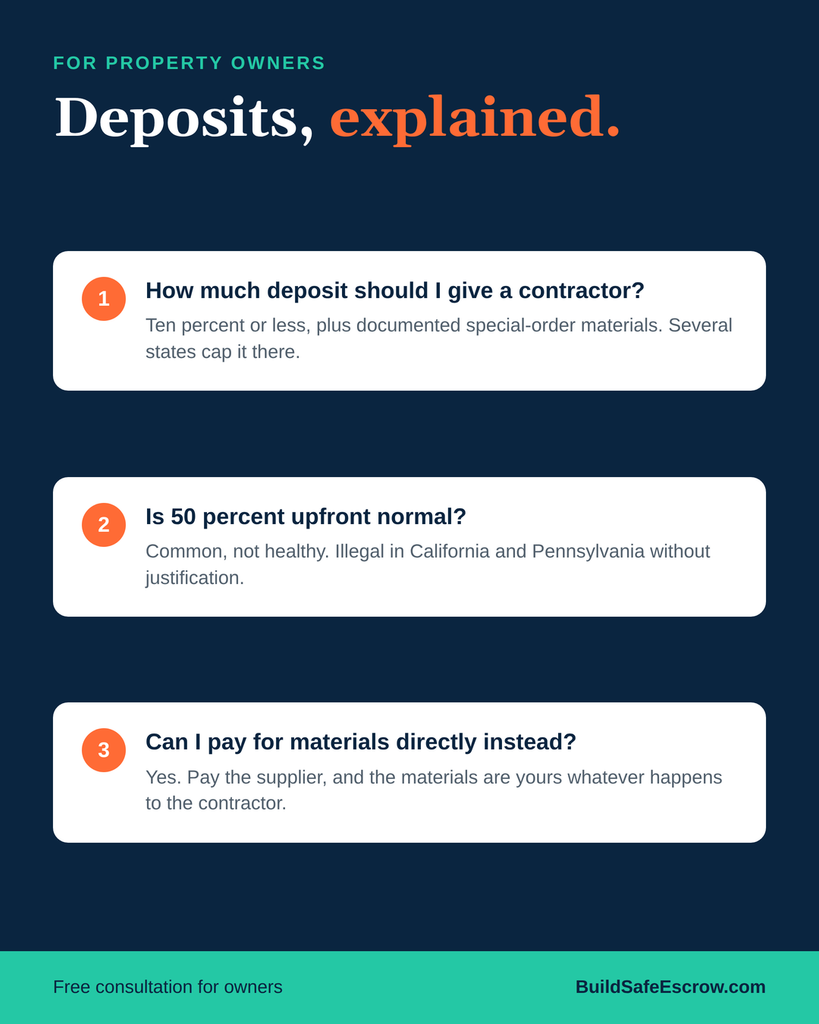
Is paying contractors upfront at 50 percent normal? Common, but not healthy. Most legitimate deposits run 10 to 33 percent. A 50 percent demand with no special-order justification is a red flag, and in California and Pennsylvania it is illegal.
Which states limit paying contractors upfront? California and Nevada cap deposits at 10 percent or $1,000. Pennsylvania, Maryland, Massachusetts, Maine, and Tennessee cap them near one-third. New York and Texas regulate where the money is held rather than how much.
Is a contractor deposit refundable? That depends on the contract and the state. Many states require the contract to say whether it is refundable. Get it in writing before you sign, and expect special-order materials to be non-refundable once ordered.
Can I pay for materials directly instead of paying contractors upfront? Yes, and it is one of the best protections available. Most suppliers will invoice you directly, and the materials are then yours regardless of what happens with the contractor.
What if my contractor takes the deposit and disappears? Document everything, send a written demand by certified mail, file a complaint with the state licensing board, and consult an attorney about small claims or civil action. Several states, including Florida, treat this as a criminal matter.
Without paying contractors upfront, is the contractor not paid until the very end? No. Escrow releases payment at each verified milestone, often within days. Contractors are paid faster and more predictably than with a traditional deposit-and-invoice cycle.
Fund the project without funding the risk
Get one short read each Friday on how construction money actually moves. Subscribe to The Build Brief.
About to sign a contract that asks for money up front? Schedule a free consultation and we will show you how a milestone schedule replaces the deposit.
References
- California Contractors State License Board, Business & Professions Code §7159
- Virginia Department of Professional and Occupational Regulation, Statement of Consumer Protections (effective July 1, 2025)
- Florida Statutes §489.126, Moneys received by contractors
- New York General Business Law §771 and Lien Law §71-a
- Texas Property Code §162.006, Construction trust funds
- Pennsylvania Home Improvement Consumer Protection Act, 73 P.S. §517.9