
Table of Contents
- The check that is always “going out Friday”
- Why contractors end up floating the job
- How does construction escrow work for contractors?
- Construction escrow for contractors, step by step
- Six things to set up before the first draw
- From the field: Luis and the $72,000 remodel
- How escrow removes the problem at the source
- FAQ
- Get paid on milestones, not maybes
- References
The check that is always “going out Friday”
Construction escrow for contractors starts with a scene every builder, general contractor, and specialty trade knows. You finished the rough-in two weeks ago, your supplier wants the lumber bill settled, and the owner’s check is “going out Friday.” It went out Friday last week too.
You are floating the job on your own credit. That is the norm in this industry, and it is the reason so many good crews run thin.
Why contractors end up floating the job
The problem is not bad owners. Most of them want to pay. The problem is the order of operations.
On a typical job, you perform the work first, invoice second, and get paid third, sometimes 30 to 60 days later. In the meantime you have covered payroll, materials, and subs out of pocket. Every day of delay is a loan you are making, interest-free, to someone else’s project.
Three things keep that pattern in place:
- No proof of funds. You signed a contract, but you never saw that the money exists. A promise to pay is not a funded account.
- Vague payment triggers. “Upon substantial completion” means one thing to you and another to the owner. Ambiguity becomes a delay.
- Leverage that only runs one way. Once the work is in the walls, the owner holds the money and you hold the risk.
Construction escrow for contractors flips that order. The money gets deposited first. The work follows. Payment tracks the work, milestone by milestone.
How does construction escrow work for contractors?
Construction escrow for contractors works by having the owner deposit the full project budget into a neutral, FDIC-insured account before work starts, then releasing payment to you in stages as each agreed milestone is completed and verified.
That one sentence covers the whole mechanism of construction escrow for contractors. Read it again and notice what changes for you.
The owner cannot spend the money on something else halfway through. The owner also cannot sit on a check while you cover payroll. And you cannot be paid for work that has not been done, which is exactly what makes a nervous owner comfortable signing.
A neutral escrow agent (Build Safe Escrow, in our case) holds the funds. We are not the lender, not the contractor, and not on either side. When a milestone is verified, the release goes out. No chasing, no “Friday.”
You can read more about construction escrow for contractors on our escrow services page, but the walkthrough below is the version that matters from your seat.
Construction escrow for contractors, step by step
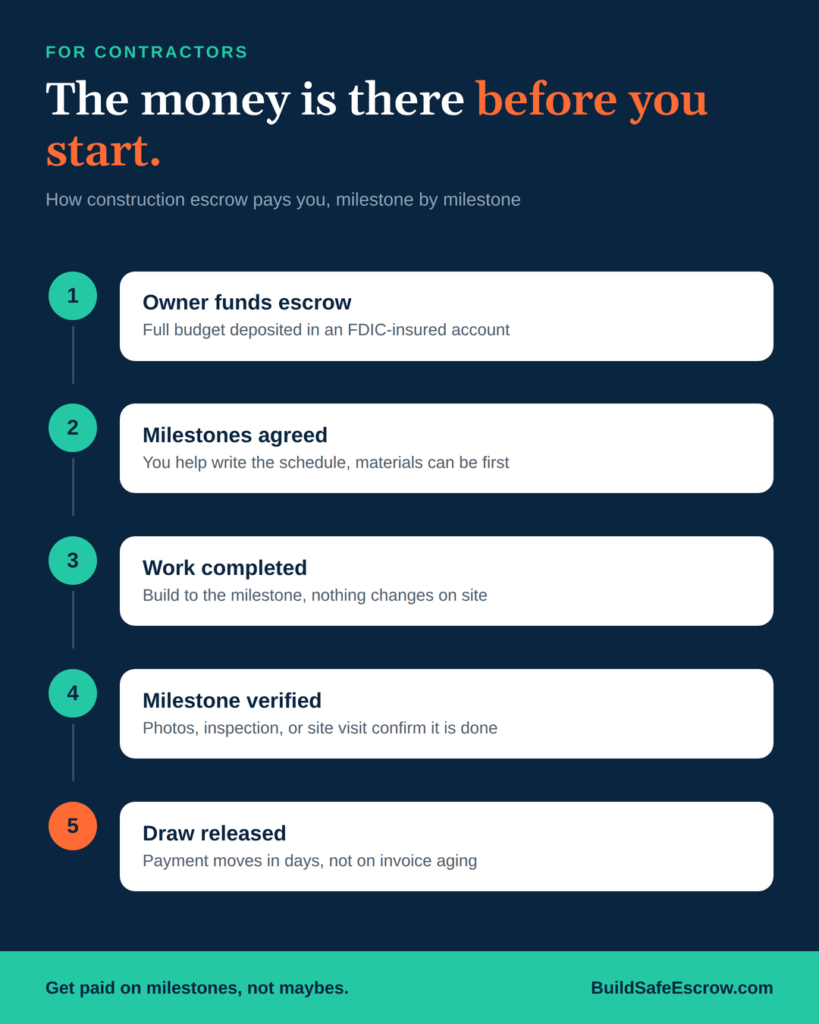
- Funded account. The owner deposits the contract amount into an FDIC-insured escrow account. FDIC insurance means the deposit is federally protected up to the applicable limit if the bank fails. Before you order a single sheet of drywall, you know the money exists.
- Milestone schedule. A milestone is a defined chunk of finished work with a dollar amount tied to it (demolition complete, rough plumbing passed inspection, cabinets installed). You help write this list. It is your production sequence, priced.
- Work completed. You build to the first milestone. Nothing new here.
- Verification. A verification is a check that the milestone is actually done as described, using photos, inspection reports, or a site visit, depending on the scope. It is objective, not a matter of the owner’s mood.
- Staged release. A draw is a payment released from escrow for a verified milestone. It moves on verification, not on invoice aging.
- Repeat, then final release. Each milestone follows the same loop. When the last one is verified, the balance releases, including any retainage (a small percentage, often 5 to 10 percent, held back until final completion, if the contract uses it).
That is the whole model of construction escrow for contractors. Money never moves ahead of the work, and work never waits on money that is not there.
Six things to set up before the first draw
Construction escrow for contractors pays off in proportion to how well you set up the schedule. Here is what to nail down before signing.
- Put a materials milestone first. If you need $18,000 in cabinets and tile on site before framing starts, make “materials delivered and receipted” Milestone 1. Escrow does not require you to float the deposit. It requires the deposit to be tied to something verifiable, and a delivery receipt qualifies.
- Write milestones you can hit in two to three weeks. Long gaps between draws recreate the cash-flow problem you are trying to escape. Short, frequent milestones keep money moving at the pace of the work.
- Define “done” in writing for each one. “Rough electrical complete” should read “rough electrical complete and passed county inspection.” A clear trigger removes the argument before it starts.
- Match lien waivers to each draw. A mechanics lien is a legal claim against the property for unpaid construction work. A lien waiver is the document that gives up that claim for a specific payment. A conditional waiver says “I waive my lien rights once this payment clears.” An unconditional waiver says “I have been paid and waive my rights, period.” With escrow, you sign a conditional waiver at the draw request, the funds release, and the owner has clean title for that stage. Nobody signs away rights before money has moved.
- Bring your subs into the schedule. If your tile setter is paid from Milestone 4, the tile setter should know what Milestone 4 requires. Specialty trades are last to get paid on most jobs. A visible schedule changes that.
- Propose escrow as a selling point. Most contractors wait for the owner to bring it up. Do the opposite. “I use a neutral escrow account so your money is protected and you only pay for verified work.” That sentence closes nervous owners. It also tells them you have nothing to hide, which is the exact reassurance a big-ticket buyer is looking for.
One more note on the myth that construction escrow for contractors slows you down. Verification on a well-written milestone takes a day or two. Chasing a check takes weeks. Contractors who use it on repeat jobs report the opposite of slow: they stop being the bank, and they schedule the next job with confidence.
From the field: Luis and the $72,000 remodel
Luis runs a six-person remodeling crew. He landed a $72,000 kitchen-and-bathroom job for a couple who had been burned once before. They did not want to hand over a $20,000 deposit to someone they met twice. Luis did not want to front $20,000 in cabinets, quartz, and fixtures on his supplier account.
Both fears were legitimate. Both were about the same $20,000.
Luis had read about construction escrow for contractors and proposed it. The owners deposited the full $72,000 into an FDIC-insured account. Together they wrote seven milestones:
- Milestone 1: Materials delivered and receipted, $19,500
- Milestone 2: Demo and rough plumbing passed inspection, $8,000
- Milestone 3: Rough electrical passed inspection, $6,500
- Milestone 4: Drywall, tile, and waterproofing complete, $12,000
- Milestone 5: Cabinets and countertops installed, $14,000
- Milestone 6: Fixtures, paint, and trim complete, $8,400
- Milestone 7: Final walkthrough and punch list, $3,600 (retainage)
The materials draw released the day the delivery was photographed and receipted. Luis paid his supplier that week instead of 45 days later. Every subsequent draw released within two business days of verification. His tile sub got paid from Milestone 4 on schedule, which had never happened on a residential job before.
The job finished nine days early. Luis did not float a dollar of it. The owners never wondered where their money went, because it never left the account until the work was in front of them.
How escrow removes the problem at the source
Every contractor problem in this article traces to the same root: money and work moving out of order. Fix the order and the problems stop appearing.
With construction escrow for contractors, chasing checks disappears because the check is already in the account. Floating materials disappears because a materials milestone can be first. Vague payment triggers disappear because “done” is defined in writing and verified by a neutral party. Being last to get paid stops being the default, because the schedule shows exactly which draw funds which trade.
Owners get the same relief from the other side. They stop worrying about deposits vanishing, and they get proof that every dollar bought finished work.
Trust is a feeling. Structure is protection. Construction escrow for contractors turns the feeling into the structure, so neither of you has to rely on the other’s good intentions to get through the job.
If you want the fuller mechanics, our construction escrow FAQs cover verification, timing, and fees in detail. We are always glad to talk it through, too: contact us here.
FAQ
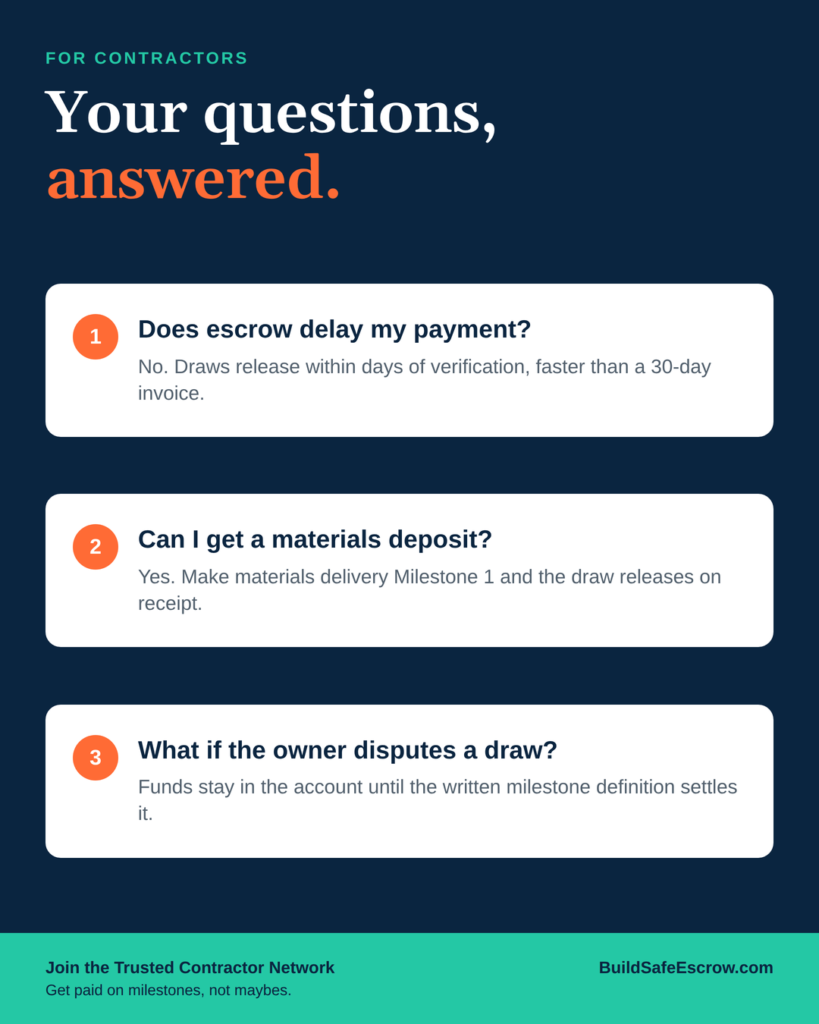
Does construction escrow for contractors delay payment? No. Draws release on verification, usually within a couple of business days of a milestone being confirmed. Compared with waiting 30 to 60 days on a standard invoice, most contractors get paid faster, not slower.
Who decides whether a milestone is complete in construction escrow for contractors? The milestone definition you and the owner agreed to at the start decides it, and a neutral verification confirms it. That is why writing clear, objective triggers matters so much.
Can I get a materials deposit through construction escrow for contractors? Yes. Make materials delivery the first milestone. When the materials are on site and receipted, that draw releases, and you never carry the supplier balance on your own credit.
What happens if the owner and I disagree on a draw? The funds stay in the account until the milestone is resolved against the written definition. Nobody can pull the money out unilaterally, which keeps a disagreement from turning into a walk-off.
Do I still need lien waivers if I use escrow? Yes, and they work better. You sign a conditional waiver with each draw request, the payment releases, and the owner gets a clean stage of title. Rules vary by state, so confirm the form and timing with your own attorney or accountant.
Get paid on milestones, not maybes
Get one short read each Friday on how construction money actually moves. Subscribe to The Build Brief.
Join the free Trusted Contractor Network. Build trust. Win more projects. Get paid on milestones, not maybes.
This article is general information, not legal or financial advice. Lien laws, waiver forms, and retainage rules vary by state, so review your specific situation with your own attorney or accountant.
References
- FDIC, Deposit Insurance: https://www.fdic.gov/resources/deposit-insurance/
- Cornell Law School Legal Information Institute, Mechanics Lien: https://www.law.cornell.edu/wex/mechanics_lien
- American Institute of Architects, contract documents and payment guidance: https://www.aia.org/