
Table of Contents
- The check that leaves your hands first
- Why the deposit is where projects go wrong
- How does construction escrow work?
- How construction escrow works, step by step
- What to set up before the first dollar moves
- From the field: Priya and the 40% deposit
- How escrow removes the problem at the source
- FAQ
- Keep the money behind the work
- References
The check that leaves your hands first
If you are a homeowner about to fund a renovation, understanding how construction escrow works is the difference between hoping and knowing. You have a signed contract, a start date, and a contractor asking for a large deposit before a single wall comes down. You write the check, and now the only thing protecting that money is your belief that the work will follow.
Most of the time it does. But you are planning for the one project where it doesn’t.
Why the deposit is where projects go wrong
Renovation payments usually run on a schedule the contractor sets. A deposit up front, a chunk at rough-in, a chunk at drywall, the rest at the end. On paper that looks like progress-based payment. In practice, each check is written before the stage it pays for is finished.
Three things make that risky for a property owner:
- Cash arrives ahead of work. Once the deposit clears, you have no leverage until the next check is due.
- Nobody neutral is checking. You are relying on your own eye, or the contractor’s word, to confirm a stage is complete.
- The money mixes with everything else. Your deposit may be funding another client’s job, a materials bill from last month, or payroll.
None of this means your contractor is dishonest. It means the structure is fragile. A good contractor with a cash-flow problem can leave you in the same spot as a bad one.
The fix is to change where the money sits and when it moves. That is what escrow does, and how construction escrow works is easier than most owners expect.
How does construction escrow work?
Construction escrow works by placing your renovation funds with a neutral third party in an FDIC-insured account, then releasing them to the contractor in stages, only after each agreed milestone is completed and verified.
The key word in how construction escrow works is neutral. The escrow provider is not your bank, not your lender, and not your contractor’s partner. It is a referee that holds the money and follows a schedule both of you signed. Nobody gets paid early, and nobody gets held hostage at the end.
Once you see how construction escrow works, the appeal for both sides is obvious. You know your money is safe and tied to real progress. Your contractor knows the full contract amount is funded on day one and will be released on time, every time a milestone clears. Many good contractors prefer it for that reason. You can read about the full structure on our escrow services page.
How construction escrow works, step by step
Assume you have never used escrow before. This is the whole process, in order.
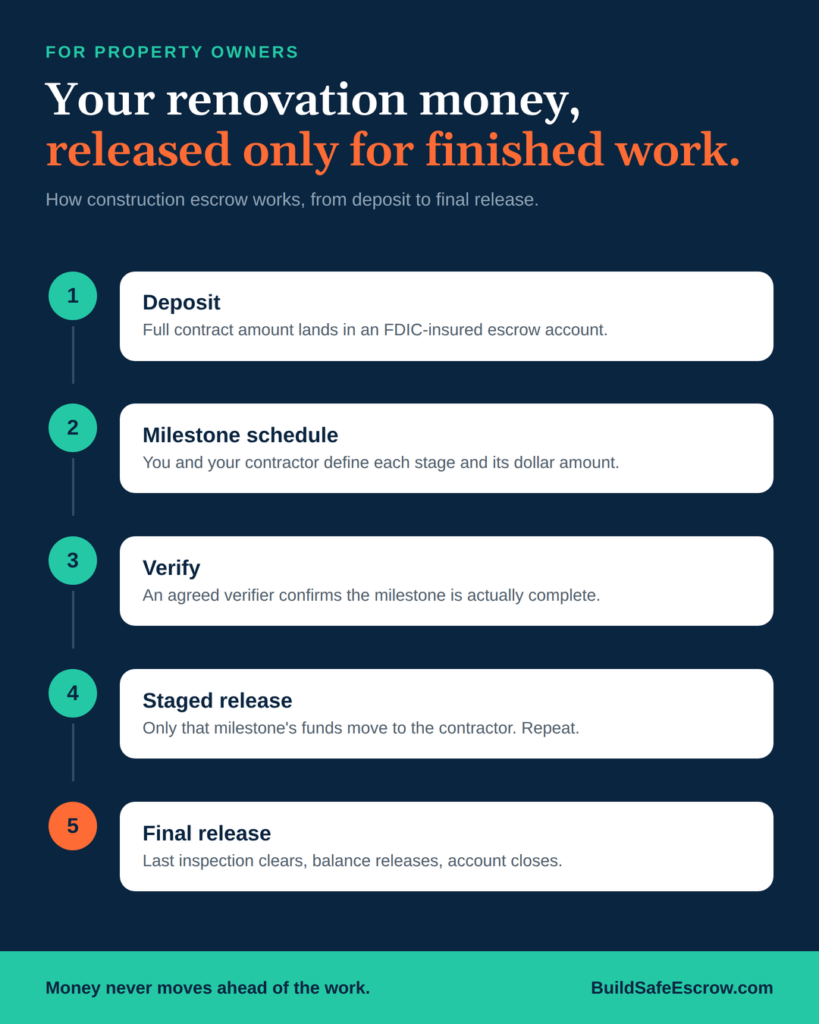
- Deposit. You fund the escrow account with the contract amount (or the first phase of it, on larger projects). The account is FDIC-insured, meaning deposits are protected up to the federal limit per depositor, per insured bank, per ownership category. The money is now separate from the contractor’s operating cash and separate from yours.
- Milestone schedule. Before work begins, you and your contractor agree on a written list of milestones. A milestone is a defined, observable stage of work with a dollar amount attached: demolition complete, rough plumbing and electrical passed inspection, drywall hung and finished, cabinets installed. Each line answers two questions. What has to be done, and how much is released when it is.
- Work. The contractor builds toward the first milestone. Because the funds are already sitting in escrow, there is no chasing, no “the check is in the mail,” and no reason to front-load a deposit.
- Verification. When the contractor says a milestone is done, it gets confirmed before money moves. Verification is the check that the agreed scope is actually complete. Depending on the project, that can mean a permit inspection sign-off, photo documentation, a site visit, or the owner’s written approval. The standard is set in the milestone schedule, so nobody is arguing about what “done” means after the fact.
- Staged release. Once verified, the escrow provider releases that milestone’s amount to the contractor. This is sometimes called a draw. Then the cycle repeats: work, verify, release. On some projects a small percentage of each draw, called retainage, is held back until the end as a completion incentive. Whether you use it is a contract decision, not an escrow requirement.
- Final release. After the last milestone is verified (usually final inspection plus a punch list walk-through), the remaining balance is released. The account closes. The project is paid in full, and every dollar moved behind finished work.
That is how construction escrow works from start to finish. There are no hidden steps.
What to set up before the first dollar moves
Knowing how construction escrow works is half the job. The other half is the schedule, because escrow is only as good as the schedule behind it. A property owner who gets these five things right will rarely have a payment problem.
- Write milestones you can see. “50% complete” is not a milestone. “Rough electrical passed city inspection” is. Tie each stage to something inspectable or photographable.
- Match dollars to real value. Early milestones should reflect early costs (demolition, framing, materials), not a lump to cover the contractor’s cash-flow gap. If your contractor needs a large upfront payment for materials, make materials delivery its own verified milestone.
- Agree on the verifier in advance. Decide who confirms each milestone: an inspector, a third-party reviewer, or you. Put it in writing. Verification is what makes the release fair to both sides.
- Use lien waivers at each release. A mechanics lien is a legal claim a contractor or supplier can file against your property if they are not paid. A lien waiver is a signed statement that a party has been paid for a stage and gives up the right to lien for that amount. Ask for a conditional waiver with each draw request (it becomes effective when payment lands) and an unconditional waiver after payment clears. That protects you from paying twice.
- Keep a change-order path. Renovations change. When scope grows, add a milestone and fund it rather than inflating an existing one. The construction escrow FAQs walk through how changes get handled mid-project.
Not sure how a specific scope should break into stages? That is exactly the conversation to have before signing. Ask your attorney about the contract terms; ask us about the structure.
From the field: Priya and the 40% deposit
Priya is funding a $95,000 whole-house renovation: kitchen, two bathrooms, flooring, and a rewire. Her contractor’s proposal asked for 40% up front, or $38,000, before demolition.
She liked the contractor. She did not like the idea of $38,000 leaving her account against nothing but a signature. A friend had explained how construction escrow works, so she proposed it. The full $95,000 went into an FDIC-insured escrow account. Together they wrote a six-milestone schedule:
- Demolition and debris removal complete: $9,500
- Rough plumbing and electrical, passed inspection: $19,000
- Drywall and paint complete: $14,250
- Cabinets, counters, and tile installed: $23,750
- Flooring and fixtures installed: $19,000
- Final inspection and punch list signed off: $9,500
The contractor got something better than a 40% deposit. He got proof that all $95,000 existed and was committed to his project. Priya got something better than a promise. The first $9,500 moved only after the demo was done and photographed.
At milestone four, the tile subcontractor missed a week. The draw waited a week. Nothing else happened, and nothing needed to. When the tile passed, the money moved the same day.
That is how construction escrow works when it is set up well. The story is boring, and boring is the goal.
How escrow removes the problem at the source
Every risk in the opening section traces back to a single mistake: money moving ahead of the work. The deposit that vanished, the stage that was paid before it was finished, the contractor who walked with a balance still in hand. Same root cause.
Escrow reverses the order. Work first, verification second, money third. That sequence is how construction escrow works, and it holds under pressure.
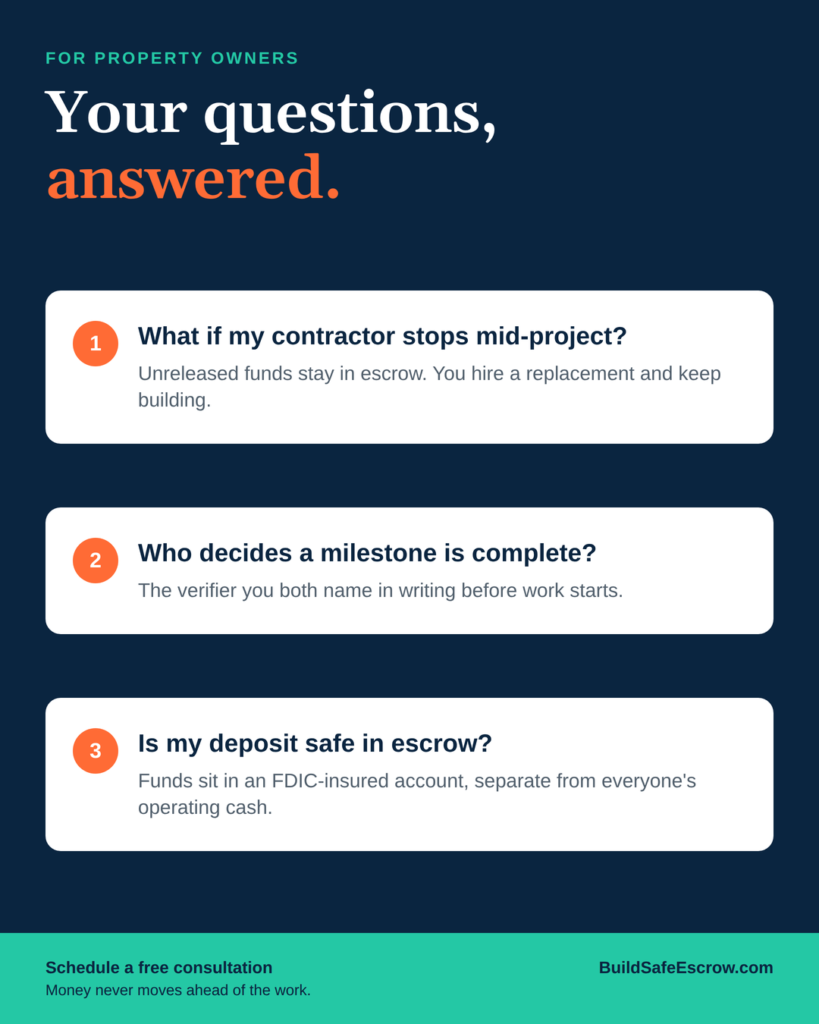
What happens if the contractor stops? The unreleased funds stay in the account. They are still yours. You can hire a replacement and fund the remaining milestones from the same balance. The money can’t vanish.
What happens if you are unhappy with a stage? The milestone does not verify, so the draw does not release. You and the contractor resolve the scope against the written standard you both agreed to. You are not negotiating with money already gone.
What does it cost? Escrow providers charge a flat fee for setting up and administering the account. It is modest relative to the funds being protected, and it is known before the project starts. Weigh it against the size of the deposit you were about to write.
Trust is a feeling; structure is protection. Escrow turns the feeling into the structure. If you want the shorter definition first, start with what construction escrow is, then come back to this walkthrough.
Money never moves ahead of the work. Everything else about how construction escrow works follows from that one rule.
FAQ
How does construction escrow work if my contractor refuses to use it? Some contractors are unfamiliar with it, and hesitation is common. Explain that the full contract amount is funded on day one and released on a schedule they help write. Contractors who understand how construction escrow works usually see it as a guarantee of payment, not a hurdle.
Is my money safe, given how construction escrow works? Funds are held in an FDIC-insured account at a bank, separate from the escrow provider’s and the contractor’s operating money. Deposit insurance limits apply, so ask how large balances are structured.
Who decides when a milestone is complete? The verifier you name in the milestone schedule. That can be a permit inspector, a third-party reviewer, or the owner, depending on the stage. The point is that it is agreed before work starts.
How long does a release take once a milestone is verified? Typically a matter of days, and often faster. Ask your provider for their standard turnaround so your contractor can plan around it.
Does using escrow replace a written contract? No. Escrow enforces the payment schedule inside your contract; it does not replace the contract itself. Have your own attorney review the agreement, and ask the Build Safe Escrow team how construction escrow works alongside it.
Keep the money behind the work
Get one short read each Friday on how construction money actually moves. Subscribe to The Build Brief.
If you are about to fund a renovation or build and want to see how construction escrow works for your specific project, schedule a free consultation. We will walk through your scope, sketch a milestone schedule, and show you exactly where the money would sit.
References
- Federal Deposit Insurance Corporation, Deposit Insurance: https://www.fdic.gov/resources/deposit-insurance/
- Federal Trade Commission, Hiring a Contractor: https://consumer.ftc.gov/articles/hiring-contractor
- Cornell Law School Legal Information Institute, Mechanics Lien: https://www.law.cornell.edu/wex/mechanics_lien