

Table of Contents
- What retainage is — and why it exists
- Why retainage in construction hurts more than it should
- What is retainage in construction?
- Five ways to stop losing your last 10%
- From the field: Theo’s drywall math
- How escrow turns retainage from leverage into verification
- FAQ
- References
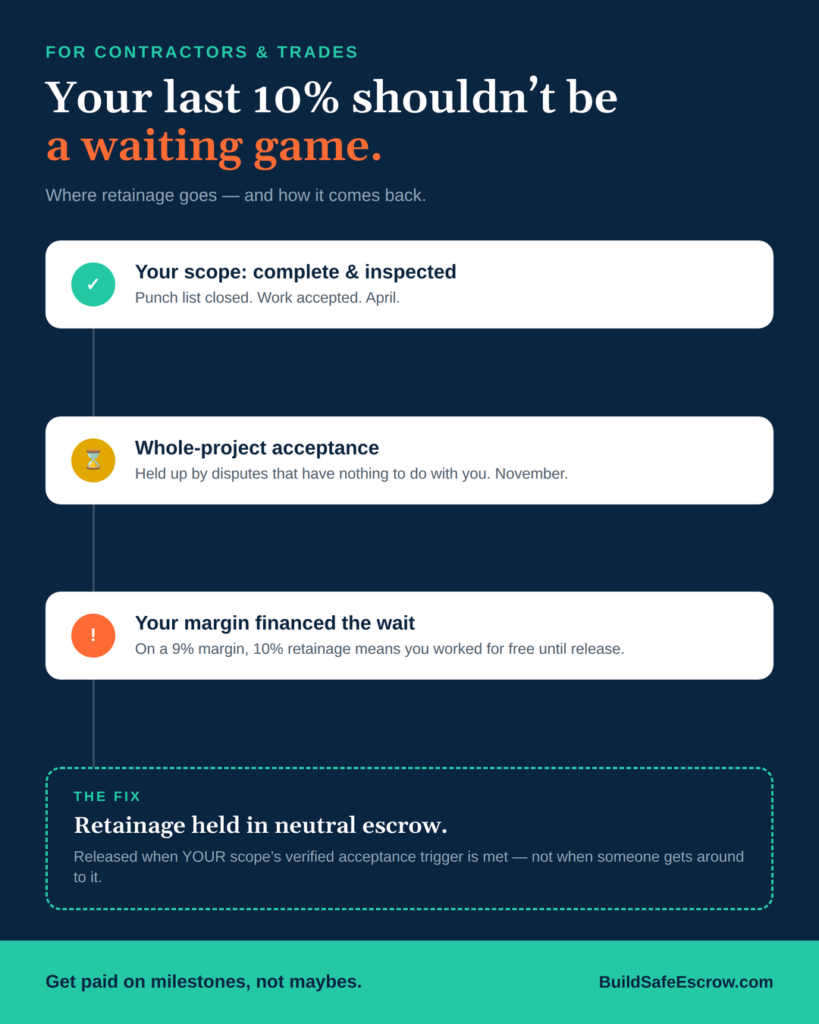
Retainage in construction is the money you already earned that you’re not allowed to have yet. If you’re a general contractor or a specialty trade, you know the shape of it: the work passed inspection months ago, the punch list is closed, and 5–10% of the contract is still sitting in someone else’s account “pending final acceptance.”
For the party writing the checks, it feels like insurance. For the party who did the work, it’s an interest-free loan you never agreed to make. This guide covers how to shrink it, track it, and get it released on proof instead of patience.
What retainage is — and why it exists
Retainage in construction (also called retention) is a percentage — typically 5–10% — withheld from every progress payment until the project, or a defined phase of it, is complete and accepted. The practice dates back to 19th-century railroad construction, and the original logic still gets cited today: hold back enough money that the contractor has a reason to finish the punch list.
There’s a real problem underneath it. Incomplete work, defects discovered late, and abandoned punch lists are genuine risks for owners. Retainage is a blunt instrument aimed at a real target.
But the instrument has drifted far from the target. Withheld funds routinely sit long after the risk they were meant to cover has expired — through final inspections, through certificates of occupancy, and sometimes through an entire warranty period the contract never tied them to.
Why retainage in construction hurts more than it should
The math is what makes the practice uniquely painful for trades:
- Margins are thinner than the withholding. Many subcontractors run net margins in the 5–10% range. When retainage is 10%, you’ve completed the job and your entire profit — and sometimes part of your cost — is still unpaid.
- You’re last in the release chain. Subs typically can’t collect retainage until the GC collects from the owner, and the GC can’t collect until final acceptance of the whole project. Your plumbing was done in March; you’re waiting on landscaping in October.
- It compounds across jobs. A trade running six projects at once can have an entire project’s worth of revenue locked up in withheld payments — while payroll, materials, and insurance bills arrive weekly.
- It quietly prices your bids. Whether you realize it or not, financing the wait is a cost — line-of-credit interest, delayed hiring, passed-up work. Trades that carry heavy retainage either eat that cost or pad every bid to cover it.
This is why slow payment consistently ranks among the top financial pressures on trades, and why lien filings spike when payment cycles stretch.
What is retainage in construction?
Retainage in construction is a percentage of each progress payment — usually 5–10% — withheld until the project is complete and accepted, meant to guarantee finished work but often held long past the point it protects anyone. It is not a penalty and not a bonus; it is your earned money, sitting as leverage. The rest of this article is about converting that leverage back into a payment with a defined trigger.
Five ways to stop losing your last 10%
1. Negotiate the rate — and the step-down — before you sign. Retainage in construction is a contract term, not a law of nature. Ask for 5% instead of 10%. Better, ask for a step-down clause: 10% held until the project is 50% complete, then 0% withheld on the back half. Owners agree to this more often than most trades expect, because by mid-project they have evidence of your performance. The ask is simple: “I’ll take standard retainage through the halfway point. Once you’ve seen the first half of my work, the second half bills clean.”
2. Know your state’s caps and prompt-payment laws. Many states cap retainage in construction contracts on public projects — often at 5% — and set deadlines for releasing it after completion, with interest penalties for late release. Private work is catching up: New York, for example, now caps retainage at 5% on private projects and lets contractors invoice for it at substantial completion. Ten minutes with your state’s prompt-payment statute changes your negotiating position from a favor to a citation.
3. Track retainage as its own receivable — and bill for it the day it’s due. Withheld amounts hide inside “contract balance” on too many books. Break retainage out as a separate line item per project, with the contractual release trigger and date attached. Review the aging monthly, the same way you review any receivable. When the trigger hits, invoice for it that day — in writing, referencing the contract clause. Money that isn’t invoiced isn’t late — it’s forgotten. And money that is invoiced starts the prompt-payment clock in states that have one.
4. Use conditional lien waivers with precision. Never sign an unconditional waiver — one that gives up lien rights outright — for a payment that includes retainage you haven’t received. A conditional waiver releases rights only when the money actually arrives. Sign the wrong form and you’ve waived your strongest collection tool while the withholding is still outstanding.
5. Move the held funds to neutral ground. The deepest problem with retainage in construction is who holds it: the party with an incentive to delay. The fix is structural — the withheld percentage sits in a neutral, FDIC-insured escrow account, and it releases when the completion trigger is verified, not when someone gets around to it. The money is visibly there the whole time, and release is a defined event instead of a favor.
From the field: Theo’s drywall math
Theo runs a nine-person drywall company, and his hardest lesson in retainage in construction came on a job he did everything right. Last year he finished a $380,000 scope on a mixed-use project in April — passed inspection, closed his punch list, demobilized. His 10% retainage, $38,000, was contractually due at “final completion of the project.”
The project’s final completion came in November, held up by a site-work dispute that had nothing to do with drywall. For seven months, Theo’s entire margin on the job — his margin was 9% — sat as someone else’s contingency fund. He made payroll that summer on a line of credit that cost him real interest against money he had already earned. Nothing in the contract had been breached. Nothing needed to go wrong for the math to hurt — the structure itself was the problem.
On his next major bid, Theo priced two versions: standard terms, and a 4% discount if the withheld funds were held in a neutral escrow account with release tied to his scope’s acceptance. The owner took the discount. Both parties got what retainage was supposed to provide — assurance of completion — without one party financing the other.
How escrow turns retainage from leverage into verification
Every fix above is a version of the same principle: money should never move ahead of the work — and it shouldn’t lag behind it either. Retainage in construction fails when it stops being verification and becomes leverage: funds held not because work is unverified, but because holding them is convenient.
A neutral escrow structure restores the original purpose. The full contract amount, including the withheld percentage, sits in a secure, FDIC-insured account from day one. Progress payments release on verified milestones. The retainage portion releases on the verified completion trigger the contract defines — inspection passed, punch list closed, scope accepted. Nobody chases anybody, because nobody is holding anybody’s money as a negotiating chip. That is what retainage in construction looks like when it works as designed: a completion guarantee with a defined release, instead of an open-ended loan from the people doing the work to the people watching it.
For trades, there’s a second benefit: bidding on escrowed projects means bidding on funds you can see. That’s the difference between pricing risk and pricing work — and it’s why contractors bid sharper on escrowed jobs. See how the structure works on our escrow services page, or start with the construction escrow FAQs. <!– MEDIA: Infographic here (retainage step-down / neutral release flow). Alt text: “Infographic showing how retainage in construction releases on verified completion through neutral escrow” –>
FAQ
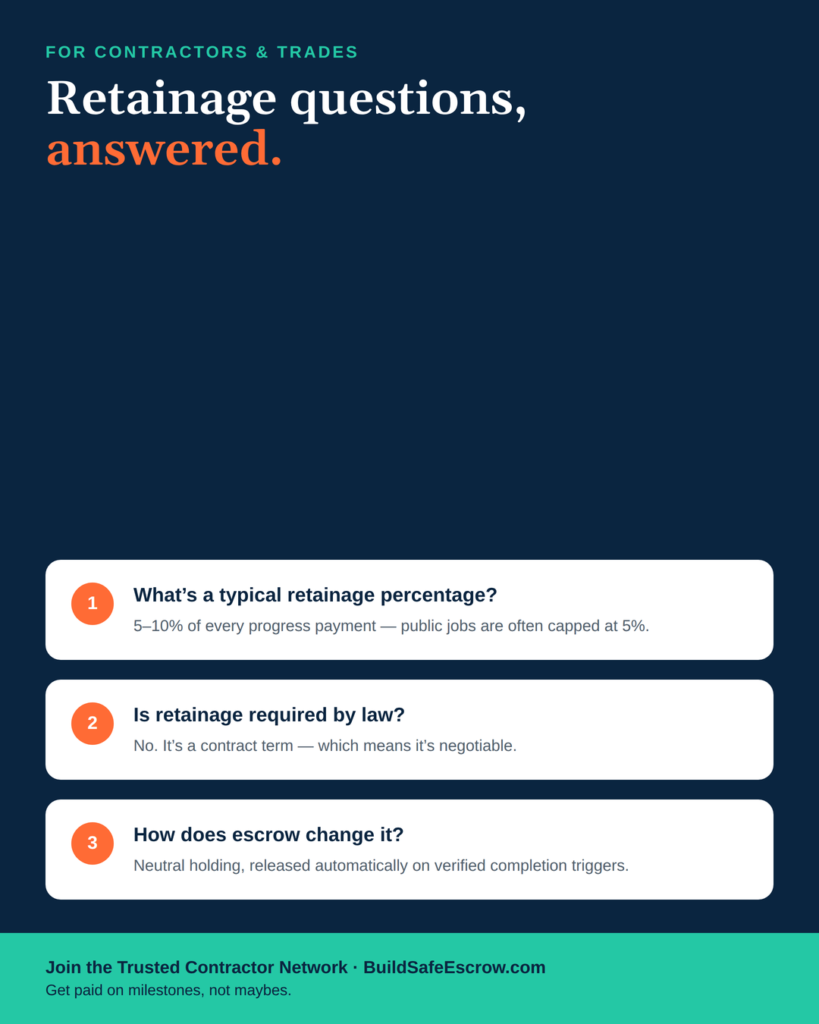
What is a typical retainage percentage? Retainage in construction typically runs 5–10% of each progress payment. Public projects in many states are capped at 5%, and step-down structures (10% to the halfway point, then zero) are increasingly common.
Is retainage in construction legally required? No. It’s a contract term. State law caps it in many cases — especially on public work — but no law requires an owner to withhold it, which means it’s negotiable.
When does retainage have to be released? Whatever the contract says — which is exactly the problem when the trigger is vague. Prompt-payment statutes in many states set outside deadlines after completion, often with interest for late release.
Can I file a lien over unpaid retainage? Generally yes — withheld amounts are earned, billable sums, and lien deadlines run whether or not the money has been released. Watch your state’s filing window, and never sign an unconditional waiver covering money you haven’t received.
How does escrow change retainage? The withheld funds sit in a neutral, FDIC-insured account instead of the payer’s account, and they release automatically when the verified completion trigger is met — verification without the waiting game.
Get paid on milestones, not maybes
Get one short read each Friday on how construction money actually moves — subscribe to The Build Brief.
And if you’re tired of financing the projects you build, join the free Trusted Contractor Network. Build trust. Win more projects. Get paid on milestones, not maybes.
This article is information, not legal or financial advice. Retainage caps, prompt-payment deadlines, and lien rules vary by state — consult your own professional for your specific situation.
References
- American Subcontractors Association — retainage advocacy and resources: https://www.asaonline.org/
- Levelset — retainage guides by state: https://www.levelset.com/retainage/
- Associated General Contractors of America — contract and payment resources: https://www.agc.org/
- Rabbet — Construction Payments Reports (cost of slow payment): https://www.rabbet.com/