
When an HOA or condo association takes on a major project — a roof replacement, a facade repair, repaving, elevator modernization, structural work — it is usually spending some of the largest sums it will ever handle. That money often comes from carefully built reserves, a special assessment that residents felt in their wallets, or both. Which means every dollar is under scrutiny, and the board is personally on the hook for handling it responsibly. HOA renovation escrow exists to protect those funds — and the people responsible for them.
Why association money is under so much pressure
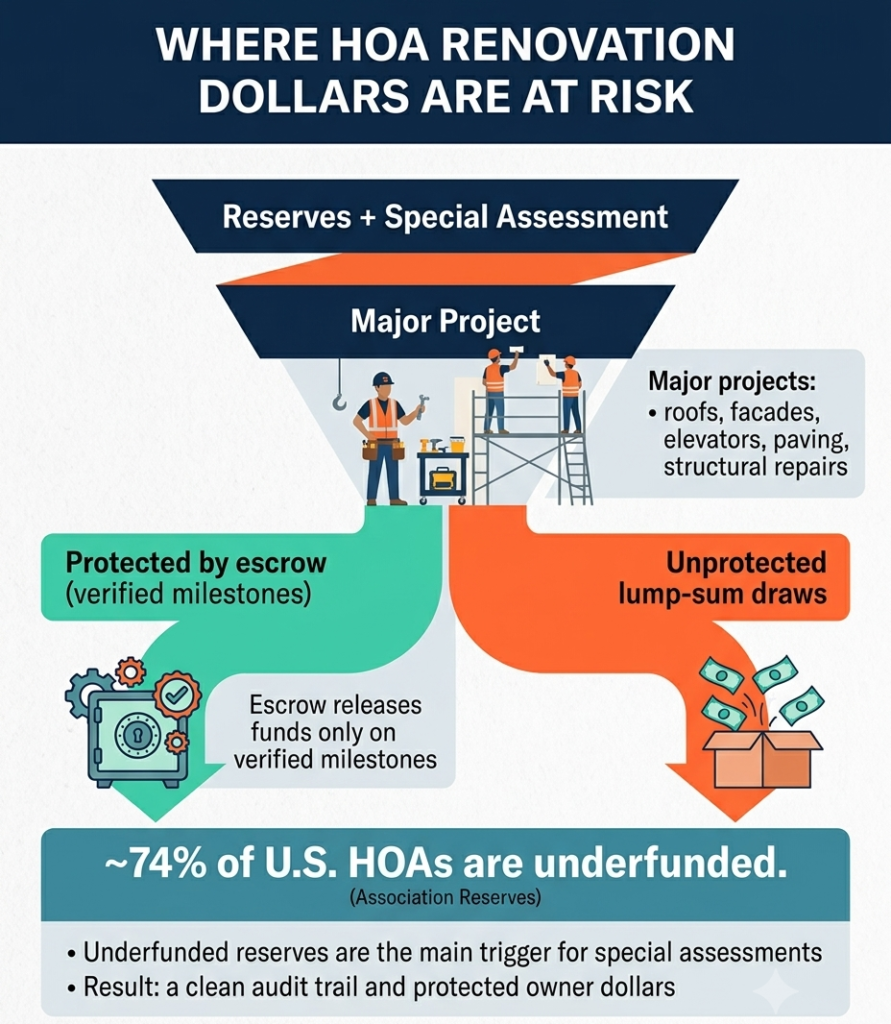
Most associations are already financially stretched. According to Association Reserves data, which draws on more than 100,000 reserve studies, roughly 74% of HOAs in the United States are underfunded — the highest underfunding rate the firm has ever recorded. The Community Associations Institute’s National Reserve Study Standards recommend keeping reserves at 70% or more of the fully funded balance; far too many associations sit well below that, and anything under 30% is considered critically underfunded.
Underfunded reserves are the single biggest reason boards have to levy special assessments — one-time charges that fall directly on owners to cover a major repair the reserves can’t. A 2026 industry analysis estimates that about 35% of associations expect to issue a special assessment within the next five years. By the time a community is funding a big project from a special assessment, residents are already paying close attention. They want to know their money is being spent exactly as promised, and not a dollar more is leaving the account than the work justifies.
The risk of paying a contractor in lump sums
The traditional way associations pay for big projects — a large deposit, then progress payments released on the manager’s or board’s say-so — creates two serious risks. The first is financial: a lump-sum deposit on a major contract is a lot of owner money sitting in a contractor’s account before the work is done. The second is governance: when residents later ask “Who approved that payment, and why?”, even a completely honest board can end up under suspicion if there isn’t a clean, neutral record. As reserve-study specialists at Reserve Advisors note, a documented, professionally guided financial trail is one of the board’s best protections if a decision is ever challenged.
On a project funded by people’s own assessment checks, both risks are amplified. A stalled or failed contractor doesn’t just cost the association money — it can fracture trust in the board and trigger exactly the kind of dispute that consumes a community for months.
How HOA renovation escrow protects the project
HOA renovation escrow puts association funds in a secure, neutral third-party account and releases them to the contractor only as each defined milestone is completed and verified. For a major association project, that does several things at once:
- Protects the principal: Reserve and assessment dollars stay in a neutral account, not in a contractor’s hands, until there is verified work to pay for.
- Ties money to progress: Each draw is released against a confirmed milestone, so the association never pays ahead of the work.
- Creates an audit trail: Every disbursement is documented against a completed phase — a clean, neutral record of where each dollar went.
- Removes the board from suspicion: When a resident asks who approved a payment, the answer is a verified milestone and a third-party record, not a board member’s judgment call.
- Reduces disputes: A shared milestone schedule keeps the contractor, the board, and the manager aligned on what gets paid and when.
Why boards and managers increasingly ask for it
For a community manager, escrow is a way to handle large sums with built-in accountability rather than personal exposure. For a board, it is a way to show fiduciary responsibility to the residents who funded the project — and to protect themselves from accusations if something goes wrong. And for the residents who paid a special assessment, it is the assurance that their money is being released only for work that is actually finished and verified.
Reserve requirements and association rules vary by state, so a board should always confirm its specific obligations with a qualified community association attorney. But the underlying principle holds everywhere: when an association is spending the largest sums it handles, on money that came straight from its members, the responsible move is to hold those funds neutrally and release them only against verified progress. That is what HOA renovation escrow is for.
Frequently Asked Questions about HOA renovation escrow
What is HOA renovation escrow?
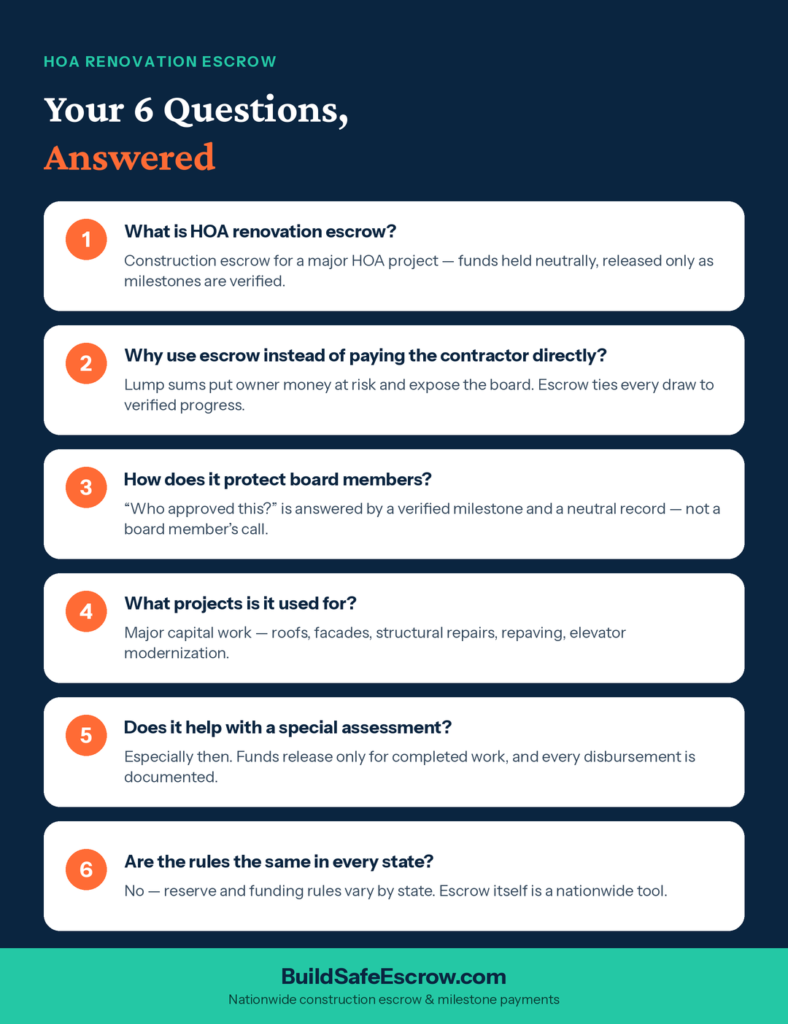
HOA renovation escrow is the use of construction escrow for an association’s major repair or renovation project. The HOA’s funds — whether from reserves, a special assessment, or both — are held in a secure, neutral third-party account and released to the contractor only as each defined milestone is completed and verified.
Why would an HOA use escrow instead of paying the contractor directly?
Direct lump-sum payments put large amounts of owner money in a contractor’s hands before the work is done, and they leave the board exposed if residents later question a payment. Escrow keeps the funds neutral, ties each draw to verified progress, and creates a clean audit trail that protects both the money and the board.
How does HOA renovation escrow protect board members?
It removes the board from the middle of every payment decision. When a resident asks who approved a disbursement, the answer is a verified milestone and a neutral third-party record — not a board member’s discretion — which demonstrates fiduciary responsibility and reduces the risk of accusations.
What kinds of HOA projects is escrow used for?
Major capital projects where large sums are at stake: roof replacements, facade and structural repairs, repaving, elevator modernization, and similar work funded from reserves or a special assessment.
Does escrow help when a project is funded by a special assessment?
Especially then. Residents who paid a special assessment scrutinize how that money is spent. Escrow assures them funds are released only for completed, verified work and documents every disbursement, which helps maintain trust during a financially sensitive project.
Are reserve and escrow rules the same in every state?
No. Reserve study and funding requirements vary by state, and an association’s governing documents may add their own rules. A board should confirm its specific obligations with a qualified community association attorney. Escrow itself is a nationwide tool for protecting and disbursing project funds.