
When you’re investing in a construction or renovation project, your priority is clear: finish the job correctly, on schedule, and without losing money if something goes wrong.
For decades, the go-to financial safeguard has been the Construction Bond — a formal guarantee that protects project owners if a contractor defaults or fails to meet contractual terms. But in today’s high-risk construction environment, there’s a new, faster, and often more effective tool: Construction Escrow.
While both a Construction Bond and Construction Escrow aim to protect project funds, they work in very different ways. Understanding the difference could save you months of frustration and thousands of dollars.
What Is a Construction Bond?
A Construction Bond is a legally binding agreement among three parties:
- Principal – The contractor who is performing the work.
- Obligee – The project owner who is protected by the bond.
- Surety – The surety company or financial institution that guarantees the contractor’s performance.
In essence, a Construction Bond is the contractor’s promise — backed by the surety — to perform the work and fulfill the contract. If the contractor fails, the project owner can make a claim on the bond to recover financial losses or get the project completed.
Common Types of Construction Bonds
- Bid Bond – Ensures a contractor will honor their bid and sign the contract if selected.
- Performance Bond – Guarantees that the contractor will complete the project as per contract terms.
- Payment Bond – Protects subcontractors and suppliers, ensuring they get paid even if the contractor fails to do so.
- Maintenance Bond – Covers defects in materials or workmanship for a set period after completion.
- Subdivision Bond – Ensures public improvements (sidewalks, drainage, utilities) in a development are completed.
- Mechanic’s Lien Bond – Protects the owner if a lien is filed by unpaid subcontractors or suppliers.
How Much Does a Construction Bond Cost?
The cost of a Construction Bond depends on two main numbers:
- Bond Amount (Penal Sum) – Usually 100% of the total project value for a performance bond.
- Bond Premium (Fee) – The cost paid to the surety, typically 1%–3% of the bond amount for well-qualified contractors, but it can be up to 15% for high-risk cases.
Example:
For a $500,000 project, a Construction Bond with a 2% premium would cost the contractor $10,000.
Payout Speed for Construction Bonds: Why It Can Be Tricky
While having a Construction Bond provides a safety net, the payout speed is often slower than owners expect.
Here’s why:
- Proof of Default – Before the surety pays, they must first confirm that the contractor was truly in default. This means reviewing the contract, project records, payment history, and even interviewing all involved parties. This investigation alone can take weeks or months.
- Claim Approval – Even after confirming the default, the surety must decide how to respond: pay the owner, hire a replacement contractor, or fund completion. Each decision requires additional internal review.
The Result: Even with good intentions and a clear case, a payout can take far longer than expected — often 90 days or more — and during that time, your project timeline can be significantly hindered.
What Is Construction Escrow?
Construction Escrow is a proactive payment method that holds funds in a neutral account and releases them only when specific project milestones are completed and verified.
Unlike a Construction Bond, which reacts after something goes wrong, Construction Escrow prevents many problems from happening in the first place.
Here’s how it works:
- Funds Deposited – The project owner deposits the agreed project funds into a secure escrow account before work begins.
- Milestones Defined – Payment milestones are outlined in the contract.
- Verification – When a milestone is reached, it’s verified by the owner or a third party.
- Payment Released – Escrow releases funds within 1–2 business days.
Construction Bond vs. Construction Escrow — Key Differences
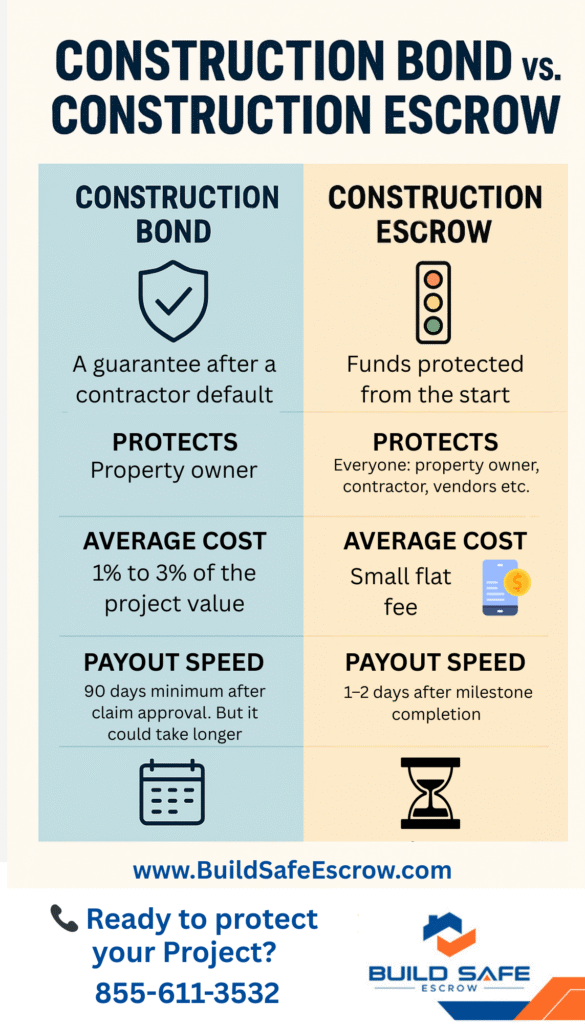
| Feature | Construction Bond | Construction Escrow |
| Purpose | Guarantee after failure | Prevention before failure |
| When Protection Kicks In | After contractor default or breach | From day one |
| Who Pays | Contractor buys the Construction Bond | Owner or contractor pays escrow fee |
| Cost | 1–3% of project value (higher for high-risk) | Small flat fee or small % of funds held |
| Payout Speed | 90 days minimum after claim approval | 1–2 business days after milestone verification |
| Protection Scope | Primarily protects the owner | Protects both owner & contractor |
| Risk Approach | Reactive | Proactive |
Real-World Example: Why Timing Matters
Scenario 1 — Using Only a Construction Bond
A contractor on a $1 million commercial renovation project declares bankruptcy halfway through. The owner files a bond claim. After 90 days of investigation — and another month for claim approval — the surety finally pays $500,000. Meanwhile, the project sits idle, and delays cost the owner an additional $150,000 in lost revenue.
Scenario 2 — Using Construction Escrow
Same situation, but funds were in escrow. When the contractor defaults, the remaining $500,000 is still in the escrow account. Within 48 hours, the owner hires a replacement contractor and resumes work — avoiding months of downtime and costly losses.
How They Work Together
Some projects, especially public works, require a Construction Bond by law. But even then, escrow can fill the gaps a bond can’t cover.
Think of it like this:
- Construction Bond = Fire extinguisher (you hope you never use it, but it’s there for emergencies).
- Construction Escrow = Fire prevention system (stops problems before they spark).
When combined, they provide complete financial protection.
Final Word: Don’t Just Rely on a Construction Bond
A Construction Bond is an important safety net — especially for large or public projects — but it’s reactive by nature. Construction Escrow is proactive, ensuring your funds are protected before problems arise.
If your project matters, don’t choose between them. Use a Construction Bond when required, but make Construction Escrow your first line of defense.
Protect Your Project with Build Safe Escrow
Set up a Construction Escrow account today and safeguard your funds from the start.
👉 Schedule a free consultation and discover how our milestone-based escrow system is helping property owners, contractors, and developers safeguard their investments—and their peace of mind.
Want to talk to someone about setting up an escrow account for your project?
📞 Call us at (855) 611-3532
🌐 Visit www.buildsafeescrow.com
Ready to Go Deeper? Grab Our Free Guides:
🏡 For Property Owners:
Renovate Smarter: How to Protect Your Project Funds
Discover how to avoid common renovation pitfalls, protect your money, and choose the right contractor with confidence.
📥 Download the free guide
👷 For Contractors:
Win More Jobs with Escrow: A Contractor’s Guide to Securing Projects and Payments
Learn how offering escrow-backed bids can help you stand out, get paid faster, and build a reputation for professionalism.
📥 Download the contractor guide
➕ More Resources from Build Safe Escrow:
🚧 How to Protect Your Construction Funds, Even with a Great Contractor
📄 The One Agreement That Can Save Your Renovation—and You Don’t Need a Lawyer to Use It
🛑 Construction Disputes Are Costly—Here’s How Escrow Solves Them
What is the single biggest difference between a Construction Bond and Construction Escrow?
A Construction Bond is reactive, offering a safety net after a contractor fails. Construction Escrow is proactive, using a controlled payment system to prevent problems from happening in the first place.
Can a Construction Bond and Construction Escrow be used on the same project?
Absolutely. They can be a powerful combination. A Construction Bond serves as a traditional legal guarantee for major defaults, while a Construction Escrow account provides immediate, ongoing financial control and payment security throughout the project’s lifecycle.
If a contractor goes bankrupt mid-project, what is the fastest way for a project owner to get control of their funds and get the job back on track?
Construction Escrow is the fastest route. The remaining project funds are securely held in the escrow account, allowing the owner to immediately hire a new contractor and resume work, avoiding the months-long investigation and payout process required by a bond.
Does a Construction Bond protect subcontractors and suppliers?
Yes, a specific type of bond called a Payment Bond is designed to protect subcontractors and suppliers, ensuring they get paid for their work and materials even if the main contractor defaults.
Who pays for a Construction Bond versus who pays for a Construction Escrow service?
The contractor is responsible for purchasing the Construction Bond, and the cost is often factored into their bid. For Construction Escrow, either the project owner or the contractor can pay the fee, which is typically a small flat rate or a percentage of the funds held.
My contractor is well-established and has a great reputation. Do I still need to consider Construction Escrow?
Yes. Even the most reputable contractors can face unforeseen circumstances like bankruptcy, illness, or major supply chain issues. Construction Escrow protects your funds against these unpredictable events, regardless of your contractor’s reputation.
How does Construction Escrow protect the contractor as well as the owner?
By providing a neutral, third-party holder of the funds, escrow guarantees that the contractor will be paid promptly once they meet a pre-defined milestone. This eliminates payment delays and disputes, providing financial security for both parties.
Why is the payout process for a Construction Bond so slow?
The surety company must first conduct a thorough investigation to prove the contractor was in legal default. This process involves reviewing contracts, project records, and communication, which can take weeks or months before any decision is made to pay a claim
What is a “Penal Sum” and how does it relate to the cost of a Construction Bond?
The Penal Sum is the maximum amount the surety will pay out, and it’s usually 100% of the total project value. The cost of the bond (the premium) is a small percentage of this Penal Sum, typically 1%–3% for a low-risk contractor.
The article says Construction Escrow protects funds “from day one.” How is this possible?
With Construction Escrow, the project funds are deposited into the secure escrow account before any work begins. This means the money is protected and unavailable to the contractor until they have successfully completed and verified the first milestone, providing immediate and ongoing financial security.