A homeowner stands in the driveway staring up at a roof that has seen better days; shingles missing, staining on the ceiling inside, an insurance claim in motion, and a knot in their stomach. They’ve already heard the stories. The “crew” that took a deposit and disappeared. The contractor who finished 80 percent and demanded 100 percent. The storm-chaser who promised the world and delivered a leak.
This is the reality behind why escrow is changing the roofing market. Not because roofing companies suddenly became less skilled; but because homeowners became more cautious. Trust in the industry has been bruised by bad actors; and honest companies are the ones absorbing the cost.
The problem is not your craftsmanship. The problem is that homeowners are buying certainty; and traditional trust signals no longer feel like enough.
The Roofing Trust Gap Homeowners Won’t Say Out Loud
Roofing is uniquely positioned for distrust. It’s high-dollar; it’s urgent; and most homeowners can’t easily “see” quality until months later when the next storm hits.
Even when a roofing company does everything right—licensed, insured, solid reviews—homeowners still hesitate because their fears are financial:
- “What if I pay a deposit and the job stalls?”
- “What if there’s a dispute and they won’t come back?”
- “What if the insurance check gets complicated?”
- “What if I have no leverage once the money leaves my account?”
That fear doesn’t always show up as an accusation. It shows up as delay; unanswered texts; “we’re getting more quotes;” the endless comparison spiral that drags your close rate down.
This is exactly why escrow is changing the roofing market. It doesn’t try to convince homeowners to “just trust”; it makes trust unnecessary by putting structure around money.
How Bad Actors Quietly Rewrote the Rules for Everyone
Bad actors don’t just steal money; they steal confidence from the entire market.
A single homeowner’s story travels fast; the post goes viral in a neighborhood group. One storm season creates a wave of complaints; suddenly every roofer is treated like a risk. Homeowners begin acting like investigators; not because they enjoy it, but because they feel they have to.
And here’s the unfair part: honest roofing companies get forced into the same box. You’re asked to over-explain; you’re asked to discount; you’re asked to “prove it” in ways that have nothing to do with your ability to install a roof correctly.
The roofing market did not become harder because roofs changed. It became harder because trust changed. That’s the gap escrow is changing the roofing market is designed to close.
Why Traditional “Trust Signals” Don’t Close Deals Like They Used To
For years, roofers relied on the standard proof points:
- License and insurance
- A portfolio of completed jobs
- Referrals and reviews
- A confident, professional estimate process
Those still matter; but they don’t resolve the homeowner’s biggest fear: “What happens to my money if something goes wrong?”
A homeowner can believe you’re legitimate and still feel unsafe paying you.
That’s the moment deals slip away; not because you weren’t credible, but because the payment structure felt like a leap.
How Escrow Works in Roofing; and Why It Changes the Conversation
Escrow isn’t a complicated concept; it’s a simple shift in how funds are held and released.
Instead of the homeowner paying large sums directly to the contractor with no guardrails, funds are placed with a neutral third party in an escrow account; then released in stages when pre-agreed milestones are completed.
In roofing terms, those milestones can be tied to clear, verifiable progress such as:
- Contract signing and material ordering
- Delivery of materials to site
- Tear-off completion and deck inspection (as needed)
- Dry-in complete (underlayment, flashing, water barrier)
- Shingle installation complete
- Final cleanup and final inspection
- Final documentation delivered (warranty, photos, lien waivers where applicable)
This structure does something powerful: it turns the homeowner’s question from “Can I trust you?” into “What’s the next milestone?”
That’s why escrow is changing the roofing market. It replaces tension with a plan.
Why Escrow Helps Honest Roofing Companies Close More Deals
When trust is the barrier, your sales process needs more than persuasion. Escrow becomes a competitive advantage because it removes the most common closing objections without turning the conversation into a debate.
Escrow reduces homeowner fear at the exact moment they stall
Homeowners don’t just hesitate at the beginning; they hesitate at the payment step. Escrow makes the payment step feel safer; which reduces last-minute indecision.
Escrow shortens decision timelines
When homeowners feel protected, they stop shopping as long. They stop overthinking. The quote becomes less about fear and more about fit.
Escrow positions your company as the “safe choice”
Bad actors avoid transparency; professionals lean into it. When you offer escrow, you are implicitly saying: “This job will be documented; this job will be accountable; this job will be clean.”
This is another reason escrow is changing the roofing market; it allows honest contractors to separate themselves from the crowd without racing to the bottom on price.
Escrow Isn’t Only Protection for Homeowners; It Protects Roofers Too
There’s a misconception that escrow “ties the contractor’s hands.” In reality, escrow often protects the roofer from the very same chaos that hurts homeowners.
Escrow reduces payment risk
When funds are secured up front, the contractor is not relying on hope; or waiting for the homeowner to “figure it out” later. This is especially valuable in situations involving insurance, supplement approvals, and unexpected scope changes.
Escrow reduces end-of-job disputes
Final payment is where deals can get emotional. Homeowners are tired; they’ve lived through noise and disruption; they become hyper-focused on small issues. Escrow creates a calm framework; punch list expectations and close-out steps can be tied to the final release.
Escrow creates clarity when life happens
Weather delays. Material delays. Scheduling issues. Even emergencies on either side. Escrow doesn’t assume people are dishonest; it assumes projects can be unpredictable. When that unpredictability hits, escrow keeps the money protected and the plan intact.
This is a core reason escrow is changing the roofing market: it reduces the “project volatility” that turns ordinary jobs into disputes.
The Truth About “Bad Clients” and Why Escrow Filters Them Out
Every roofer knows the warning signs:
- The homeowner who wants perfection but refuses structure
- The client who negotiates everything except clarity
- The person who keeps asking for “just one more change” without acknowledging cost
Escrow doesn’t just build trust; it creates healthy boundaries.
When a project has written milestones, clear release conditions, and a neutral process, it becomes harder for unrealistic expectations to control the job. Escrow often attracts clients who value professionalism; and quietly repels clients who want chaos.
That’s another way escrow is changing the roofing market: it’s upgrading the quality of projects honest contractors accept.
What It Looks Like to Offer Escrow Without Slowing Your Jobs
Roofing companies don’t have time for friction. If escrow takes weeks to set up, it won’t scale. The right structure keeps it fast and contractor-friendly.
Here’s a practical, roofing-ready approach:
1) Define milestone payments in plain language
Use milestones that match how roofing actually progresses. Avoid vague terms like “progress payment.” Use clear checkpoints like “dry-in complete” or “shingle installation complete.”
2) Tie releases to objective verification
Verification can be as simple as photos, a walkthrough approval, or an inspection pass where applicable. The point is clarity; not bureaucracy.
3) Keep documentation clean
If lien waivers are relevant in your projects, build them into the release conditions. Include warranty delivery in close-out. Use a standard checklist so your office can run this repeatedly.
4) Present escrow as a trust feature, not a defensive move
The framing matters. Escrow isn’t “because homeowners don’t trust roofers.” Escrow is “because professional companies run projects with financial guardrails.”
This is the language of leadership; and it’s part of why escrow is changing the roofing market.
The Bigger Shift; Escrow as the New Standard for Roofing Trust
Every industry that faces high-dollar risk eventually standardizes protection.
Seatbelts were optional once. Inspections were “extra” once. Digital payments felt unfamiliar once. Then consumers experienced the benefit; and the old way started to feel reckless.
Roofing is in that moment now. Homeowners want certainty. Honest roofers want fewer disputes and faster closes. Escrow meets both needs without attacking either side.
That’s why escrow is changing the roofing market; it’s not a trend built on fear. It’s a system built on clarity.
Closing Thoughts; Honest Roofing Companies Shouldn’t Pay for Someone Else’s Choices
The roofing industry is full of hardworking professionals who show up, do the work, and stand behind it. But when trust breaks at the market level, professionalism alone doesn’t always win the deal.
Escrow gives honest companies a way to turn trust into structure; structure into confidence; and confidence into signed contracts.
If your team is looking for a practical way to stand out, reduce disputes, and win better clients, consider making escrow part of your standard offering. Because escrow is changing the roofing market; and the companies that adopt it early don’t just survive the trust gap—they grow through it.
Build Safe Escrow helps roofing companies implement milestone-based escrow that protects homeowners, secures contractor payments, and keeps projects moving with clear release rules.
Offer escrow on your next project and let transparency become your competitive edge.
FAQs: How Escrow Is Changing the Roofing Market
What does it mean that escrow is changing the roofing market?
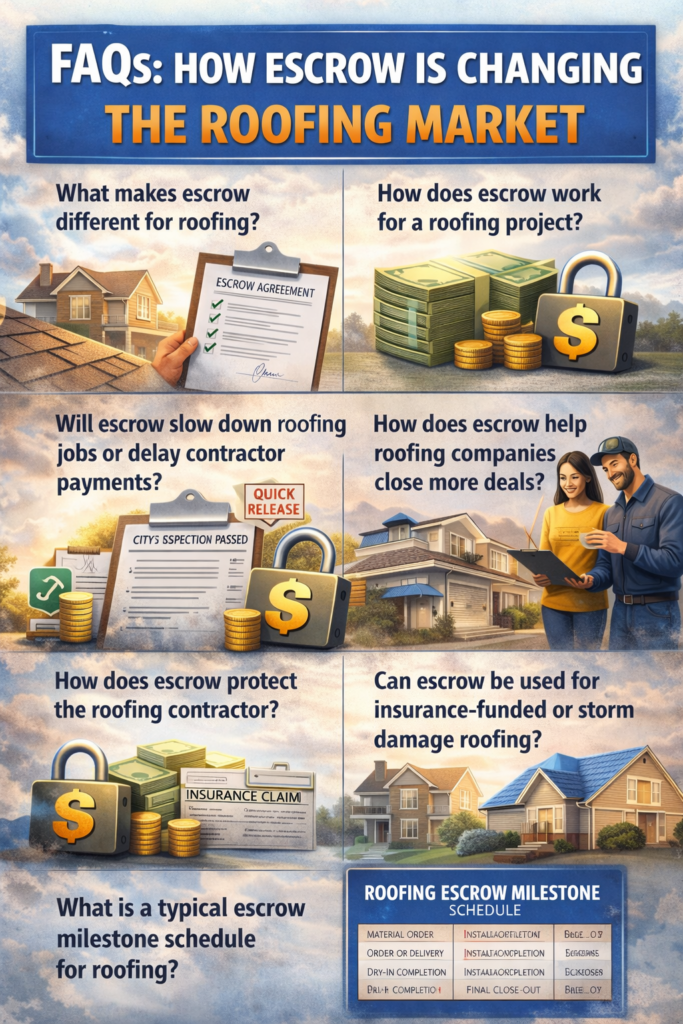
Escrow is changing the roofing market because it turns trust from a personal gamble into a clear process. Instead of homeowners wondering if their money is safe, funds are secured with a neutral third party and released only when agreed roofing milestones are completed; that transparency helps honest companies win more projects and reduce disputes.
How does escrow work for a roofing project?
In a roofing project, the homeowner deposits project funds into an escrow account; then payments are released in stages as milestones are met. Typical roofing milestones can include material delivery, tear-off completion, dry-in completion, installation completion, and final cleanup/closeout. This structure keeps homeowners protected and gives roofers predictable, documented payments.
Does escrow slow down roofing jobs or delay contractor payments?
Not when it’s set up correctly. Escrow can actually speed up momentum because funds are secured upfront and releases are tied to clear milestones. Once the milestone proof is provided (photos, owner approval, inspection pass, or agreed verification), payment can be triggered quickly; the goal is smooth, on-time draws—not delays.
Is escrow only for large roofing projects?
No. Escrow is changing the roofing market across both small and large projects because the trust issue exists at every price point. Escrow can be used for full replacements, major repairs, multi-structure properties, HOA roofing projects, and storm restoration work—any situation where deposits, insurance money, or homeowner anxiety can create payment friction.
How does escrow help honest roofing companies close more deals?
Escrow helps honest roofing companies close more deals by removing the homeowner’s biggest objection: fear of paying without protection. When you offer escrow, you’re signaling professionalism, transparency, and accountability. That makes it easier for homeowners to say yes, reduces shopping-around behavior, and positions your company as a safer choice than competitors who rely on trust alone.
How does escrow protect the roofing contractor?
Escrow protects the contractor by confirming funds exist before work begins and by setting clear release rules that reduce payment disputes—especially at the end of the job. It also helps prevent situations where homeowners delay payment due to unrelated issues (insurance timing, budgeting stress, second thoughts); the project follows the agreed milestones instead of emotion.
What’s the best milestone structure for roofing escrow?
A strong roofing escrow structure uses milestones that match real job flow and are easy to verify. A common example:
Material order or delivery confirmed
Tear-off complete (if applicable)
Dry-in complete
Installation complete
Final walkthrough, cleanup, and closeout documents
Milestones should be written in plain language so there’s no confusion on what “complete” means.
Can escrow be used for storm restoration and insurance-funded roofing work?
Yes; and it’s one of the best use cases. When insurance checks, supplements, and timelines create confusion, escrow adds stability. Funds can be secured and released as work is completed, reducing homeowner anxiety and protecting the contractor from payment uncertainty. This is another reason escrow is changing the roofing market during storm seasons.