
Table of Contents
- How should property managers pay contractors?
- Why contractor payments get messy in property management
- What a weak process actually costs
- Five controls for an audit-ready contractor payment process
- What should be in the payment file for every contractor invoice?
- Big projects need more than a routine process
- From the field: the roof deposit nobody could explain
- How escrow fits into your contractor payment process
- Contractor payment process FAQs
A contractor payment process is easy to ignore until an owner asks a question you can’t answer. Why did the plumber get paid twice in March? Who approved the $14,000 roof deposit? Where are the photos?
If you’re a property manager, you’re paying vendors with other people’s money, across buildings, owners, and accounts. Most of those payments are routine. The audit only cares about the few that aren’t, and those are usually the ones with the thinnest paper trail.
How should property managers pay contractors?
Property managers should pay contractors only after a vetted vendor, a written scope and price, an approval from someone other than the person paying, and proof the work was done are all on file.
Everything below is how to make that routine across dozens of vendors without slowing down a single repair.
A good contractor payment process protects three groups at once. Owners see where their money went. Contractors get paid on predictable terms. And you, the manager, can answer any question with a document instead of a memory.
Why contractor payments get messy in property management
Property management combines high volume, many owners, and a lot of informal approval. That mix strains any contractor payment process, and it produces the same problems in almost every portfolio.
- Approvals live in text threads. “Go ahead, fix it” from an owner at 10 p.m. is a real approval. It’s also nearly impossible to find six months later.
- The same person approves and pays. In a small office, one manager may request the work, accept the invoice, and release the payment. That’s efficient, and it’s exactly the gap auditors look for.
- Vendor files are incomplete. A handyman gets called for an emergency and paid before anyone collects a W-9 or a certificate of insurance. Then January arrives.
- Deposits go out with no milestone attached. A large deposit to start a roof or a parking lot job, with nothing written about what that money buys.
- Owner funds blur together. Paying one owner’s invoice from the wrong building’s account takes a single click, and reconciling it later takes much longer.
Nobody in these scenes is doing anything dishonest. The structure just depends on people remembering things, and people forget.
What a weak process actually costs
Most mistakes in a contractor payment process are honest. Some aren’t, and a loose process can’t tell the difference.
The Association of Certified Fraud Examiners studied 2,402 occupational fraud cases for its 2026 Report to the Nations. The median loss was $104,000 per case, and the median scheme ran 12 months before anyone caught it. More than half of the cases involved either a lack of internal controls or an override of existing ones.
Property managers carry a second layer of risk because the money belongs to someone else. Many states treat it as trust money with its own rules. California’s Department of Real Estate, for example, lists trust fund handling among its most common enforcement violations and expects brokers to reconcile trust accounts monthly and avoid commingling. Your state’s rules may differ, so check with your licensing agency.
Five controls for an audit-ready contractor payment process
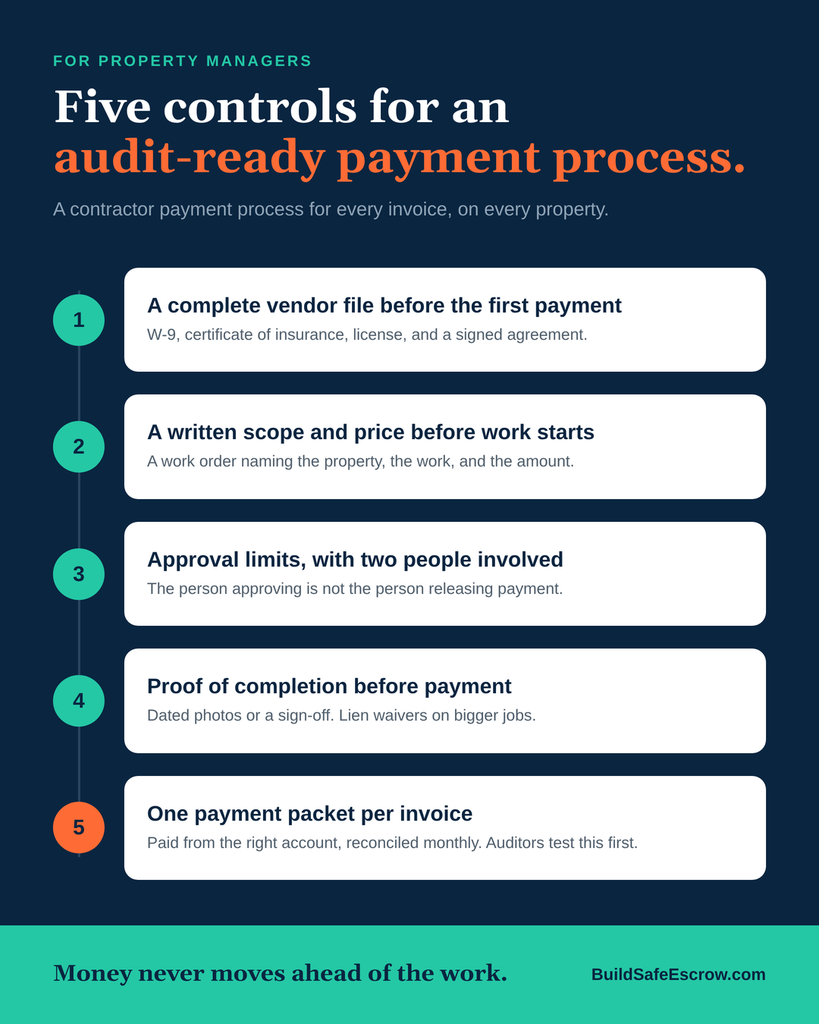
You don’t need new software to fix your contractor payment process. You need five habits, written down and applied every time.
- A complete vendor file before the first payment. Collect a W-9, a current certificate of insurance, any required license, and a signed vendor agreement. No file, no payment, including emergencies (collect it the same day). The W-9 also sets you up for year-end reporting: for payments made in 2026 and later, the IRS threshold for Form 1099-NEC rose to $2,000.
- A written scope and price before work starts. A work order or purchase order that names the property, the work, and the agreed amount. A text or email is fine, as long as it’s saved to the property file.
- Approval limits, with two people involved. Decide who can approve what (for example, managers up to $1,500, owner sign-off above that) and make sure the person approving a payment is not the person releasing it. In a two-person office, the owner or a bookkeeper can be the second set of eyes.
- Proof of completion before payment. Dated photos, a tenant or site sign-off, or an inspection for larger jobs. On bigger projects, add a lien waiver (a contractor’s signed statement giving up the right to file a lien for the amount paid) with each payment.
- One payment packet per invoice, paid from the right account. Every payment gets a single record that ties the invoice to the work order, approval, and proof, paid from the correct owner’s account and reconciled monthly.
Control 5 is the one auditors test first. If every invoice already has its packet, an owner audit becomes a filing exercise.
What should be in the payment file for every contractor invoice?
Every contractor invoice should be filed with the work order, the approval, proof the work was completed, and a record of the payment, all tied to the same property and owner.
In practice, that means:
- The contractor’s invoice
- The work order or purchase order it matches
- The approval, with the approver’s name and date
- Photos, a sign-off, or an inspection note
- A lien waiver, for larger jobs
- The payment record: date, amount, method, and account
Store it in your property management software or a shared folder named by property and date. The format matters less than the habit. A contractor payment process is only audit-ready if the packet exists before anyone asks for it.
Big projects need more than a routine process
Routine repairs fit a standard contractor payment process well. A $400 faucet doesn’t need a draw schedule.
Capital projects are different. A roof replacement, an elevator modernization, or a parking lot rebuild can run from $50,000 into the hundreds of thousands. These jobs usually come with a deposit request, several months of work, and multiple payments. That’s where the routine process starts to strain:
- One approval no longer covers the job, because the money moves in stages.
- “Proof of completion” has to mean proof of each stage, not the whole job.
- The owner’s money may sit with the contractor for weeks before the matching work exists.
For these projects, a contractor payment process needs milestones written into the contract, each with a defined amount and a defined proof. Without that, a big deposit is just a hope with a dollar sign.
From the field: the roof deposit nobody could explain
Rafael manages fourteen small apartment buildings in Charlotte, North Carolina, for nine different owners. His contractor payment process for routine work was solid. Then one building needed a $46,000 roof.
The roofer asked for 30% up front. The owner approved it by text, and Rafael paid $13,800 from the building’s operating account. Weeks went by with materials delivered but little work done. The owner, now nervous, asked for a breakdown: what the deposit had paid for, what was finished, and what was left.
Rafael had the invoice and a text thread. He didn’t have a scope tied to payments, photos by stage, or anything showing what $13,800 had bought. The job eventually finished, but the owner moved two other buildings to a different firm that spring.
Rafael’s next capital project ran on a milestone schedule with funds held in escrow. The owner got a record of every release, and nobody had to reconstruct anything.
How escrow fits into your contractor payment process
Construction escrow takes the hardest part of a big-project contractor payment process, the money moving in stages, and hands it to a neutral third party.
The owner’s project funds are deposited with the escrow agent before work starts and held in a secure, FDIC-insured account. Funds are released to the contractor only as each agreed milestone is completed and verified. Each release comes with its documentation, so the record you’d otherwise assemble by hand builds itself as the job moves.
For a property manager, that means:
- The owner sees the money is protected before work begins, without wiring a large deposit to a contractor.
- You stop being the person in the middle of every payment dispute. The release rules are written in the escrow agreement.
- The contractor gets paid promptly once a milestone is verified, which keeps good vendors happy to work your buildings.
- Your audit file comes with the project. Every release has its own record.
Your trust or operating accounts still handle routine work. Escrow is for the projects where the stakes, and the questions, are highest. We’ve written before about how escrow and draw services help property owners and condominium associations on exactly these projects.
Trust is a feeling. Structure is what holds up in an audit. Money never moves ahead of the work. You can see how the process runs on our construction escrow services page, or start with the construction escrow FAQs.
Contractor payment process FAQs
Do I need a W-9 from every contractor before paying them?
It’s the safest habit. A W-9 gives you the information you need for year-end reporting, and collecting it before the first payment avoids a January scramble. Ask your tax professional which vendors need a 1099.
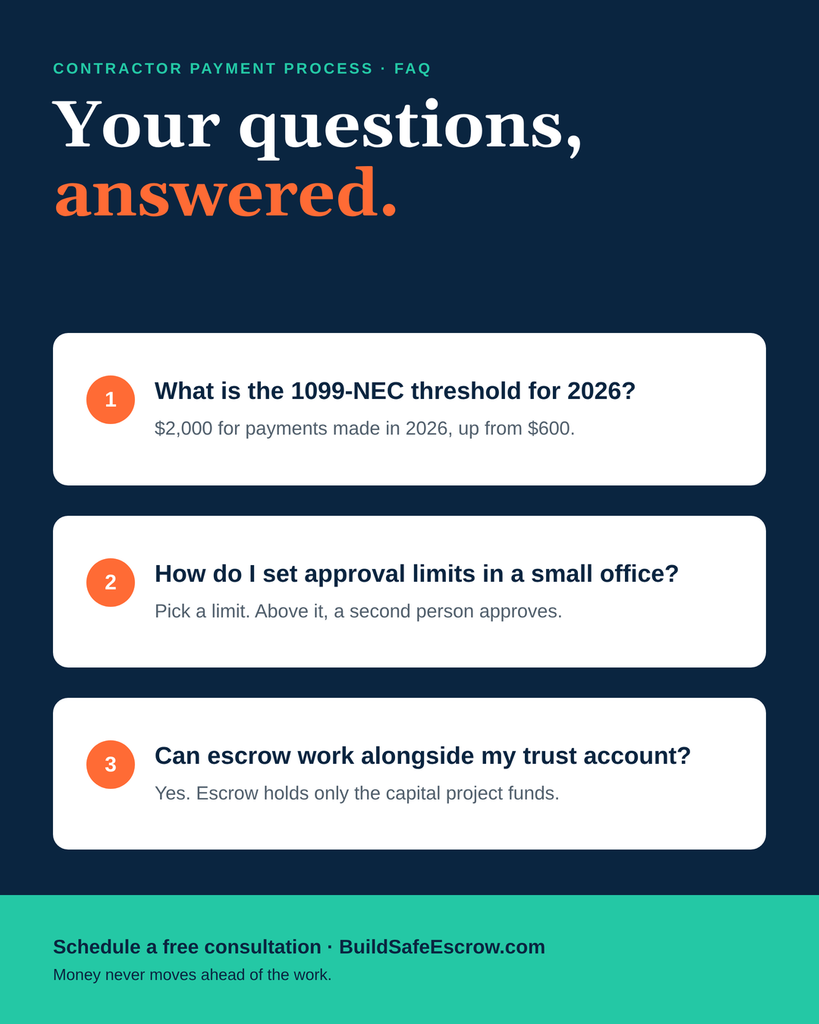
What is the 1099-NEC threshold for contractor payments in 2026?
For payments made in 2026, the IRS reporting threshold for nonemployee compensation is $2,000, up from $600. Forms are due January 31 of the following year.
Should property managers pay contractor deposits?
Sometimes a deposit is reasonable, especially for special-order materials. Tie it to a written scope and a first milestone, and for large projects, consider holding it in escrow instead of paying it out directly.
How do I set approval limits in a small office?
Pick a dollar amount you can approve alone, and require a second approver (the owner, a bookkeeper, or another manager) above it. The person approving shouldn’t be the person releasing the payment.
Can escrow work alongside my trust account?
Yes. Your trust or operating accounts keep handling rent, routine repairs, and recurring vendors. Escrow holds the funds for a specific capital project and releases them on verified milestones.
Give every owner a clean answer
If you’re managing a capital project for an owner, you shouldn’t have to defend every payment from memory. Schedule a free consultation and we’ll show you how a milestone-based escrow schedule would work on your next project: schedule a free consultation.
Get one short read each Friday on how construction money actually moves. Subscribe to The Build Brief.
This article is general information, not legal, tax, or accounting advice. Trust account and reporting rules vary by state and situation, so talk to your own attorney, CPA, or licensing agency.
References
- Occupational Fraud 2026: A Report to the Nations, Key Findings (Association of Certified Fraud Examiners)
- Instructions for Forms 1099-MISC and 1099-NEC (Internal Revenue Service)
- About Form W-9, Request for Taxpayer Identification Number and Certification (Internal Revenue Service)
- DRE Highlights Most Common Enforcement Violations (California Department of Real Estate, August 2025)