
Table of Contents
- Why the homework you already did is not enough
- How to evaluate a home builder before signing a contract
- The seven checks that vet a home builder properly
- Things homeowners should never accept from remodeling contractors
- Red flags before signing a sunroom contract (or any addition)
- Safest way to hire a home remodeling contractor for a big renovation
- From the field: Helena in Scottsdale
- How escrow removes the risk at the source
- FAQ
- Keep your money tied to the work
- References
You are about to vet a home builder, and the first meeting went well. He was on time, he liked your plans, and his number came in under the other two bids. Now there is a contract on the kitchen table, a deposit request at the bottom of it, and a small voice asking what you actually know about this person.
That voice is right to ask. Most owners who get burned did not skip the homework. They did the homework that was easy to do and stopped there. This guide covers how to vet a home builder properly: the checks that matter, the things you should never agree to, and the one piece of structure that makes the whole decision less risky.
Why the homework you already did is not enough
The way most people vet a home builder is reviews, a portfolio, and a friendly walkthrough. Those tell you whether a builder can produce nice work. They tell you nothing about whether the builder is solvent, insured, or organized enough to finish your job on the money you give him.
Those are separate questions. A builder can be talented and broke at the same time. In fact that combination causes more abandoned projects than outright fraud does. The deposit you hand over goes to close out someone else’s job, your materials never get ordered, and the crew stops showing up. Nobody set out to cheat you. The money just moved ahead of the work.
So the goal when you vet a home builder is to test two things: the quality of the work, and the structure that protects your money while the work happens.
How to evaluate a home builder before signing a contract
To evaluate a home builder before signing a contract, verify the license and insurance directly with the issuing agency, call two recent clients and one supplier, and confirm the payment schedule ties every dollar to completed, inspectable work. That is how you vet a home builder in three moves. Everything else on the list below supports one of those three.
The full sequence to vet a home builder, in the order that saves you the most time:
The seven checks that vet a home builder properly
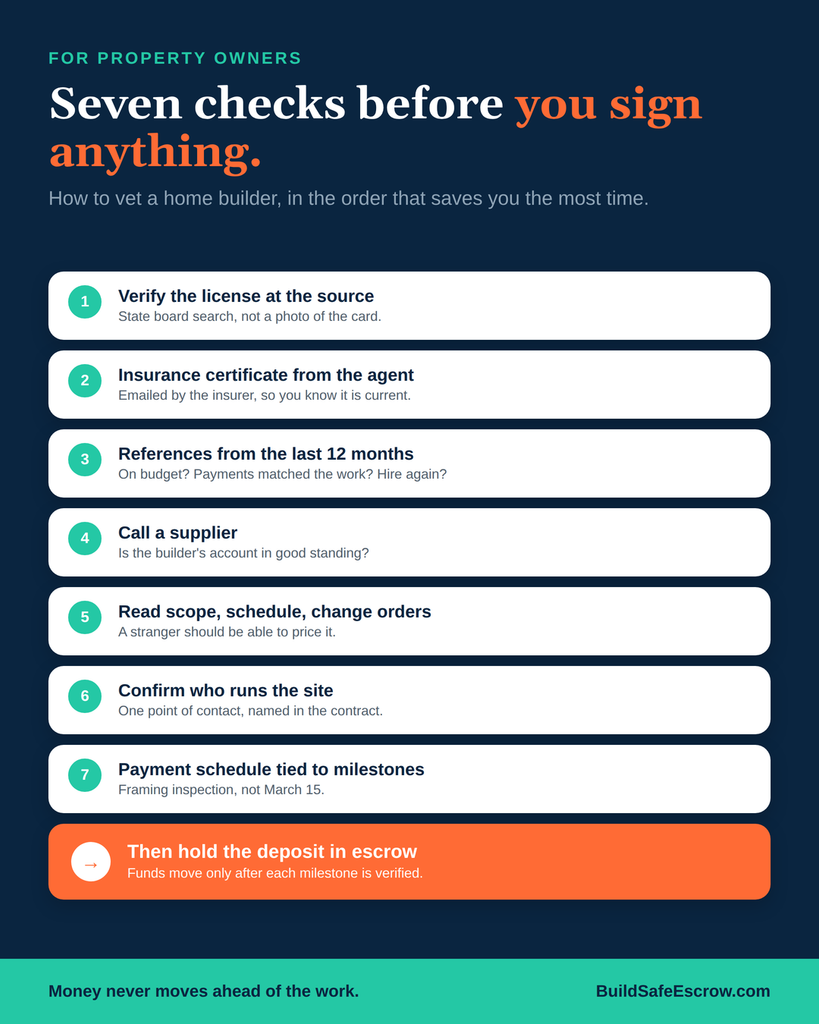
1. Verify the license at the source. Every state handles contractor licensing differently, and some cities layer their own requirements on top. Do not accept a photo of a license card. Look the builder up on the state licensing board’s public search, confirm the name on the license matches the name on your contract, and note any disciplinary history. If your state does not license residential builders, check for the local registration or business license that applies instead.
2. Get the insurance certificate sent to you by the insurer. Ask for a certificate of insurance showing general liability and workers’ compensation, and ask the builder’s agent to email it directly. A certificate that comes straight from the agent is current. A PDF forwarded by the builder may be expired. Then read the limits and make sure the policy covers the type of work you are buying.
3. Call references who finished a project in the last year. Older references only prove the company was good once. Ask each one three things: did the job finish on budget, did the payment schedule match the work, and would they hire this builder again. Listen for hesitation more than for the words.
4. Call a supplier. Almost nobody makes this call when they vet a home builder, and it tells you the most. A lumber yard or plumbing supply house will usually say whether a builder’s account is in good standing. A builder who is slow paying suppliers is a builder whose next deposit will go to catch up on someone else’s job.
5. Read the contract for scope, schedule, and change orders. The scope should describe finishes, allowances, and exclusions in enough detail that a stranger could price it. The schedule should have a start date, a substantial-completion date, and a process for delays. Change orders (any change to the agreed scope or price) should require a signed document before the work happens, not after.
6. Confirm who will be on site. Many builders sell the job and then hand it to a project manager you have never met. Ask who runs the site day to day, how often the owner of the company visits, and who your single point of contact is when something goes wrong.
7. Examine the payment schedule line by line. A payment schedule should read like a list of milestones, not a list of dates. “Twenty percent at framing inspection” protects you. “Twenty percent on March 15” does not, because March 15 arrives whether the framing is done or not. If the draws are tied to the calendar, ask for them to be tied to the work.
Every one of these checks is cheap. The most expensive one is the supplier call, and it costs about ten minutes.
Things homeowners should never accept from remodeling contractors
Homeowners should never accept a large upfront deposit, a cash-only arrangement, a verbal change order, a contractor who asks you to pull the permits yourself, or a payment schedule tied to dates instead of completed work. The Federal Trade Commission lists several of these as classic warning signs of contractor fraud, and the rest are the habits that turn honest builders into problems.
A few more that deserve their own line:
- A pressure deadline on the contract. “This price is good until Friday” is a sales tactic, not a construction schedule.
- A deposit that exceeds what your state allows. Several states cap residential deposits by law; Florida, California, and Maryland all have limits. Check yours before you write the check.
- Materials “left over from another job.” This is one of the oldest lines in the trade, and it usually means the materials were never bought at all.
- A refusal to put allowances in writing. If the builder will not commit to a dollar figure for tile or fixtures, you will discover the real number after demolition.
- A lien waiver you do not understand. A lien waiver is a document a contractor or supplier signs to give up the right to file a claim against your property for a payment. Never make a final payment without collecting one from the builder and the major subs.
Seeing one of these does not end the conversation, but it should change how hard you vet a home builder before you sign. None of this means the builder is dishonest. It means the structure is missing, and structure is what protects you when the unexpected shows up.
Red flags before signing a sunroom contract (or any addition)
The red flags before signing a sunroom contract are the same as for any addition: no permit in the contract, no engineered drawings for the foundation and roof tie-in, a deposit that covers most of the job, and no defined milestone for the inspection that has to pass before the next payment. Additions attach to your existing structure, which makes the permit and the engineering non-negotiable, and it is why you vet a home builder for an addition more carefully than for a bathroom.
Sunrooms specifically attract a certain kind of sales operation: a showroom, a financing partner, and a contract that asks for fifty percent down before anyone has measured the slab. The product might be fine. The payment structure is not. Ask the seller to tie the balance to the framing inspection and the final inspection, and watch how the conversation changes.
Safest way to hire a home remodeling contractor for a big renovation
The safest way to hire a home remodeling contractor for a big renovation is to run the seven checks above, hold the deposit and progress payments in a neutral escrow account, and release each payment only after the milestone it covers has been verified. On a big renovation the dollar amounts are large enough that a payment mistake is hard to recover from, so the structure has to do more of the work.
That is the point where you stop trying to vet a home builder harder and start deciding where the money lives.
From the field: Helena in Scottsdale
Helena hired a builder for a 1,400-square-foot second story addition in Scottsdale, Arizona. She checked reviews, visited a finished project, and confirmed the license online. The contract asked for 35 percent down, which she paid.
Framing started on schedule. Then the crew thinned out. The builder explained that a supplier had delayed the trusses. Two weeks later the site was empty and the calls went to voicemail. When she finally reached a supplier, she learned the truss order had never been placed because the builder’s account was on hold for nonpayment.
Helena had done four of the seven checks you need to vet a home builder. The supplier call and the payment schedule review would have caught this before she signed. She recovered part of the deposit through a state recovery fund, more than a year later, and hired a second builder to finish the job on a milestone escrow schedule. The second builder was paid on time at every stage, and the addition passed final inspection in five months.
How escrow removes the risk at the source
The work you do to vet a home builder reduces the odds of hiring the wrong one. Escrow removes the consequences of guessing wrong.
With construction escrow, your deposit and progress payments sit in a neutral, FDIC-insured account that neither you nor the builder controls. The payment schedule is written as milestones. When a milestone is finished, the builder requests a release, the work is verified, and the funds move. Until then, they stay put.
That structure changes the builder’s behavior in ways a background check cannot. A builder whose next payment depends on finishing framing has every reason to finish framing. A builder who has already been paid for framing has to rely on discipline, and discipline is not something you can verify from a portfolio.
It also protects the good builders. An honest contractor wants to know the money is real before he orders your cabinets. Escrow proves it. Many of the builders we work with now suggest it themselves, because a funded escrow account is the fastest way to turn a nervous homeowner into a signed contract. If you want to see how the process runs from the first deposit to the final release, the construction escrow FAQs walk through it step by step.
Trust is a feeling. Structure is protection. Money should never move ahead of the work.
FAQ
What questions should I ask before I vet a home builder?
Start with three: how many projects like mine did you finish in the last year, who will run my site day to day, and can your insurance agent send me a certificate directly. The answers tell you about capacity, accountability, and whether the coverage is real.
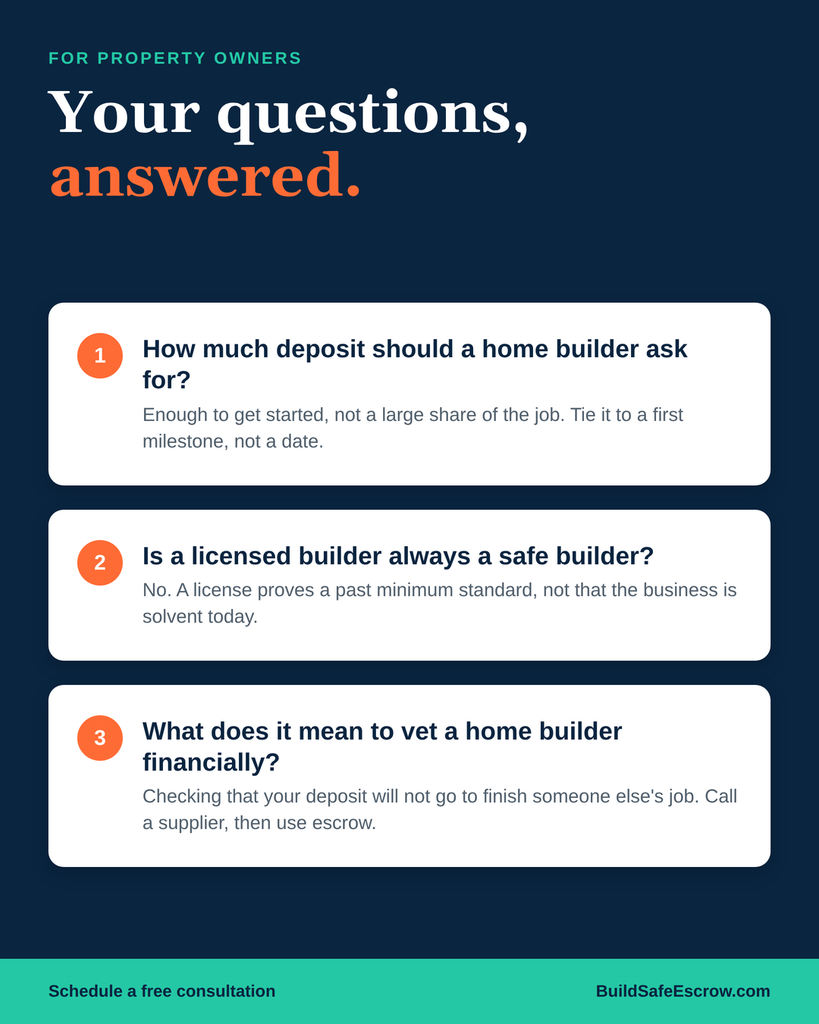
How much deposit should a home builder ask for?
It depends on your state and the project, but a deposit should cover the cost of getting started, not a large share of the job. Several states cap residential deposits by law. Whatever the number, tie it to a defined first milestone rather than a date.
Is a licensed builder always a safe builder?
No. A license proves the builder met a minimum standard at some point, not that the business is solvent today. Vet a home builder past the license: check insurance, references, and a supplier before you decide.
What does it mean to vet a home builder financially?
It means checking whether the builder can carry your job without using your deposit to finish someone else’s. Calling a supplier, asking about the payment schedule, and holding funds in escrow all address that question directly.
Can I vet a home builder if my state does not license contractors?
Yes. Check for local registration or a business license, confirm insurance directly with the agent, call recent references and a supplier, and put more weight on the payment structure. Escrow does the same job in every state.
Do I need an attorney to review a construction contract?
For a large renovation or an addition, a short review by a construction attorney is worth the cost. This article is information, not legal advice; your attorney can tell you what applies in your state.
Keep your money tied to the work
Get one short read each Friday on how construction money actually moves. Subscribe to The Build Brief.
Ready to vet a home builder with the deposit protected from day one? Schedule a free consultation and we will walk you through a milestone schedule for your project.
References
- Federal Trade Commission, “Hiring a Contractor” (consumer.ftc.gov): https://consumer.ftc.gov/articles/hiring-contractor
- National Association of Home Builders, “How to Find a Home Builder”: https://www.nahb.org/other/consumer-resources/how-to-find-a-home-builder
- Better Business Bureau, “Tips for Hiring a Contractor”: https://www.bbb.org/all/home-improvement
- Levelset, “Lien Waivers: The Ultimate Guide”: https://www.levelset.com/lien-waivers/