
Table of Contents
- The check you wrote on someone else’s behalf
- Why the exposure lands on the manager
- How does construction escrow work for property managers?
- Construction escrow for property managers, one step at a time
- What to set up before the first deposit
- From the field: Marcus and the $180,000 roof
- How escrow removes the problem at the source
- FAQ
- Keep reading, then let’s talk
- References
The check you wrote on someone else’s behalf
Construction escrow for property managers starts with a moment you already know. You are a property manager, the roofer wants 40% down before the crew shows up, and the money belongs to an owner who will ask you next month how it went. You approve the deposit, because that is how the roofer has always worked, and you hope the report you send later reads well.
That hope is the problem.
Why the exposure lands on the manager
You sit between two parties who never meet. The owner (or the HOA board) trusts you with the capital. The vendor trusts you to pay. When something slips, both of them look at the same person.
A few reasons this keeps happening:
- Deposits move before work does. Most vendor agreements front-load cash. A 30% to 50% mobilization payment is common, and it goes out on a signature, not on progress.
- Verification is informal. You get a text with a photo, or a foreman’s word that the tear-off is done. That is not evidence you can put in front of a board.
- Vendors stack up. A capital improvement year might mean a roofer, a paving contractor, an elevator company, and three unit-turn crews. Each has its own payment rhythm, and you track all of them from a spreadsheet.
- The paper trail is scattered. Invoices in email, approvals in a text thread, lien waivers in a drawer. When an owner asks where the money went, you rebuild the answer by hand.
None of this makes you careless. It makes you the single point of failure. That is the gap construction escrow for property managers is built to close.
How does construction escrow work for property managers?
Construction escrow for property managers works by depositing project funds into a neutral, FDIC-insured account and releasing them to each vendor only after an agreed milestone is completed and verified, so the manager never pays ahead of the work and every release is documented for the owner.
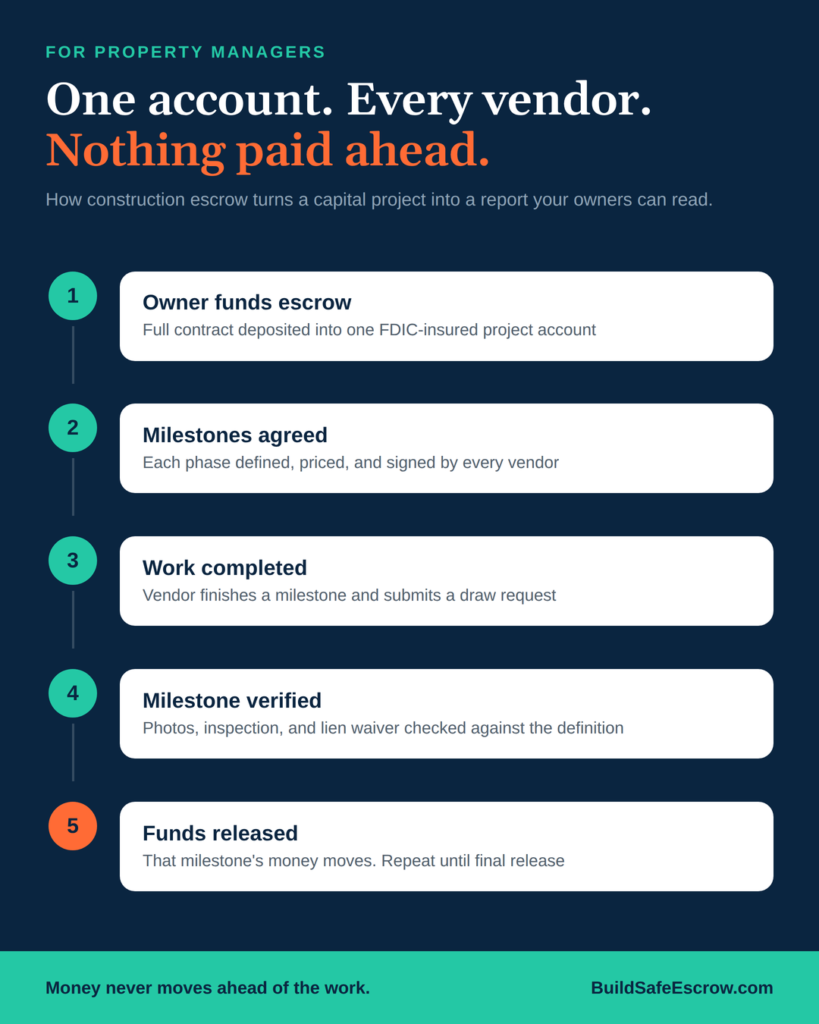
Think of it as a referee holding the ball. The owner’s money goes into an escrow account, a segregated account held by a neutral third party that is not the owner, not the vendor, and not you. The funds sit in an FDIC-insured deposit, protected by federal deposit insurance up to the applicable limits.
Before any work starts, everyone signs off on a milestone schedule. A milestone is a defined, inspectable chunk of the job: “tear-off complete on Building A,” “underlayment and flashing installed,” “final inspection passed.” Each milestone has a dollar amount attached.
When the vendor finishes a milestone, they request a draw. A draw is a request to release the funds tied to that milestone. The draw gets verified, meaning someone confirms the work is actually done (site photos, an inspection, or a third-party review). Only then does the money move.
The vendor gets paid promptly for real progress. The owner gets a record of what was verified and when. You get to stop being the bank.
Learn more about our escrow services and how construction escrow for property managers fits a multi-property portfolio.
Construction escrow for property managers, one step at a time
Construction escrow for property managers runs the same on a $20,000 unit turn and a $2 million common-area renovation. The scale changes, the sequence does not.
- Open the account. One project, one escrow account. The owner (or the association) funds it with the contract amount, or the first tranche if the project is phased. Funds are held in an FDIC-insured account from day one.
- Agree the milestone schedule. You, the vendor, and the escrow agent lock in the milestones, the dollar value of each, and what “done” looks like for each one. Be specific. “Roof complete” is vague. “Shingles installed and ridge vent sealed, Building B, inspector sign-off” is a milestone.
- Work begins, cash stays put. The vendor starts because the money is visibly there. That visibility often removes the “I need a deposit to trust you” conversation entirely.
- The vendor submits a draw. With the first milestone complete, the vendor sends a draw request. It typically includes photos, an invoice for that milestone, and a lien waiver. A lien waiver is a signed document in which the contractor gives up the right to file a mechanics lien (a legal claim against the property for unpaid work) for the amount being paid. A conditional waiver takes effect once payment clears; an unconditional waiver takes effect on signature. Ask your attorney which your state expects.
- Verification, then release. The milestone is checked against the definition from step 2. Once verified, the escrow agent releases that milestone’s funds to the vendor. Repeat for each milestone.
- Final release. The last milestone usually covers punch list, final inspection, and closeout documents. Some projects hold retainage, a small percentage (often 5% to 10%) withheld from each draw and paid at the end, once everything is signed off.
- The report. Every deposit, draw, verification, and release is logged. That log is the owner report, and it is where construction escrow for property managers earns its keep. You did not write it; the structure did.
What to set up before the first deposit
Construction escrow for property managers works best when a few decisions are made early. These are the ones that matter most when you are running several projects at once.
- One account per project, not per vendor. If the roof job has a roofer and a separate gutter sub, both draw from the same project account against their own milestones. Owners see one ledger per project.
- Write milestones the owner can understand. The board will read this. “Phase 2 complete” means nothing to them. “Building A roof: tear-off, dry-in, shingle, inspect” does. Four to eight milestones suits most jobs.
- Decide who verifies. On a unit turn, a site visit and photos may be enough. On a roof or structural work, use your inspector or the municipal inspection. Name the verifier in the agreement.
- Require lien waivers with every draw. This is the step that protects the owner’s title. Many states have statutory waiver forms; your attorney can tell you which apply. Cornell’s overview of the mechanics lien is a good primer.
- Put the escrow clause in the vendor contract. Reference the milestone schedule and the escrow agent directly in the agreement. Vendors who balk are telling you something worth hearing.
- Set the reporting cadence with the owner up front. Monthly ledger, or a summary at each release. Either one becomes a copy-and-send exercise.
For more on the mechanics, our construction escrow FAQs cover the questions we hear most from managers and boards.
From the field: Marcus and the $180,000 roof
Marcus manages 14 buildings for three ownership groups. Two of those buildings, owned by the same group, need full roof replacements. The combined contract is $180,000.
The roofer’s standard terms: 40% down, 40% at dry-in, 20% at completion. That first check would be $72,000 of the owner’s money, gone before a single shingle came off.
Marcus had read about construction escrow for property managers and proposed it instead. The owner funded the full $180,000 into one project account. The milestone schedule looked like this:
- Building A tear-off and dry-in: $36,000
- Building A shingle, flashing, ridge vent, inspection passed: $54,000
- Building B tear-off and dry-in: $36,000
- Building B shingle, flashing, ridge vent, inspection passed: $45,000
- Final punch list, closeout docs, and release of 5% retainage: $9,000
The roofer hesitated for a day, saw the funded balance, and started Building A the following Monday.
Building A went smoothly. Two draws, two verifications (city inspector plus Marcus’s photos), two releases. Building B hit a snag: the crew found rotten decking and the roofer wanted $11,000 for the change. Instead of an argument over a check already spent, the owner approved a change order (a documented change to scope and price), funded the $11,000 into escrow, and a new milestone was added. Work continued.
At the ownership group’s quarterly meeting, Marcus sent the escrow ledger. Every release matched a verified milestone. The board asked one question: “Can we do this on the parking lot next spring?”
How escrow removes the problem at the source
Look back at the four root causes: deposits ahead of work, informal verification, too many vendors, scattered paper. Escrow does not manage those problems better. It removes the conditions that create them.
Money never moves ahead of the work. That single rule means there is no deposit to lose, no “trust me” moment, and no owner call that starts with “so, about the roofer.” The vendor still gets paid, and usually faster, because the funds are already there waiting for verified progress.
Construction escrow for property managers also changes what your job looks like from the outside. You stop being the person who approved a wire and become the person who built a system. The ledger is the proof, and you did not have to build it after the fact.
Trust is a feeling. Structure is protection. Escrow turns the feeling into the structure, and it does it once per project instead of once per phone call.
The money can’t vanish. That is the whole point.
FAQ
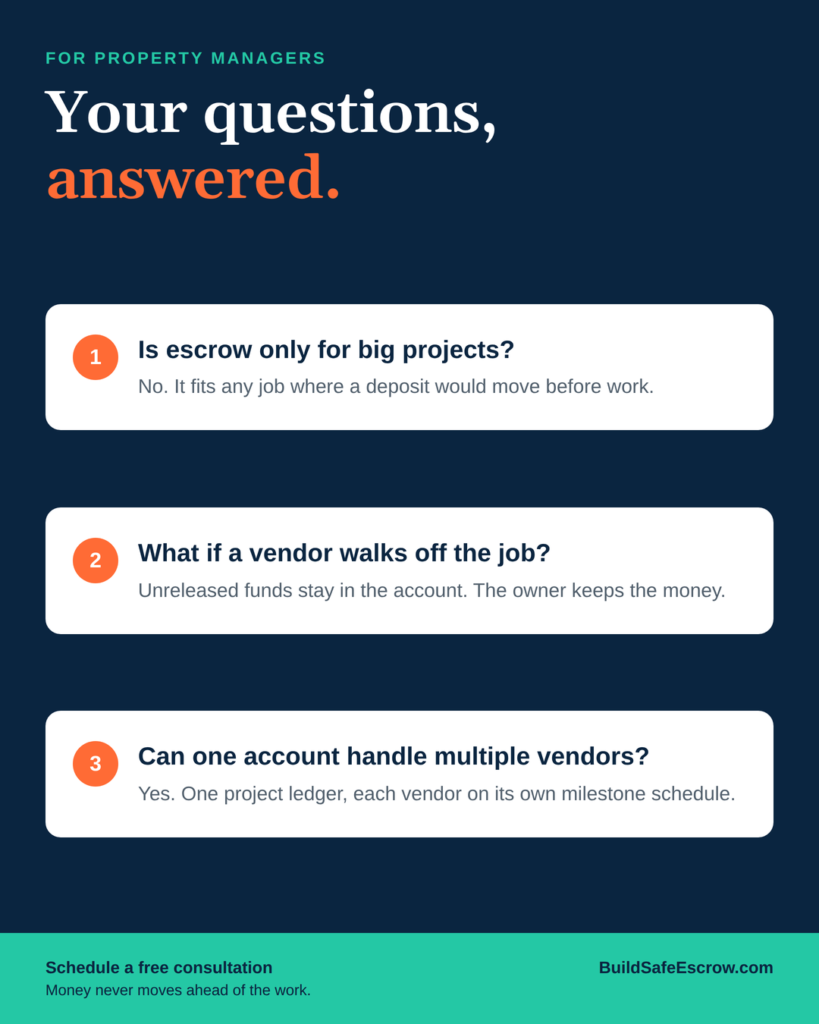
Is construction escrow for property managers only for big projects? No. It fits any project where a deposit would otherwise move before work. Managers use it on unit turns, roofs, paving, and common-area work.
Who owns the money while it sits in escrow? The funds remain the depositor’s (the owner’s or association’s) until a milestone is verified and released. The escrow agent holds them; it does not own them.
What happens with construction escrow for property managers if a vendor walks off the job? Unreleased funds stay in the account. The owner keeps the money for the work that was never done, and you have a documented record of what was and was not completed.
Can construction escrow for property managers handle multiple vendors on one project? Yes. One project account can serve several vendors, each with their own milestone schedule. Owners see one ledger for the whole project.
Does construction escrow for property managers slow the vendor’s payment down? Usually it speeds it up. Funds are already deposited, so once a milestone is verified, release is fast. Vendors do not wait on an owner’s approval chain or a board meeting.
Keep reading, then let’s talk
Get one short read each Friday on how construction money actually moves. Subscribe to The Build Brief.
If you manage capital projects for owners or boards and want a structure you can put in front of them, schedule a free consultation. We will show you how construction escrow for property managers would fit your next project. Or contact us with a specific question.
This article is educational, not legal or financial advice. Consult your own attorney or financial professional for your situation.
References
- FDIC, Deposit Insurance: https://www.fdic.gov/resources/deposit-insurance/
- Cornell Law School, Legal Information Institute, Mechanics Lien: https://www.law.cornell.edu/wex/mechanics_lien
- Federal Trade Commission, Hiring a Contractor: https://consumer.ftc.gov/articles/hiring-contractor