
Table of Contents
- Twelve Owners, Forty Vendors, One Signature
- Why the Manager Ends Up Holding the Risk
- How should a property manager pay contractors for capital projects?
- Five Fixes for Portfolio Payment Control
- From the Field: Yolanda’s Roof Season
- How Escrow Removes the Problem at the Source
- FAQ
- Protect the Owners. Protect Yourself.
- References
Twelve Owners, Forty Vendors, One Signature
Property manager vendor payments are where a management company’s liability concentrates. You manage a dozen owners’ properties. Between them there are two roof replacements, a parking lot resurface, a unit turn program, and a chiller swap this quarter. Forty vendors, four trust accounts, and every invoice crosses your desk before money moves.
The owners hired you so they would not have to think about this. That is exactly why, when a payment goes out ahead of the work, the phone call comes to you.
This guide is for the property manager or management company principal responsible for capital and repair spending across multiple owners, and for the friction that builds when every payment decision runs on your judgment alone.
Why the Manager Ends Up Holding the Risk
The structure of property manager vendor payments pushes risk toward the manager in three ways.
You have fiduciary duty without full control. You hold owner funds in trust and owe each owner a duty of care. But you did not write the contractor’s scope, you cannot inspect every milestone on every site, and the owner often wants the invoice paid yesterday. The duty is yours; the visibility is partial.
Lien exposure attaches to the property, not to you, but the blame does. Under Florida’s Construction Lien Law, a subcontractor or supplier who serves a Notice to Owner and is not paid by the general contractor can lien the property even after the owner has paid the GC in full. When that lien shows up on a building you manage, the owner does not call the GC. They call you and ask why property manager vendor payments went out without waivers attached.
Volume erodes verification. On one project you can drive out and look at the roof. On nine concurrent projects across three counties, verification becomes a photo in a text message and a vendor’s word. That is not negligence; it is arithmetic. But it means property manager vendor payments are, in practice, often released on far less evidence than any single owner would accept for their own home.
Add the ordinary risks (a vendor who takes the deposit and reschedules four times, a GC who underbids and stalls, an owner who disputes a completed job after the fact) and the manager is exposed from every direction at once.
How should a property manager pay contractors for capital projects?
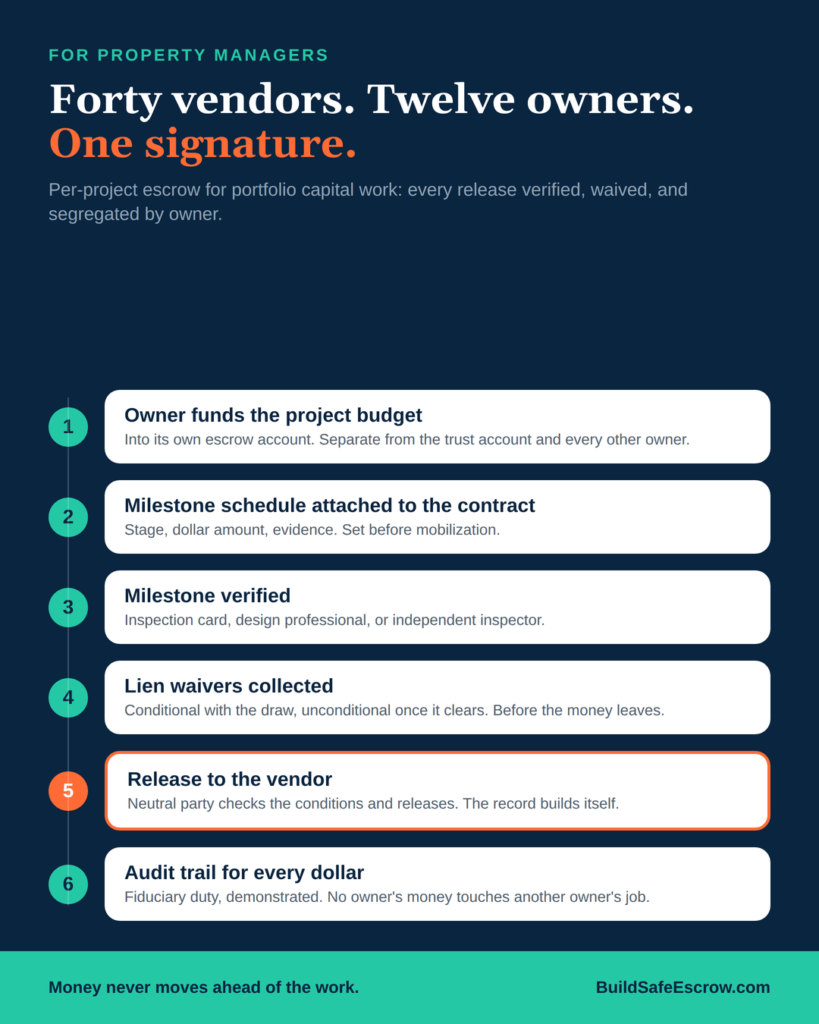
A property manager should pay contractors for capital projects only against verified milestones, with lien waivers collected at each draw, from funds committed at the start of the project and held separately from operating trust accounts, so that no payment can move ahead of the work and no owner’s funds are exposed to another owner’s project.
That sentence is the whole discipline behind property manager vendor payments. The rest of this article is about making it operational when you have forty vendors instead of one.
Five Fixes for Portfolio Payment Control
A written milestone schedule on every capital project, before mobilization. Most property manager vendor payments for small repairs can run on invoices. Anything over a defined threshold (many managers use $10,000 or a percentage of the property’s annual budget) gets a milestone schedule attached to the contract: what stage, what dollar amount, what evidence. “Roof tear-off complete, photos plus permit inspection card” is a milestone. “50% progress” is not.
Lien waivers as a release condition, not a follow-up. For property manager vendor payments on any lienable work, build the waiver into the payment request. Conditional waiver from the GC and every sub who has served a Notice to Owner, submitted with the draw; unconditional waiver once the prior draw clears. If your accounting software cannot hold a payment for a missing document, a spreadsheet can. The point is that the waiver arrives before the money leaves, every time.
Third-party verification for anything you cannot see yourself. For milestones beyond your reach, use the municipal inspection record, the architect or engineer of record, or an independent inspector. The permit inspection card is free, public, and cannot be edited by the vendor. Use it.
Owner-approved authority limits, in writing. Every management agreement should state what you can pay without owner sign-off and what you cannot. Then hold to it. A manager who releases a $45,000 draw on verbal approval has taken on the owner’s risk personally. A manager who follows a written limit has done their job.
Segregated, milestone-released project funds. This is the structural fix for property manager vendor payments at scale. Each capital project’s budget is committed by the owner at the start and held in a neutral escrow account, separate from the operating trust account and from every other owner’s money. Releases go to the vendor against verified milestones and collected waivers. You approve, a neutral party verifies and releases, and the record is complete without you building it by hand.
The first four fixes tighten property manager vendor payments on the strength of your own discipline. The fifth removes the risk from your desk entirely.
From the Field: Yolanda’s Roof Season
Yolanda runs a 30-property management portfolio in Broward County. After the 2025 storm season she had six roof replacements approved across four owners in the same eight-week window, all with the same two roofing contractors.
Her old process for property manager vendor payments: contractor invoices 30% at mobilization, 40% at dry-in, 30% at final. Yolanda approves, the bookkeeper pays from each owner’s trust ledger, waivers get requested at the end.
On roof number four, the dry-in draw went out on a Tuesday. On Friday a Notice to Owner arrived from the underlayment supplier for roof number two, unpaid for six weeks. The GC had used roof four’s dry-in payment to cover roof two’s supplier. Not fraud, just a roofer in a cash crunch during peak season. But it meant one owner’s money had funded another owner’s project, and Yolanda had authorized both payments.
She restructured the remaining five roofs. Each owner’s approved budget was placed into its own construction escrow account. The milestone schedule was rewritten to match the county inspection sequence, and each release required the roofer’s conditional waiver plus the supplier’s. Both roofing contractors agreed in a day; one said the escrow was the first time an owner had proven the money was funded before he ordered materials.
The remaining roofs finished on schedule. No further notices. And when one owner questioned a final payment in November, Yolanda sent the escrow release record, with inspection cards and waivers attached, instead of writing an explanation.
How Escrow Removes the Problem at the Source
Every risk in this article traces to the same design: property manager vendor payments run through the manager’s judgment and the manager’s accounting, one invoice at a time, with verification and waivers as things you have to remember to collect.
Construction escrow for capital projects changes the design. Each project’s budget is deposited by the owner into a secure, FDIC-insured account held by a neutral third party. The milestone schedule from fix one becomes the release schedule. Waivers from fix two become release conditions. Verification from fix three is documented against each release. And the money is segregated by project, so one owner’s funds never touch another owner’s job.
What that does for property manager vendor payments:
- Fiduciary duty becomes demonstrable. The release record is the audit trail. Every dollar has a milestone, a verification, and a waiver attached.
- Lien exposure drops to near zero on escrowed projects, because the waiver is collected before the release, not chased after.
- Volume stops eroding verification. The neutral party checks the conditions on project nine with the same rigor as project one, because that is its only job.
- Vendor relationships improve. Contractors see a funded budget and a defined trigger for each payment. The good ones prefer it.
Money never moves ahead of the work. For a single homeowner that is a principle. For a manager responsible for a dozen owners’ capital, it is the operating rule that keeps the phone from ringing. You can see how milestone releases are structured on our escrow services page, and the construction escrow FAQs address multi-party projects and disputed milestones.
Trust is a feeling. Structure is protection. Managers who run on trust carry the risk themselves. Managers who run on structure hand it to the process.
FAQ
Can property manager vendor payments run through escrow without changing the management agreement? Usually the management agreement already allows the manager to engage third parties on the owner’s behalf. Escrow for a specific capital project is set up per project with the owner’s approval, and the owner funds it directly. Have your attorney confirm for your agreement.
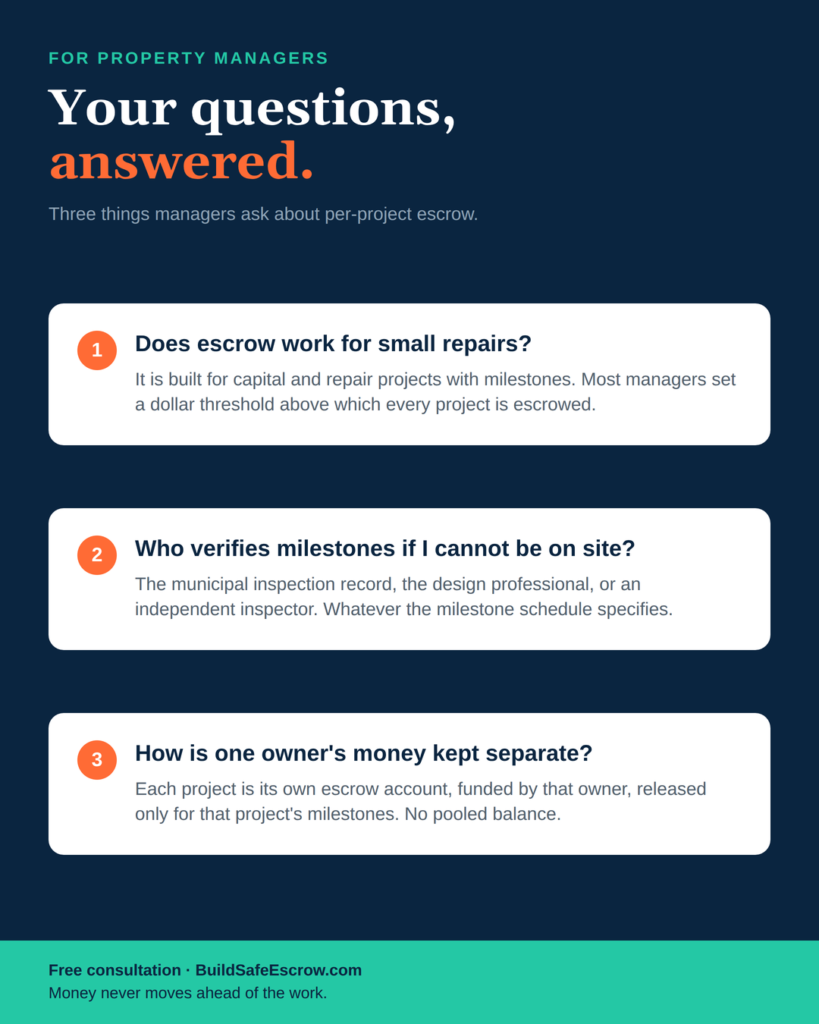
Does escrow work for small repairs? It is built for capital and repair projects with a milestone structure. Routine maintenance under your authority limit still runs on invoices. Most managers set a dollar threshold above which every project is escrowed.
Who verifies the milestones if the manager cannot be on site? Verification can come from the municipal inspection record, the design professional of record, an independent inspector, or the manager’s own site visit. The escrow release is conditioned on whatever evidence the milestone schedule specifies.
How does escrow keep property manager vendor payments for one owner separate from another’s? Each project is its own escrow account, funded by that owner, released only for that project’s milestones. There is no pooled balance for a vendor to draw from across jobs.
What happens when an owner disputes a completed milestone? The release is held while the dispute is resolved under the contract’s process. The vendor is not paid for disputed work, and the owner is not out the money. That is the outcome both parties actually want, even if neither enjoys the pause.
Are property manager vendor payments through escrow slower? Releases happen when the conditions are met. On projects where waivers and verification were already being collected properly, escrow is no slower and often faster, because the vendor knows exactly what to submit. On projects where they were not being collected, the added time is the time that should have been spent anyway.
Protect the Owners. Protect Yourself.
If you are heading into a heavy capital season across multiple owners, schedule a free consultation. We will walk through how per-project escrow fits your property manager vendor payments, your authority limits, your trust accounting, and your vendors’ draw schedules.
Get one short read each Friday on how construction money actually moves. Subscribe to The Build Brief.
This article is information, not legal or accounting advice. Trust accounting and fiduciary rules vary by state; consult your own attorney and CPA for your situation.
References
- Florida Statutes § 713.06, “Liens of persons not in privity; proper payments; notice to owner.” https://www.flsenate.gov/Laws/Statutes/2025/713.06
- Jimerson Birr, “Notice to Owner: Exceptions to Serving in Florida.” https://www.jimersonfirm.com/blog/2016/02/notice-to-owner-exceptions-to-serving-in-florida
- Federal Trade Commission, “Hiring a Contractor,” consumer.ftc.gov. https://consumer.ftc.gov/articles/hiring-contractor
- Florida Statutes § 489.126, “Moneys received by contractors.” https://florida.public.law/statutes/fla._stat._489.126