
How should an HOA pay a contractor? If you sit on a board, that question carries more weight for you than it does for any private homeowner, because the money you are moving is not yours. It belongs to every owner in the community, and you hold it as a fiduciary. This guide is for HOA board members and treasurers who want a payment structure that protects the funds, the project, and the board itself.
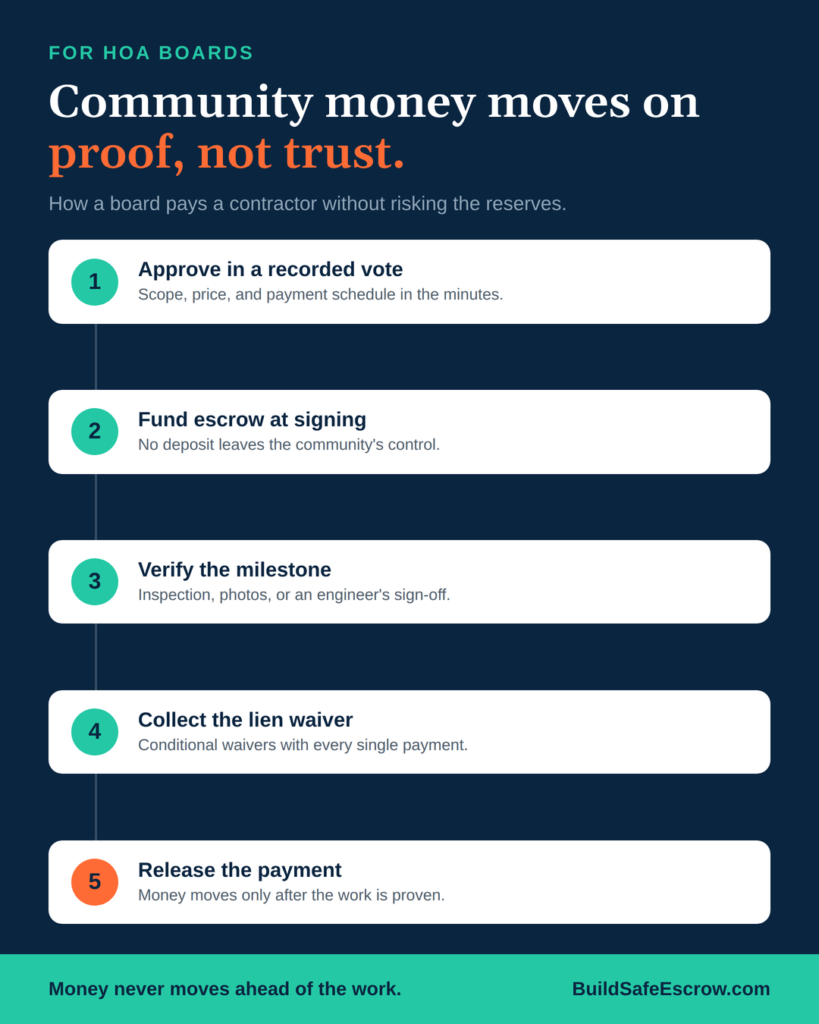
Table of Contents
- Why HOA payments are different
- 1. Approve the contract in a recorded vote
- 2. Replace the deposit with a funded milestone schedule
- 3. Verify before every release
- 4. Collect lien waivers with every payment
- 5. Take release authority out of any one person’s hands
- A short field example
- How should an HOA pay a contractor? The direct answer
- How escrow removes the problem at the source
- FAQ
- Protect your community’s next project
- References
Picture the meeting. Your community needs a new roof, repaved roads, or a clubhouse renovation. The reserve study says the money exists, or a special assessment just raised it. Bids are in and a contractor has been chosen. Then someone at the table asks the question nobody has a clean answer to: so how do we actually pay them?
The instinct is to treat it like a personal project, only bigger. Cut a deposit check, pay as invoices arrive, hope it goes well. That instinct is how communities end up with drained reserves, half-finished amenities, and recall petitions.
Why HOA payments are different
Boards that ask “how should an HOA pay a contractor” are really asking several questions at once, about the money, the sums involved, and the neighbors watching. Three things separate an association’s project from a private one.
The money is fiduciary money. Board members have a legal duty to protect association funds. A payment that goes out ahead of verified work is a governance risk that individual board members can be held accountable for by their own neighbors, not just a project risk.
The sums are large and pooled. A community roofing or paving contract routinely runs into six or seven figures, pooled from hundreds of households through assessments. U.S. community associations collect over a hundred billion dollars a year in assessments, and much of it flows into exactly these projects. When that money moves badly, the loss lands on everyone.
The audience is watching. Every homeowner in the community is a stakeholder with a right to ask where their money went. “The contractor has our deposit and stopped showing up” is a sentence no treasurer ever wants to say at an annual meeting.
Different stakes call for a different structure. Five parts.
1. Approve the contract in a recorded vote
Before any payment question, get the foundation right: a written contract, approved in a recorded board vote, with the scope, the total price, and the payment schedule spelled out inside it.
The payment schedule is not an administrative detail to sort out later. It is the risk. Approving a contract without approving how the money moves is approving half a contract, so put the milestone schedule in the motion, in the minutes, and in the signed agreement.
Doing it this way protects the board twice over: it proves the decision was made properly, and it prevents any later argument about what was authorized.
2. Replace the deposit with a funded milestone schedule
Contractors ask associations for large deposits for one honest reason. They want proof the money is real before they mobilize crews and order materials. Boards hand over deposits because they do not know another way to give that proof.
There is a better way. Instead of a deposit, the association funds the project into a neutral escrow account at signing. The contractor now holds something stronger than a deposit: verified proof that the entire contract amount exists and is committed to this project. The association keeps something stronger too, because not one dollar has left the community’s control ahead of the work.
From there the money releases in stages. Mobilization and materials, then phase completions, then the final punch list, with each milestone carrying a definition of “complete,” a dollar amount, and a verification step. The deposit argument disappears, since both sides just got what the deposit was pretending to provide.
3. Verify before every release
No payment should move on an invoice alone. Every release gets tied to verified completion: a property manager’s inspection, dated photos, an engineer’s sign-off on structural phases, or a walkthrough documented in the minutes.
Verification is what makes the schedule real. Without it, a milestone schedule is just a deposit broken into pieces. With it, every dollar the association releases has purchased finished, confirmed work, and the treasurer can prove that to any homeowner who asks.
For large projects, name the verifier in the contract. Ambiguity about who confirms completion turns into a dispute later; a named verifier turns into a checkbox.
4. Collect lien waivers with every payment
Now the risk boards rarely see coming. If the contractor fails to pay their subcontractors or suppliers, those unpaid parties can often file a mechanics lien against the association’s property, even though the association paid the contractor in full.
The defense is routine paperwork. With every milestone payment, collect a signed lien waiver, the document that releases lien rights for the work being paid. Use conditional waivers, which take effect when payment clears, and require the contractor to deliver waivers from major subs and suppliers as well, not just their own.
It takes minutes per payment and closes the door on the ugliest surprise in community projects: paying twice for the same roof.
5. Take release authority out of any one person’s hands
The final piece is governance. Even a perfect milestone schedule has a weak point if one signature can move community money early, whether through pressure, friendship with the contractor, or plain fatigue with the process.
A neutral third party holding the funds removes that weak point. Releases happen only when the agreed milestone is verified. Not when the contractor calls the treasurer, and not when a board member gets tired of saying no. The structure says no for you.
This turns out to be the board’s best political protection as well. When a homeowner asks how payments were handled, the answer is that no individual touched the money; a neutral escrow released it against verified work, every time. That sentence ends most arguments before they start.
A short field example
Lorena is the treasurer of a 240-home association facing a $610,000 roofing and gutter project funded by a special assessment. The winning contractor’s bid asked for 30% down, $183,000, before materials would be ordered.
The previous board would have written the check. Lorena’s board instead placed the full contract amount in neutral escrow at signing and offered the contractor verified proof of funds in place of the deposit. The contractor’s estimator called it “better than a deposit,” since his firm could see the whole number was there.
The project ran on six milestones: mobilization, materials delivered on site, three building phases each signed off by the association’s engineer, and the final punch list. Every release was matched to a conditional lien waiver, including from the shingle supplier. At the annual meeting, one homeowner demanded an accounting. Lorena’s answer took ninety seconds. Six releases, six verifications, six waivers, and the money never moved ahead of the work.
[MEDIA: Infographic, 4:5, placed here. Board payment structure: recorded vote, fund escrow, milestone verified, waiver collected, release. Alt text: “Infographic showing how should an HOA pay a contractor through a verified milestone escrow structure.”]
How should an HOA pay a contractor? The direct answer
An HOA should pay a contractor in verified stages, funding the full contract into neutral escrow at signing, then releasing money milestone by milestone, only after completion is confirmed and a lien waiver is collected.
That single structure answers every version of the question boards actually face. No deposit leaves the community’s control. No individual board member holds release power alone. No payment moves without proof of finished work and a waiver protecting the property. It is the answer a fiduciary can defend to any homeowner, in any meeting, without a single caveat.
How escrow removes the problem at the source
Every risk this guide has named, the deposit, the unverified invoice, the surprise lien, the lone signature, comes from one root: association money sitting where the board cannot fully control it, or moving before the work it was meant to buy exists.
Construction escrow removes that root. The community’s funds sit in a secure, FDIC-insured account held by a neutral third party. They release to the contractor in stages, only as each milestone is completed and verified. The contractor gets certainty of payment, the association gets certainty of performance, and the board gets a paper trail that answers every homeowner question in advance.
We are not on the board’s side or the contractor’s side. We are the referee both sides asked for. And the next time someone at a meeting asks how should an HOA pay a contractor, the answer fits in one sentence. Money never moves ahead of the work. For a board spending its neighbors’ money, that is not just a principle. It is the job description.
Learn how staged releases work on our escrow services page, or bring your project questions to us directly: contact us any time.
This article is general information, not legal or financial advice. Association governance, lien law, and fiduciary standards vary by state, so consult your association’s attorney before signing or paying.
FAQ
How should an HOA pay a contractor deposit request? Ideally, it shouldn’t. Replace the deposit with the full contract amount funded into neutral escrow. The contractor gets verified proof of funds, and the association gives up nothing before work is done.
Can the association’s manager approve contractor payments alone? A manager can administer the process, but release authority should never rest with one person. Tie releases to verified milestones held by a neutral party, with the structure documented in the contract and minutes.
What if the contractor refuses to work without a deposit? Offer escrowed proof of funds instead. Most reputable contractors accept it readily, since it is stronger assurance than a deposit check. A contractor who refuses verified funds and insists on unrestricted cash up front is telling you something.
Do we still need lien waivers if we pay through escrow? Yes. Waivers are collected as a condition of each release. Escrow makes the collection automatic instead of an item someone must remember under pressure.
How should an HOA pay a contractor for emergency repairs? Speed and structure are not enemies. Even urgent work can fund into escrow in days and release against completion. Emergencies are precisely when boards are most tempted to skip the protections they will later wish they had.

Protect your community’s next project
Your neighbors trusted the board with their money. The question was never whether to trust your contractor; it was how should an HOA pay a contractor so that trust is never the load-bearing wall.
For everyone: Get one short read each Friday on how construction money actually moves: subscribe to The Build Brief.
For HOA boards and managers: Before your next project payment is scheduled, put the structure in place. Schedule a free consultation and we will walk your board through a milestone escrow setup.
References
- Foundation for Community Association Research, statistical information on U.S. community associations: https://foundation.caionline.org/
- Community Associations Institute, board member resources: https://www.caionline.org/
- Levelset, mechanics lien rules by state: https://www.levelset.com/mechanics-lien/
- FDIC, deposit insurance overview: https://www.fdic.gov/resources/deposit-insurance/