Cash Flow Is Killing Small Construction Businesses. Milestone Payments Are the Fix.
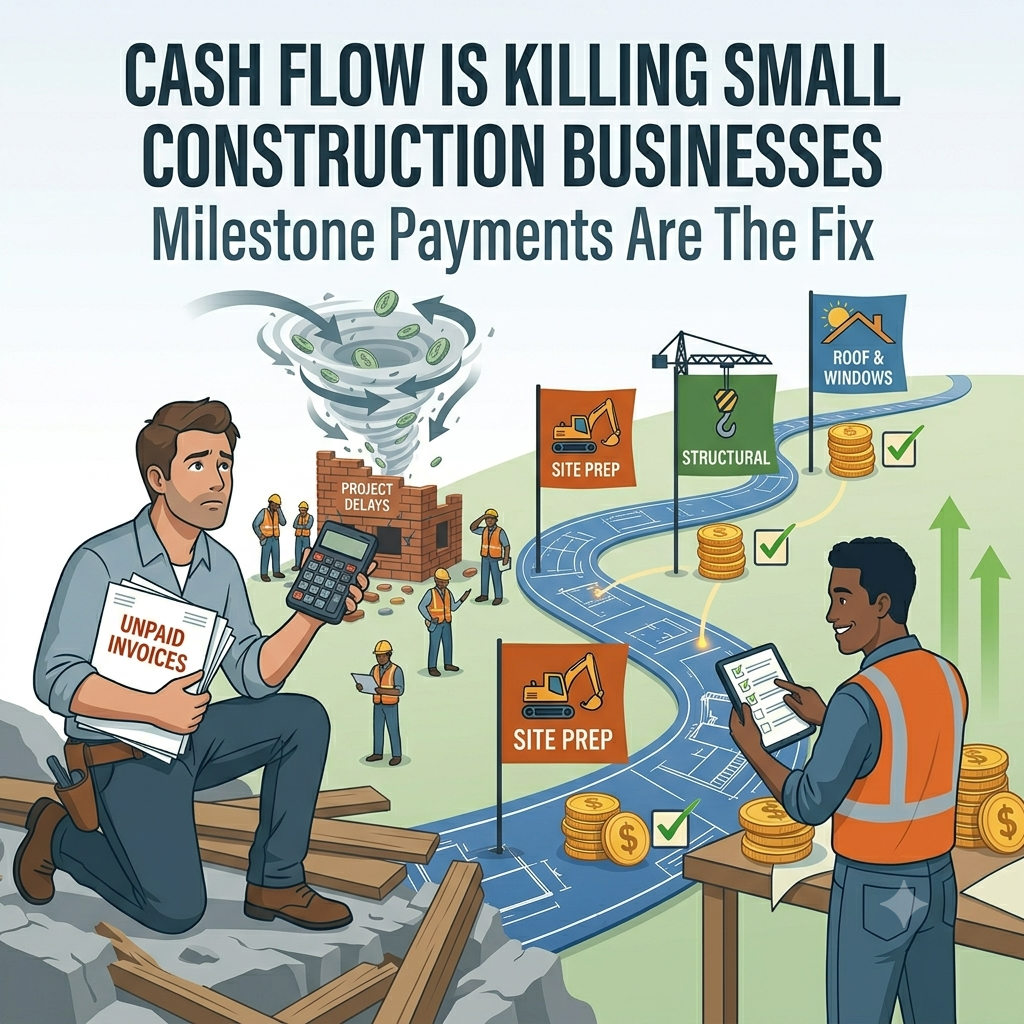
Ask any small contractor what keeps them up at night and the answer is rarely quality, crew, or competition. It’s cash flow. Specifically, the gap between when work gets done and when payment actually arrives.
That gap funds nothing. It doesn’t cover payroll. It doesn’t buy materials for the next phase. It doesn’t keep the lights on. And when it stretches long enough — weeks, then months — it doesn’t just strain the business. It ends it.
Cash flow problems are the number one reason small construction businesses close. Not bad craftsmanship. Not a slow economy. The money cycle itself. And the frustrating part is that for most contractors, the fix has existed for years. They just haven’t been using it.
The Numbers Behind the Problem
This isn’t a perception problem. The data is consistent across every corner of the construction industry:
The mechanics are straightforward: a contractor mobilizes, buys materials, pays labor, and completes a phase of work. Then they wait. The invoice sits. The client is slow to respond. The next draw isn’t released. Meanwhile, the next job has already started — funded by a loan, a credit line, or money that was supposed to cover something else.
This is the cycle that breaks small construction businesses. Not one bad client. The structural reality of an industry that has always moved money too slowly.
Traditional Payments vs. Milestone Payments
The difference between the old model and a milestone-based structure isn’t just financial — it changes the entire dynamic of a project.
| Traditional Payment Model | Milestone Payment Model | |
|---|---|---|
| When payment releases | On client’s timeline — often delayed 30–90 days | When a defined phase of work is completed |
| Who controls the funds | The client — no structure or obligation | A neutral escrow account — released by agreement |
| Dispute resolution | Verbal history, invoices, often litigation | Clear milestone records, documented in escrow |
| Contractor cash flow | Unpredictable — dependent on client responsiveness | Predictable — tied to completed work phases |
| Client trust level | Low — no structure, reliant on goodwill | High — funds confirmed held, released on completion |
| Lien risk | Higher — payment delays create lien pressure | Lower — structured payments reduce non-payment risk |
| Project completion rate | Lower when cash flow tightens mid-project | Higher — financial incentives align with progress |
The milestone model doesn’t just protect the contractor. It creates a structure that benefits everyone on the project — which is exactly what makes it easier to sell to clients than most contractors expect.
How Milestone Payments Actually Fix Cash Flow
The core shift is simple: instead of completing work and then hoping for payment, a contractor works within a structure where funds are already secured and released predictably at each phase.
Here’s what that looks like in practice:
- 1Funds are committed before work begins. The project budget is placed into a construction escrow account at contract signing. The contractor knows the money exists — it’s not contingent on the client’s mood or cash position mid-project.
- 2Each phase has a defined payment amount. Foundation, framing, mechanical rough-in, finishes — each milestone maps to a specific draw. There’s no ambiguity about what triggers a payment.
- 3Payment releases when the milestone is completed. No waiting 45 days on an invoice. No chasing. The release mechanism is built into the escrow agreement from day one.
- 4The contractor’s cash flow becomes predictable. Payroll, materials, subcontractors — all of these can be planned around a known payment schedule instead of an uncertain one.
- 5Disputes have a structure for resolution. If a disagreement arises, the escrow record documents exactly which milestones were completed and when each payment was released. There is no “he said, she said.”
Milestone Payments Don’t Just Protect Contractors — They Make Them More Competitive
A contractor who walks into a client meeting with a structured milestone payment proposal — backed by a construction escrow account — is presenting something most of their competitors can’t match. It signals professionalism, financial stability, and confidence in their own work. In a market where trust is the deciding factor, that’s not a small advantage.
How to Pitch Escrow to a Skeptical Client
The most common hesitation contractors face isn’t client hostility — it’s unfamiliarity. Most property owners have never heard of construction escrow. Here’s how to introduce it without making it feel complicated or alarming.
Lead with protection for both sides
Don’t frame escrow as something that benefits you. Frame it as something that protects the project. “This structure means your funds are secure before work begins, and I get paid when each phase is done. It keeps everyone accountable and eliminates payment disputes.”
Connect it to their biggest fear
Most property owners are afraid of paying too much upfront and losing leverage. Escrow directly addresses that fear. “You’re not handing money to me — you’re placing it with a neutral third party. It only releases when the agreed work is done.”
Use it as a differentiator, not a requirement
The contractors who close best with escrow don’t present it as a condition — they present it as a choice. “We work with Build Safe Escrow on all our projects. It’s optional, but most clients appreciate the structure once they understand it.”
Let the structure do the selling
Bring a one-page milestone payment schedule to every consultation. When a client can see exactly when each payment triggers — and that it maps directly to completed work — most of the skepticism dissolves. Specificity builds trust faster than any pitch.
Frequently Asked Questions
FAQLarge construction firms have access to revolving credit lines, bonding capacity, and financial teams that can absorb payment delays. Small contractors typically don’t. A 60-day payment delay on a $150,000 project can mean missing payroll, defaulting on material suppliers, or being unable to mobilize on the next job. The same cash flow gap that a large firm absorbs in stride can end a small business. Milestone payments level that playing field by ensuring money moves with the work — not on the client’s schedule.
A typical residential renovation milestone structure breaks down like this: 10–15% mobilization deposit at contract signing (materials procurement), 25–30% at completion of demolition and rough work, 25–30% at mechanical, electrical, and plumbing rough-in, 20–25% at substantial completion of finishes, and 10–15% final payment at punch list completion and final walkthrough. The exact percentages vary by project type and scope — but the principle holds: each payment ties to a defined phase, and the final draw stays in escrow until the client confirms completion.
From a contractor’s perspective, the process is straightforward. Before work begins, the client deposits the agreed project funds into a Build Safe Escrow account. The escrow agreement outlines the milestone schedule — what work triggers each draw and the corresponding payment amount. When a milestone is completed, the draw is released from escrow to the contractor. The contractor never has to chase invoices, negotiate payment timing, or absorb the financial risk of a slow-paying client. The structure is set at contract signing and followed throughout the project.
Some will ask questions — which is healthy. Most pushback comes from unfamiliarity rather than genuine resistance. Clients who understand that their funds are protected in a neutral account — and only release when work is done — typically see escrow as a benefit, not a burden. The contractors who report the least resistance are the ones who introduce it early, frame it as a mutual protection structure, and bring a clear milestone schedule to the first meeting. A client who pushes back hard on escrow is often signaling something worth paying attention to.
Yes. One of the downstream benefits of milestone-based escrow is that it gives the general contractor predictable, on-time draws — which makes it significantly easier to pay subcontractors on schedule. Late sub payments are one of the most common causes of lien filings and project disputes. When the GC’s cash flow is structured and reliable, the payment chain below them stabilizes too. Escrow doesn’t just protect the contractor at the top — it creates conditions where everyone on the project gets paid more predictably.
Join the Build Safe Trusted Contractor Network
Property owners are actively searching for contractors who work with construction escrow. Getting listed puts your business in front of clients who are already sold on milestone payments — meaning less negotiation, faster sign-offs, and projects that run the way they should.
Ready to Fix Your Cash Flow With Milestone Payments?
Build Safe Escrow sets up the milestone payment structure for your next project — so you get paid when work is done, not when the client gets around to it.
Related Posts