
There is a moment every HOA or condo manager recognizes; it usually arrives quietly, right after the first big payment goes out.
At first, the project feels normal. The board voted; the vendor is reputable; the contract is signed; the residents were notified. Then someone asks a simple question in a hallway, an email thread, or a late-night comment on the community portal:
“Who approved that payment?”
And just like that, the project stops being a repair or renovation; it becomes a trust test.
This is the part nobody warns you about. You can be completely honest, follow procedure, document everything, and still end up in a bad situation; because when money moves without a system residents can clearly see and understand, your name and reputation can end up on the line anyway.
That’s why Escrow protects HOA and Condo projects has become more than a financial tactic; it is a modern standard for transparency, accountability, and calm leadership.
The hidden risk: honest management can still look suspicious
HOA and condo projects sit at a strange intersection of responsibility and perception. You are often managing other people’s money, on behalf of a board, under a microscope of varying expectations.
Even when you do everything correctly, these realities create friction:
- Residents do not see what you see; they see invoices and hearsay.
- Boards change; memories fade; but payment decisions live forever in meeting minutes.
- Vendors can be reputable and still fall behind; or face labor shortages; or experience supply chain delays.
- A few vocal owners can turn “routine progress payment” into “mismanagement” within hours.
This is where Escrow protects HOA and Condo projects becomes practical, not theoretical. Escrow turns the money flow into a shared, predictable process; it replaces “trust me” with “here’s the method.”
What the transparency standard really means for associations
Transparency is not just sending updates; transparency is creating a structure where questions are already answered.
A real transparency standard includes:
- Clear rules for when money can be released;
- Clear proof for what must be completed;
- A neutral party to administer releases;
- A consistent paper trail that does not depend on personality, politics, or who happens to be on the board this year.
That is why Escrow protects HOA and Condo projects is so powerful. It creates transparency that is built into the financial workflow itself; not dependent on how well someone communicates.
Why HOA and condo projects are uniquely vulnerable
Most HOA and condo projects have three features that increase conflict risk:
1) Shared funds; individual emotions
A roof, elevator modernization, concrete restoration, painting, plumbing risers, or balcony repairs may be “association responsibility”; but the stress is personal for each resident who hears noise, sees scaffolding, or pays an assessment.
2) Multiple decision-makers
Boards vote; committees advise; managers coordinate; attorneys review; vendors perform. When multiple hands touch a process, it becomes easy for owners to assume someone “pushed something through.”
3) The timeline is never perfectly linear
Inspections get rescheduled; weather shifts the calendar; materials arrive late; change orders happen. The more change, the more opportunities for doubt.
With those realities, Escrow protects HOA and Condo projects by making the financial side resilient; even when the project timeline is messy.
What escrow actually does; and why it removes room for questioning
Escrow is simple in concept: funds are held securely by a neutral third party and released only when pre-agreed conditions are met.
The impact, however, is transformational. Because Escrow protects HOA and Condo projects in a very specific way:
- Funds are safeguarded; they are not sitting in a place where a single person can move them based on pressure or urgency.
- Milestone rules are agreed in advance; the “why” and “when” of payment is not reinvented every month.
- Documentation is part of the process; releases require the right approvals and evidence.
- The escrow agent is neutral; no one can credibly claim favoritism or backroom decisions.
- The record is clean; if a question arises six months later, the answer is in the file.
In other words; Escrow protects HOA and Condo projects because it replaces interpretation with structure.
The common pain points escrow prevents for HOA and condo managers
When you implement the transparency standard, the usual conflict points shrink fast:
“We paid too early.”
Escrow milestone releases can be tied to measurable progress; inspections passed; defined deliverables; written approval through a secure process. Escrow protects HOA and Condo projects by aligning payment timing with verified outcomes.
“We paid and the vendor disappeared.”
Escrow does not magically eliminate all performance risks, but it reduces exposure; because funds are released in stages, not by blind faith. Escrow protects HOA and Condo projects by limiting what is at risk at any given moment.
“Why did we approve that change order?”
Change orders are where reputations can get bruised. With escrow, change orders can be handled as written exhibits or amendments; connected to a specific milestone; tracked with signatures and a clear audit trail. Escrow protects HOA and Condo projects by making scope changes visible and accountable.
“We don’t know what we’re paying for.”
If milestone language is tight, every release maps to a deliverable. This is where owners feel the difference immediately; because clarity lowers anxiety. Escrow protects HOA and Condo projects by turning payment into a checklist, not a mystery.
“The board is playing favorites.”
Even if that accusation is untrue, it can be damaging. A neutral escrow structure reduces the credibility of favoritism claims; the rules are the rules. Escrow protects HOA and Condo projects by removing discretionary payment decisions from the social arena.
How to structure escrow so it works in the real world
The best escrow system is not complicated; it is specific.
Here’s a practical framework many associations use:
1) Define milestone-based payments that match the project
Good milestones are objective and easy to verify. Examples (depending on project type):
- Mobilization and materials staged on-site;
- Demo complete;
- Rough-in complete;
- Waterproofing or concrete phase complete;
- Painting phase complete;
- Equipment delivered and installed;
- Inspection passed (city, engineer, or third-party);
- Punch list substantially complete;
- Final completion and closeout package delivered.
This is where Escrow protects HOA and Condo projects becomes tangible; because the milestone table becomes the transparency map.
2) Establish release triggers that do not rely on vague language
Avoid phrases like “commencement” or “substantial work” without defining them. Instead use measurable triggers; inspection approval; signed confirmation; photo documentation; engineer sign-off where needed.
When triggers are clear, Escrow protects HOA and Condo projects by removing ambiguity, which is where disputes breed.
3) Require consistent documentation
A strong process might include:
- Invoice matching the milestone;
- Confirmation of milestone completion;
- Required approvals from authorized signers;
- Lien waiver or release documents where appropriate;
- W-9 and vendor verification; if applicable.
You are not just paying; you are creating a record. Escrow protects HOA and Condo projects by turning every payment into a documented event.
4) Communicate the system upfront to residents
You do not need to share sensitive banking information. You can share the structure:
- Funds are held in escrow;
- Payments are milestone-based;
- Releases require completion verification;
- The association has a neutral process that protects everyone.
Owners may not cheer for admin controls, but they relax when they see the logic. Escrow protects HOA and Condo projects because it reassures the community that you are not improvising.
The reputation benefit; why managers sleep better with escrow
There is a professional difference between being responsible and being provably responsible.
Without escrow, you can do everything right and still face distrust; because payments can look like judgments. With escrow, the payments look like compliance with a pre-agreed system.
That is the heart of the transparency standard; and it is why Escrow protects HOA and Condo projects in a way that matters to managers personally:
- If the vendor complains, you can point to the release conditions;
- If owners complain, you can point to the proof-of-work requirements;
- If a new board questions the past, you can point to the audit trail;
- If the project turns stressful, you can point to the process and keep leading.
Escrow does not just protect funds; Escrow protects HOA and Condo projects by protecting the people responsible for overseeing those funds.
A quick example; how questions change when escrow is in place
Picture two versions of the same project: a major building repainting and waterproofing initiative.
Without escrow, payment discussions sound like this:
- “Are we sure they did enough to get paid?”
- “Why did we pay before the rain delays were resolved?”
- “Who signed off?”
- “Can we stop payment?”
- “Is the manager too close to this vendor?”
With escrow, the conversation changes:
- “Which milestone are we on?”
- “Did the engineer confirm completion?”
- “Is the documentation uploaded?”
- “Once the release conditions are met, escrow will disburse.”
That shift is not cosmetic; it is cultural. And it is exactly why Escrow protects HOA and Condo projects as a transparency standard.
Getting started; a simple implementation path
If you want to apply the transparency standard on your next project, start here:
- Choose the projects that benefit most: capital improvements, large repairs, multi-phase renovations, special assessment projects, or any job where payments will occur in multiple draws.
- Build a milestone table: align it with the vendor contract; keep milestones measurable; make amounts match the payment schedule.
- Set release triggers: inspections, third-party approvals, written owner/board approvals through a secure process.
- Decide documentation requirements: invoices, approvals, lien waivers where appropriate, completion evidence.
- Communicate the structure to the board and owners: emphasize that Escrow protects HOA and Condo projects by preventing disputes and protecting reputations.
Closing; the new expectation for trust
HOA and condo managers are not just managing projects; you are managing confidence.
And confidence is fragile. It does not break only when someone is dishonest; it breaks when a process is unclear enough for suspicion to grow.
That is why Escrow protects HOA and Condo projects is more than a phrase; it is a leadership tool. It creates trust without requiring blind faith; it creates transparency without endless explanations; it creates accountability without making you the target.
If you want fewer accusations, fewer late-night emails, and a cleaner record for every decision; the transparency standard is simple:
Escrow protects HOA and Condo projects.
Disclaimer: This article is for informational purposes only and is not legal advice. Associations should consult their legal counsel regarding their specific circumstances and governing documents.
If your HOA or condo has a capital project coming up, don’t wait for the first payment to trigger questions. Escrow protects HOA and Condo projects by locking in milestone-based releases, required documentation, and a neutral audit trail from day one. Contact Build Safe Escrow to set up a simple escrow structure for your next project; and move forward with clarity, trust, and accountability.
Learn how Escrow can Protect your HOA / Condo Projects
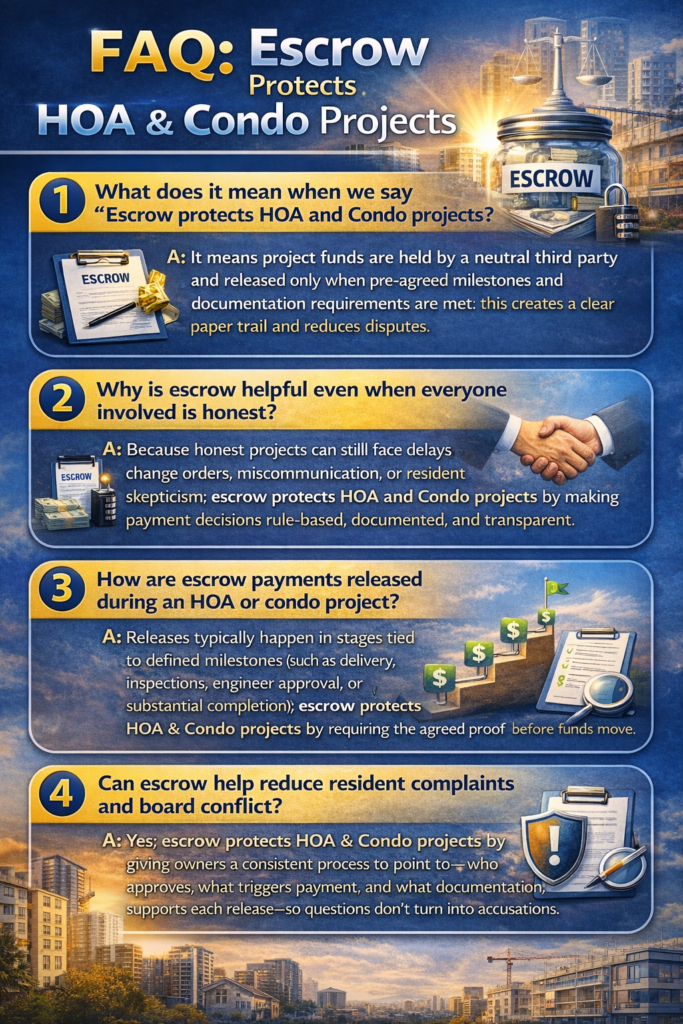
FAQ: Escrow Protects HOA and Condo Projects
What does it mean when we say “Escrow protects HOA and Condo projects”?
It means project funds are held by a neutral third party and released only when pre-agreed milestones and documentation requirements are met; this creates a clear paper trail and reduces disputes.
Why is escrow helpful even when everyone involved is honest?
Because honest projects can still face delays, change orders, miscommunication, or resident skepticism; escrow protects HOA and Condo projects by making payment decisions rule-based, documented, and transparent.
How are escrow payments released during an HOA or condo project?
Releases typically happen in stages tied to defined milestones (such as delivery, inspections, engineer approval, or substantial completion); escrow protects HOA and Condo projects by requiring the agreed proof before funds move.
Can escrow help reduce resident complaints and board conflict?
Yes; escrow protects HOA and Condo projects by giving owners a consistent process to point to—who approves, what triggers payment, and what documentation supports each release—so questions don’t turn into accusations.
What documents are usually required when using escrow for HOA and condo projects?
Common items include the milestone schedule, invoices, approval confirmation, completion evidence (photos or inspections), and lien waivers where appropriate; escrow protects HOA and Condo projects by ensuring each payment is backed by a complete record.